
Artificial intelligence is no longer a future consideration for internal audit. 42% of Chief Audit Executives already identify embedding generative AI into audit workflows as a top priority for 2025, with 72% expecting deployment by year end and AI funding rising by 37.4% on average. The core shift is this: AI handles the volume work, and auditors handle the judgement. That division is not a threat to the profession. It is the biggest opportunity internal audit has seen in a generation.
- AI automates routine tasks such as data extraction, workpaper formatting, and first-pass reviews.
- 62% of internal audit teams currently use or research generative AI to support planning and documentation.
- AI augments human auditors. Professional judgement, scepticism, and contextual reasoning remain irreplaceable.
- The Government Internal Audit Agency has published guidance on responsible AI use, signalling that governance and transparency are non-negotiable.
- 73% of financial reporting leaders expect generative AI to become standard practice for auditors within two years.
Table of Contents
- How AI integrates into audit tools, processes, and workflows
- Building an AI-ready internal audit workforce
- Managing risks and ethical considerations when using AI in audit
- What 2025 benchmarks reveal about AI adoption in UK internal audit
- How to measure the impact of AI on audit effectiveness
- Intelligentassessments: built for audit teams ready to move beyond spreadsheets
- Key takeaways
How AI integrates into audit tools, processes, and workflows
The technologies driving artificial intelligence in auditing fall into four broad categories: generative AI (large language models), machine learning, natural language processing (NLP), and robotic process automation (RPA). Each plays a distinct role across the audit lifecycle.
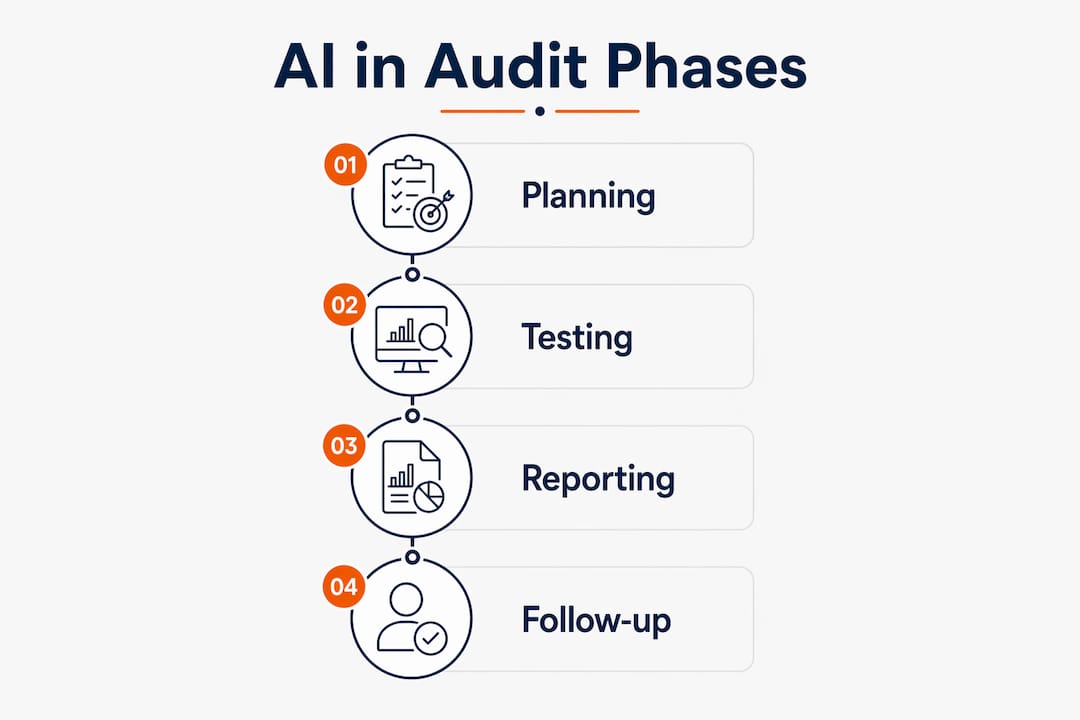
Planning is where most teams start. Generative AI drafts scoping memos, constructs audit announcements, and prepares interview guides in minutes. Machine learning sorts through executive risk questionnaires, surfacing the most frequently cited concerns. Fieldwork benefits from NLP-powered document review and RPA-driven data extraction across large transaction populations. Reporting is where generative AI earns its keep most visibly: AI can automate first-pass workpaper reviews, fixing grammar, standardising formatting, and flagging inconsistencies before a senior auditor ever opens the file. Follow-up tracking, action log management, and management response summarisation are all candidates for automation.
Firms including Protiviti and Grant Thornton have published frameworks for AI-enabled audit delivery, and the Government Internal Audit Agency has shared practical AI expertise specifically for UK public sector audit functions. Their consistent message: start with low-risk productivity tasks, build confidence, then expand.
Pro Tip: Build a prompt library early. Well-engineered, tested prompts shared across the team cut the time spent on prompt engineering and produce more consistent outputs across audit engagements.
| Audit phase | AI application | Primary technology |
|---|---|---|
| Planning | Risk questionnaire synthesis, scoping memos | Generative AI, NLP |
| Fieldwork | Transaction testing, document review | Machine learning, RPA |
| Reporting | Workpaper review, report drafting | Generative AI |
| Follow-up | Action tracking, management response summaries | Generative AI, RPA |
Building an AI-ready internal audit workforce
Upskilling is the single biggest lever audit leaders control. Technical AI literacy does not mean every auditor needs to write code. It means understanding what a large language model can and cannot do, how to write an effective prompt, and when to push back on an AI output.
Cross-disciplinary teams accelerate this. Pairing experienced auditors with data analysts or AI specialists creates a feedback loop where domain knowledge and technical capability reinforce each other. The agile, pilot-driven approach recommended by EY is the most practical entry point: run a low-risk pilot, such as using AI to summarise meeting notes or draft an audit announcement, measure the time saved, and build from there.

Resistance is common and understandable. Auditors who have spent careers developing expertise naturally worry about relevance. The answer is not to dismiss that concern but to reframe it.
Recommended steps for workforce readiness:
- Identify two or three low-risk AI use cases and run structured pilots with volunteer team members.
- Create a shared prompt library so that successful approaches are not siloed with one individual.
- Pursue formal training such as The IIA's AI-Enabled Coordinated Assurance Certificate, which covers governance frameworks and real-world scenarios.
- Reassess hiring criteria to include data literacy and comfort with AI tools alongside traditional audit competencies.
Managing risks and ethical considerations when using AI in audit
The risks of deploying AI in internal audit are real and specific. Generative AI hallucinates. It produces confident, plausible-sounding outputs that are factually wrong. Human-in-the-loop validation is not optional. Every AI output that feeds into formal audit evidence or reporting must be critically reviewed by a qualified auditor before it is relied upon.

Data privacy is the other major exposure. Using public, non-enterprise AI tools with sensitive audit data risks violating UK GDPR. Private, secure AI instances are the only appropriate environment for internal audit work involving personal data, commercially sensitive information, or client records.
Key risk areas to govern:
- AI bias: Models trained on historical data can perpetuate existing blind spots. Auditors must interrogate AI outputs for systematic skew.
- Hallucinations: Factual errors in AI-generated content require mandatory human review before any output enters the audit record.
- Data privacy: UK GDPR compliance requires that sensitive data never passes through unsecured or public AI environments.
- Transparency: Audit trails must document where and how AI was used, so findings remain defensible.
- Accountability: Human auditors remain professionally responsible for every conclusion, regardless of how it was generated.
Only about 17% of organisations have clear, organisation-wide guidelines for generative AI use. That governance gap is itself an advisory opportunity for internal audit functions.
Pro Tip: Before deploying any AI tool, sit down with your IT security and legal teams to map data flows and confirm that your chosen AI environment meets your organisation's GDPR obligations and information security standards.
What 2025 benchmarks reveal about AI adoption in UK internal audit
The 2025 data paints a picture of rapid momentum alongside significant maturity gaps. 37% of organisations have already deployed generative AI in their audit functions, with a further 35% planning to do so before the end of 2025. AI funding is rising at an average of 37.4%. Yet most audit functions remain in the exploration or piloting stage, not the scaling stage.
The use cases attracting the most attention are planning (35.6% of early adopters use AI extensively here) and reporting (31.2%). Continuous monitoring, agentic AI, and autonomous risk assessment are on the horizon but remain aspirational for most UK teams in 2025.
| AI maturity stage | Typical activities | % of audit functions |
|---|---|---|
| Exploring | Ad hoc prompting, personal productivity | Majority |
| Piloting | Structured use cases, prompt libraries | Growing minority |
| Scaling | Integrated workflows, agentic AI | Small minority |
Intelligentassessments sits squarely in the piloting-to-scaling gap. Its platform digitises assessments, audits, and compliance reviews with structured frameworks, AI-generated executive summaries, and real-time dashboards, giving audit teams a governed environment to move from spreadsheets to continuous assurance without building bespoke infrastructure.
How to measure the impact of AI on audit effectiveness
Measurement is where many AI programmes stall. The temptation is to track activity (prompts run, hours saved on drafting) rather than outcomes. The metrics that matter to audit committees and CFOs are different: time from engagement kickoff to report delivery, cost per audit, and audit client satisfaction scores.
Charles King of KPMG US frames it directly: measurable goals such as reducing report delivery time by four weeks or cutting average cost per audit by 20% are the outcomes that earn internal audit a seat at the strategic table. Track those, not just the hours saved on formatting. AI also expands audit coverage, allowing teams to test entire populations rather than samples, which changes the quality conversation entirely.
Intelligentassessments: built for audit teams ready to move beyond spreadsheets
Most internal audit teams know what they want from AI. Fewer have a governed, structured environment to actually deliver it without building bespoke infrastructure or relying on generic tools that were never designed for audit evidence management.
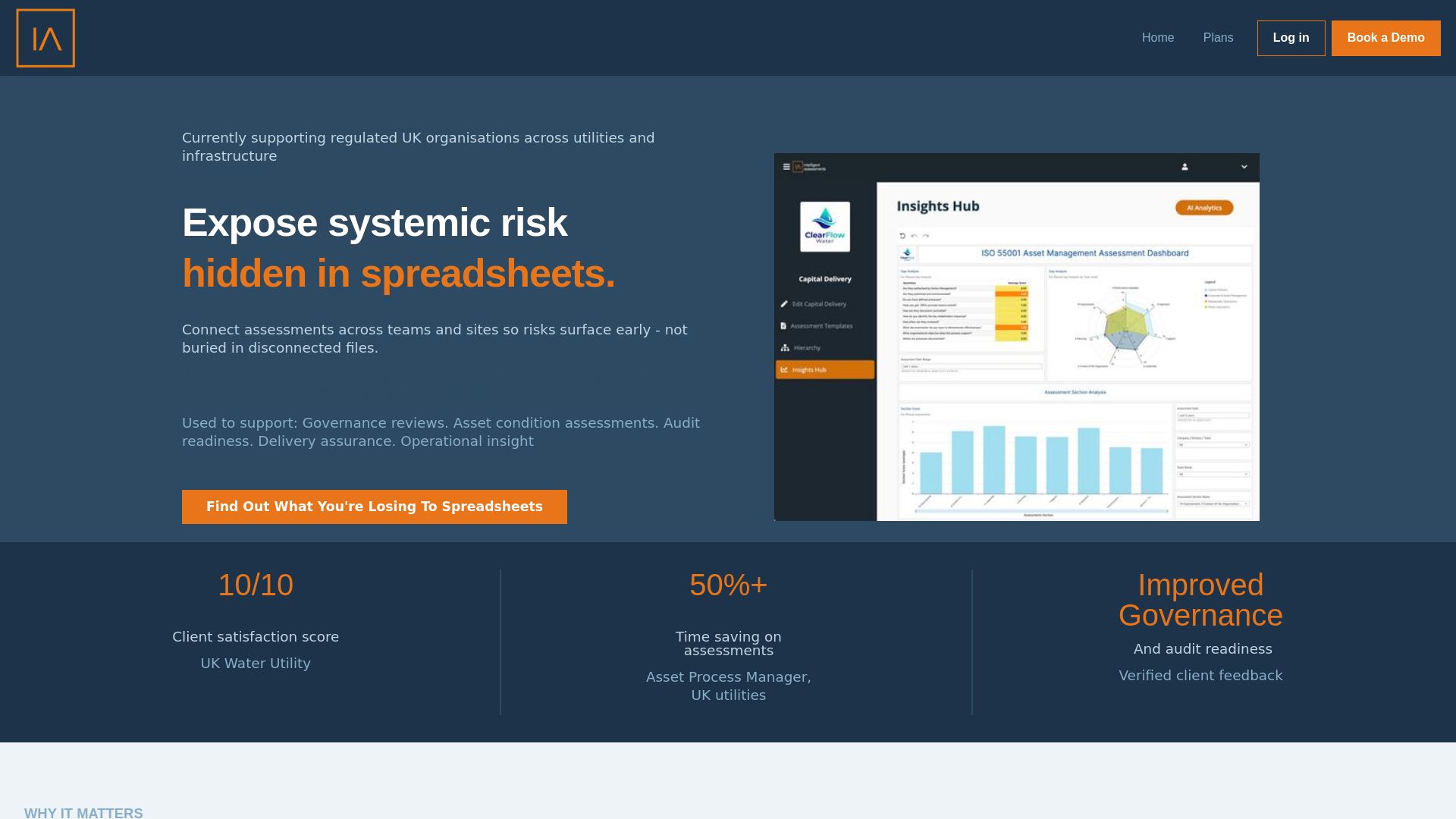
Intelligentassessments gives UK audit and assurance teams a purpose-built platform: structured assessment frameworks, automated AI executive summaries, weighted RAG scoring, evidence management, and real-time dashboards, all from a single source of truth. There are no spreadsheets to reconcile and no manual PDF assembly. The platform covers audits, compliance reviews, governance reviews, pulse surveys, and delivery assurance, so your team can run continuous assurance rather than point-in-time snapshots. Book a demo to see how it fits your audit function's current maturity and priorities.
Key takeaways
AI in internal audit delivers the greatest value when human judgement governs AI outputs, governance frameworks are in place before scaling, and measurement focuses on audit outcomes rather than activity metrics.
| Point | Details |
|---|---|
| Adoption is accelerating fast | 42% of CAEs prioritise generative AI in 2025, with AI funding rising 37.4% on average. |
| Planning and reporting lead adoption | 35.6% of early adopters use AI extensively in planning; 31.2% in reporting. |
| Governance gaps are the biggest risk | Only 17% of organisations have clear AI use policies, creating both risk and advisory opportunity. |
| Human oversight is non-negotiable | AI hallucinations and GDPR exposure require mandatory human review of all AI-generated audit content. |
| Intelligentassessments supports the transition | The platform provides governed, structured AI-powered audit workflows without bespoke infrastructure. |