
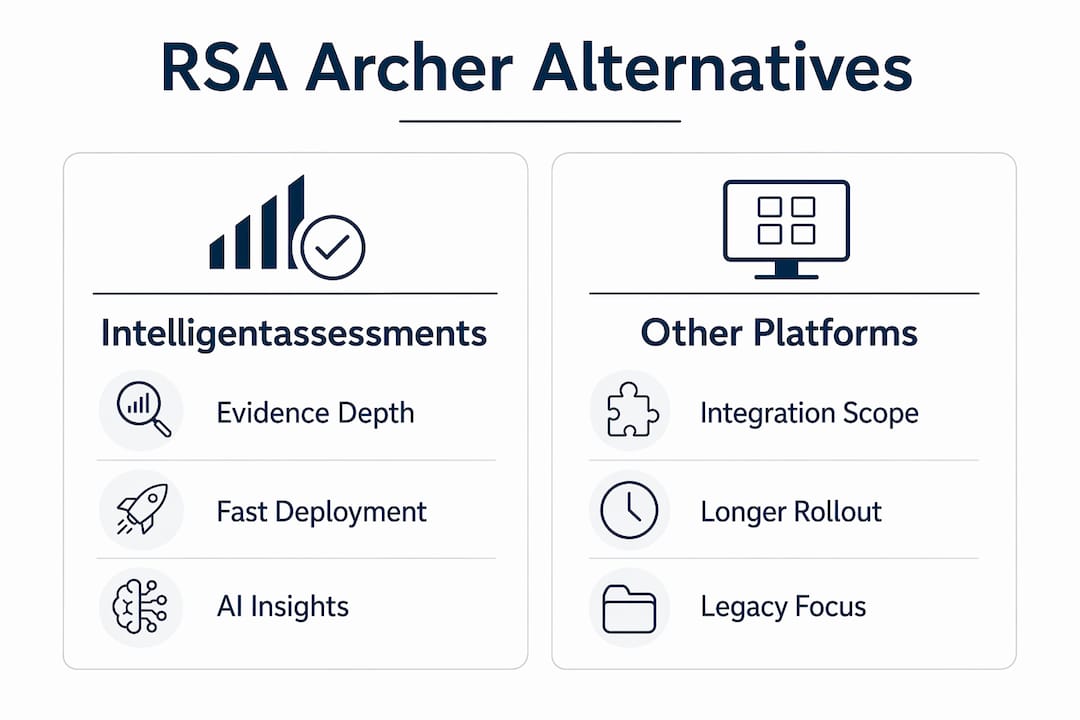
For regulated UK utilities and infrastructure organisations, Intelligentassessments is the strongest RSA Archer alternative when the priority is AI-powered continuous assurance, structured evidence management, and real-time dashboards. It deploys faster than legacy GRC suites, is built for the audit-readiness demands that Ofgem and sector regulators expect, and handles UK data handling requirements. Beyond Intelligentassessments, the credible shortlist includes enterprise consolidation platforms (ServiceNow GRC), mature GRC suites (MetricStream), privacy-converged risk platforms (OneTrust), and focused risk-module tools (Resolver).
The reason to move away from RSA Archer is rarely about features on paper. Legacy GRC tools tend to be rigid, slow to adapt to changing regulatory pressure, and costly to maintain compared with modern SaaS alternatives. What modern platforms offer instead: evidence management that creates an auditable chain without manual chasing, AI-generated executive summaries that cut report preparation time, and dashboards that surface risk status without a weekly spreadsheet run.
- Intelligentassessments — recommended lead option for UK utilities needing continuous assurance and rapid deployment
- ServiceNow GRC — enterprise consolidation for large, IT-integrated estates
- MetricStream — deep GRC suite for heavily regulated sectors with complex control libraries
- OneTrust — privacy-first platform expanding into risk and compliance
- Resolver — focused, faster-to-deploy tool for specific assessment or third-party risk functions
Pro Tip: Before shortlisting, map each platform to a specific assurance outcome you need in the next 90 days. A platform that cannot demonstrate that outcome in a POC is not ready for your organisation, regardless of analyst ratings.
Table of Contents
- Which Archer alternatives should you compare?
- What does Intelligentassessments offer UK utilities?
- How do enterprise consolidation platforms compare?
- What do mature GRC suites offer heavily regulated sectors?
- When does a privacy-first platform make sense?
- What can focused risk-module platforms deliver quickly?
- How do you choose the right alternative for a regulated UK utility?
- Migration checklist: moving from Archer to a replacement
- What should you test in a POC before committing?
- Key takeaways
- Why evidence management is the real differentiator
- Intelligentassessments: see it against your Archer use case
- Useful sources and further reading
Which Archer alternatives should you compare?
When switching from RSA Archer, vendor selection commonly turns on four axes: product capability coverage, integration and deployment, service and support, and evaluation and contracting. For regulated utilities, two additional dimensions matter: UK data residency and ISO 27001 certification. The table below maps these across the shortlisted options.
| Dimension | Intelligentassessments | ServiceNow GRC | MetricStream | OneTrust | Resolver |
|---|---|---|---|---|---|
| Best for | Continuous assurance, audits, utilities | Large IT-integrated enterprise | Regulated sectors, complex GRC | Privacy + risk convergence | TPRM, focused assessments |
| Core capabilities | Evidence management, AI summaries, RAG dashboards, templates | Workflow builder, ITSM/CMDB integration, broad modules | Enterprise risk, audit, third-party risk, compliance mapping | Privacy registry, assessments, incident logging, risk modules | Modular risk apps, template libraries, quick configuration |
| Deployment | Cloud SaaS | Cloud / on-prem | Cloud / on-prem | Cloud SaaS | Cloud SaaS |
| Security & compliance | ISO 27001, UK data handling | SOC 2, data residency options | ISO 27001, SOC 2 | ISO 27001, SOC 2 | SOC 2 |
| Implementation effort | Low-medium (weeks for assessment workflows) | High (months, specialist config) | High (months, consultant-led) | Medium | Low-medium |
| Pricing model | Subscription SaaS | Module-based, per-user | Module-based, enterprise | Subscription, modular | Subscription, per-user |
| POC/demo available | Yes | Yes | Yes | Yes | Yes |
| UK availability | Yes, UK-focused | Yes | Yes | Yes | Yes |
The dimensions that most often move the purchase decision for utilities: evidence management depth, dashboard customisation, AI insight quality, and the availability of local support during implementation.
What does Intelligentassessments offer UK utilities?
Intelligentassessments is an AI-powered continuous assurance platform purpose-built for the kind of structured, repeatable assessment work that utilities run constantly: asset condition reviews, compliance audits, delivery assurance, governance reviews, and pulse surveys. Core capabilities include:
- Structured assessment frameworks with template libraries covering common regulatory and operational use cases
- Evidence management with full traceability, replacing the email-and-spreadsheet chain most teams still rely on
- Automated AI executive summaries that convert raw assessment data into regulator-ready narratives
- Weighted RAG scoring and roll-ups for portfolio-level risk visibility
- Real-time dashboards, instant PDF reporting, and CSV exports for downstream analysis
The deployment story is genuinely different from legacy GRC. Assessment workflows go live in weeks, not months, because the platform is configured around use cases rather than built from a blank workflow canvas. For a utility that needs audit readiness now, that matters.
Where to be candid: integration scope with existing CMDB, HR, and finance systems needs scoping early, and large legacy datasets from Archer will require a structured migration plan. Professional services are available, but budget for that effort upfront.
Pro Tip: When preparing for an Intelligentassessments demo, bring one live Archer use case, your current evidence collection process, and a sample control library. A side-by-side comparison on real data is far more useful than a generic product walkthrough.

How do enterprise consolidation platforms compare?
ServiceNow GRC is the natural comparison point for organisations that want to consolidate GRC into an existing ServiceNow estate. Its strengths are genuine: broad module coverage, deep ITSM and CMDB integration, and a workflow builder that can model almost any process. For a large utility already running ServiceNow for IT service management, the consolidation argument is real.
The trade-off is implementation weight. End-user feedback consistently flags that enterprise platforms require significant specialist configuration before basic assessment workflows are live. Expect months, not weeks, and budget for a dedicated implementation partner. UK data residency options exist, but confirm the specific configuration for your tenancy. Local support availability varies by contract tier.
- Strong for: large estates with existing ServiceNow investment, complex workflow requirements
- Watch for: configuration overhead, implementation timelines, module-based pricing that escalates with scope
What do mature GRC suites offer heavily regulated sectors?
MetricStream sits at the deep end of the GRC market. It covers enterprise risk, internal audit, third-party risk, compliance mapping, and policy management within a single platform, with an extensive library of pre-mapped frameworks. For a utility with a complex, multi-entity control environment, that depth is genuinely useful.
The limitations are equally real. Setup is consultant-led, timelines run long, and the platform rewards organisations that invest in ongoing configuration. Purpose-built platforms with pre-mapped frameworks and faster onboarding often outperform mature suites on time-to-value for assessment-specific workflows. When migrating from Archer, expect a structured exercise to map existing control libraries and historical evidence into the new data model. ISO 27001 and SOC 2 certifications are in place.
- Strong for: complex, multi-framework GRC with large control libraries and deep audit requirements
- Watch for: consultant dependency, long implementation, high total cost of ownership
When does a privacy-first platform make sense?
OneTrust started as a privacy and consent management platform and has expanded into risk and compliance modules. For utilities where data privacy and technology risk are converging, that combination has appeal: a single platform covering GDPR obligations, privacy impact assessments, incident logging, and an expanding set of risk workflows.
The gap to watch is continuous evidence management for operational assurance. Privacy-centric platforms tend to excel at data mapping and consent workflows; they may need augmentation for the kind of ongoing audit-ready evidence chains that utilities require for asset and delivery assurance. When a utility's primary driver is data privacy compliance with risk modules as a secondary need, OneTrust is a credible option. When continuous operational assurance is the priority, it typically needs to be paired with a more assessment-focused tool.
- Strong for: data privacy compliance, GDPR, tech risk convergence
- Watch for: depth of continuous evidence management for operational audit workflows
What can focused risk-module platforms deliver quickly?
Resolver targets specific functions: third-party risk management, audit management, and control testing. It deploys faster than legacy platforms and is easier to configure, which makes it attractive for teams that need value from a single workflow quickly.
- Template deployment: pre-built templates for common frameworks reduce configuration time significantly
- Modular approach: buy the modules you need; avoid paying for broad GRC coverage you will not use
- Pilot timescales: a small pilot on a single use case can be live within weeks; enterprise roll-out across multiple functions takes longer and may require additional modules or integrations
- Scope limitation: Resolver works well for focused needs but may require additional tools for full enterprise GRC coverage across a large utility
For utilities that need a fast win on a specific assessment type while a broader platform decision is made, Resolver is worth a short pilot.
How do you choose the right alternative for a regulated UK utility?
Start with outcome mapping. Before evaluating any platform, list the specific assurance outcomes you need in the next 12 months: continuous asset assurance, audit readiness for a regulatory submission, vendor oversight, or delivery assurance for a capital programme. Each outcome has different platform requirements.
- Map each shortlisted platform to your top three assurance outcomes
- Confirm UK data residency and ISO 27001 certification for each vendor
- Ask vendors to demonstrate evidence capture and traceability in a live environment, not a slide deck
- Clarify pricing: subscription versus modular licensing, per-user versus per-assessment, and what professional services cost separately
- Request customer references from regulated UK utilities or infrastructure organisations specifically
Red flags worth noting: a vendor that cannot show an end-to-end evidence flow in a demo, pricing that only becomes clear after a lengthy scoping exercise, and implementation timelines that depend entirely on a third-party consultancy with no fixed accountability.
Pro Tip: Ask every vendor: "Show me how an auditor accesses evidence for a specific control, from submission to export, without involving your team." The answer tells you more than any feature list.
Migration checklist: moving from Archer to a replacement
A structured migration reduces the risk of losing historical evidence or breaking existing integrations. Work through these steps in order:
- Discovery and inventory: catalogue all active Archer applications, control frameworks, assessment templates, and integration points
- Framework mapping: map existing control libraries to the new platform's data model before any data movement
- Evidence extraction and normalisation: export historical evidence in a structured format; normalise field names and metadata to match the target schema
- Integration planning: sequence integrations with CMDB, HR, and finance systems; stage them to reduce cutover risk
- Test migration and reconciliation: run a parallel environment; reconcile record counts and evidence chains before decommissioning Archer
- Cutover and hypercare: plan a defined hypercare period with vendor support on standby
Typical timelines: a pilot on a single use case runs a few weeks; phased roll-out across multiple functions takes several months; full enterprise cutover from a large Archer deployment can take from half a year to a year depending on integration complexity.
Pro Tip: Archive Archer historical records in a read-only environment for at least 12 months post-cutover. Regulators may request evidence from periods that predate your new platform, and a clean archive avoids a painful retrospective exercise.
What should you test in a POC before committing?
A POC that does not test your actual workflows is not a POC. Evidence traceability and exportable audit packages are the non-negotiable criteria; everything else is secondary.
| POC test | Pass criteria | Priority |
|---|---|---|
| Evidence upload and traceability | Full audit trail from submission to sign-off, no manual steps | Critical |
| AI insight accuracy and explainability | Summaries are accurate, sourced, and editable | Critical |
| Dashboard customisation and refresh | Custom views configurable without vendor involvement; near-real-time refresh | High |
| API integrations | Documented API; test connection to at least one existing system | High |
| User permissions and SSO | Role-based access; SSO with your identity provider | High |
| Exportable audit packages | PDF and CSV export; complete evidence bundle for a single audit | Critical |
- Set acceptance criteria before the POC starts, not after
- Involve your internal audit team in the evidence traceability test
- If a vendor fails a Critical criterion, escalate to a formal re-test with a fixed remediation timeline before proceeding
Analyst guidance recommends requesting customer references in regulated sectors as part of the same due-diligence exercise, alongside demo availability and published implementation timelines.
Key takeaways
For regulated UK utilities replacing RSA Archer, the platform decision comes down to evidence management depth, AI insight quality, and deployment speed, with Intelligentassessments as the recommended lead option for continuous assurance.
| Point | Details |
|---|---|
| Lead recommendation | Intelligentassessments delivers AI-powered continuous assurance with fast deployment for UK utilities. |
| Shortlist criteria | Prioritise evidence traceability, ISO 27001 certification, UK data residency, and AI insight quality. |
| Immediate next step | Run a 2-week pilot on a critical audit use case with a scripted POC test against your real data. |
| Migration planning | Archive Archer records for 12 months post-cutover; stage integrations to reduce cutover risk. |
| Intelligentassessments POC | Book a demo with a live use case, your control library, and expected assurance outcomes. |
Why evidence management is the real differentiator
Most conversations about replacing RSA Archer focus on features: workflow builders, module counts, integration lists. The actual problem is usually simpler and more painful. Audit preparation in a regulated utility still involves chasing evidence across email threads, shared drives, and disconnected spreadsheets. A platform that solves that specific problem, and makes the evidence chain visible to an auditor without a week of manual assembly, is worth more than a broader platform that does not.
AI-powered platforms differentiate themselves from legacy GRC through robust evidence management and real-time dashboarding. That is not marketing language; it is the practical difference between a regulator conversation that goes smoothly and one that requires a retrospective evidence hunt. The platforms that do this well surface audit-ready evidence automatically, generate transparent AI summaries that practitioners can verify, and give risk leaders a live view of assurance status rather than a monthly snapshot.
My recommendation for any risk team in a regulated utility: prioritise the evidence chain above everything else in your POC. If a platform cannot demonstrate a clean, traceable evidence flow from submission to export in a 30-minute demo, it will not solve your audit preparation problem at scale.
Intelligentassessments: see it against your Archer use case
Replacing a legacy GRC platform is a significant decision, and the gap between a vendor's feature list and what actually works for your organisation only becomes visible when you test it against real data. Intelligentassessments offers a structured demo that maps directly to your existing Archer use case: evidence import from your current process, dashboard configuration for your assurance framework, and a sample AI executive summary generated from your data.
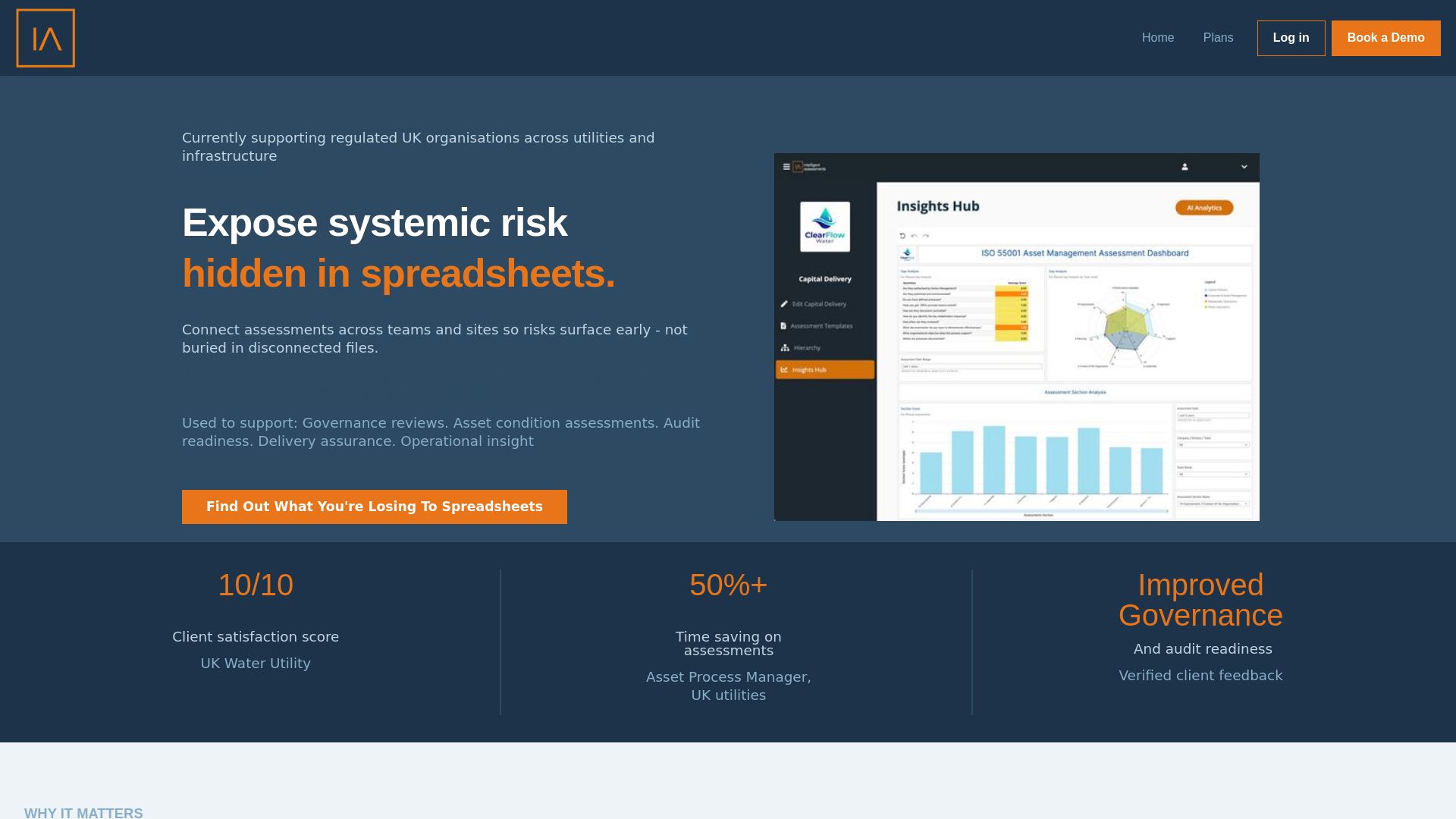
To get the most from a demo, bring a live assessment use case, a sample from your control library, and a clear statement of the assurance outcome you need to achieve. The Intelligentassessments team will configure the session around those inputs rather than running a generic walkthrough. Subscription and licensing options are available to review ahead of the conversation, and professional services support is available for migration planning if you are moving a large Archer dataset.
Book a demo and bring your Archer use case. The POC will tell you what a feature comparison cannot.
Useful sources and further reading
- Gartner Peer Insights: Archer alternatives and competitor comparisons — peer reviews and evaluation criteria from practitioners who have switched from Archer
- RSA Archer TPRM alternatives: practitioner analysis — evidence management and dashboarding as differentiators for modern platforms
- SoftwareReviews: Archer alternatives in GRC — end-user feedback on ease of use, support quality, and implementation effort
- Intelligentassessments platform overview — capability summary, UK relevance, and case study references
- Intelligentassessments plans and licensing — subscription models and licensing options for regulated organisations
- ZRG Mineral platform — an example of real-time risk and supply visibility applied in an industrial context, illustrating the dashboard patterns relevant to utilities