
A committee-ready audit report format starts with a one-page executive summary containing a single verdict sentence and a weighted RAG roll-up, followed by objectives and scope, a brief methodology note, structured findings using the 5-Cs (Condition, Criteria, Cause, Effect/Risk, Recommendation), management action plans (MAPs) with named owners and target dates, a final opinion, and appendices including an evidence index. That structure satisfies both IIA Standard 2410 and the needs of a continuous AI assurance environment.
Minimal template at a glance:
- Executive summary: one page, single verdict, RAG roll-up table
- Objectives and scope: coverage period, exclusions, risk register linkage
- Methodology: approach, sampling, AI assistance disclosed
- Findings: 5-Cs structure, criticality rating, evidence link
- MAPs: owner, due date, acceptance signature
- Opinion/conclusion: internal verdict or ISA-compliant opinion
- Appendices: evidence index, definitions, dashboards
Example RAG roll-up (copy/paste ready):
| Area | RAG | Critical findings | MAPs overdue |
|---|---|---|---|
| Asset integrity | Red | 2 | 1 |
| Billing compliance | Amber | 1 | — |
| Cyber resilience | Green | — | — |
| Overall | Amber | 3 | 1 |
Table of Contents
- What does each section of the audit report template contain?
- How do you make audit reports digestible for senior audiences?
- How should you design severity and RAG scoring for continuous assurance?
- How does continuous AI assurance change the reporting workflow?
- What governance and tone requirements apply to UK regulated utilities?
- How do you roll out this format inside an organisation using AI SaaS?
- Key takeaways
- Why the format matters more than the length
- Intelligentassessments produces this format from day one
- Useful sources and further reading
What does each section of the audit report template contain?
The IIA prescribes that findings appear in order of significance and that each observation follows the 5-Cs. The table below maps every section to its required content, primary evidence, and intended audience.

| Section | Must contain | Evidence anchor | Primary audience |
|---|---|---|---|
| Executive summary | Verdict sentence, RAG roll-up, top 3 priorities | Dashboard export | Audit Committee, Board |
| Objectives and scope | Coverage, period, exclusions, risk register link | Engagement plan | Audit Committee |
| Methodology | Approach, sampling, AI disclosure | Workpapers | Audit Director |
| Detailed findings | 5-Cs per finding, criticality, evidence ref | Evidence index | Management, regulator |
| MAPs | Owner, due date, status, acceptance | Signed MAP log | Management, Committee |
| Opinion/conclusion | Internal verdict or ISA opinion + basis | All above | Board, regulator |
| Appendices | Evidence index, definitions, dashboards | Repository links | All |
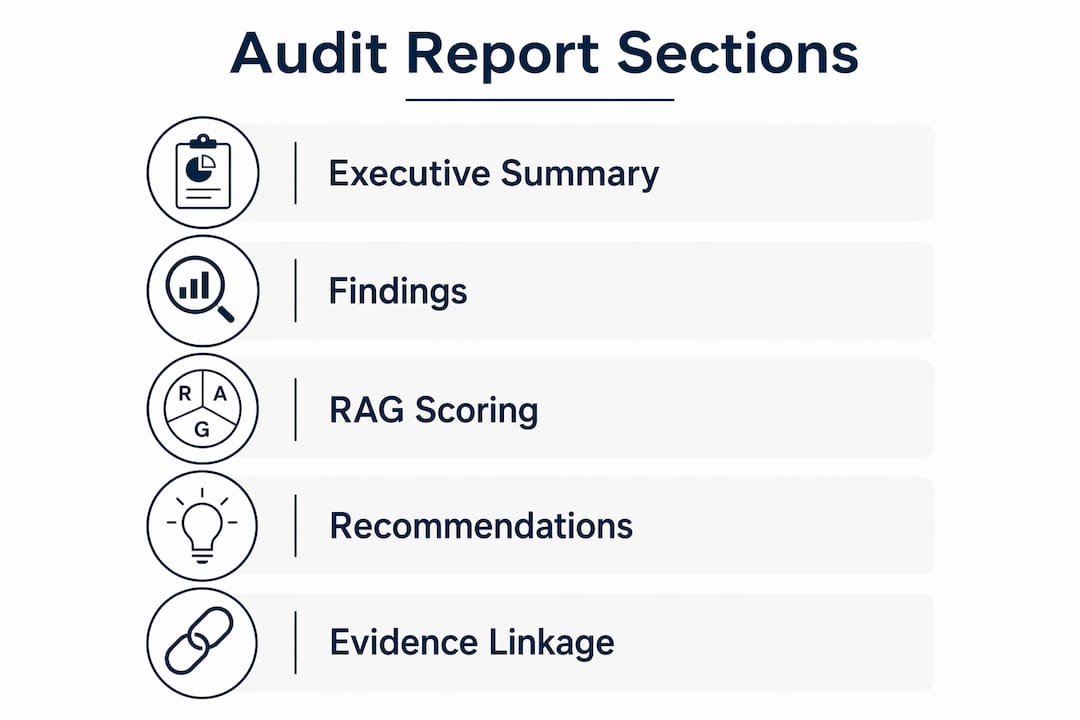
Findings section in practice. Each finding needs a neutral title, a criticality rating (Critical/High/Medium/Low), and the full 5-Cs. Missing the Criteria element — what should exist — is the most common cause of management pushback, because without it the finding reads as opinion rather than fact. Link every finding to a specific policy, regulation, or standard.
Opinion wording. For internal reports, a short conclusion suffices: "Based on the work performed, the control environment for [area] provides [adequate/limited/inadequate] assurance over [period]." For external financial audits, ISA 700 requires the opinion to appear first, followed immediately by a Basis for Opinion section. Listed entities also require a Key Audit Matters section under the revised ISA 700 series. Never swap those positions in an external report.
IIA Standard 2420 requires internal audit communications to be accurate, objective, clear, concise, constructive, complete and timely. Tailoring the level of detail to the audience is not optional — it is a standard requirement.
Audit report templates that standardise these fields make results comparable across audit cycles and save authors significant drafting time.
How do you make audit reports digestible for senior audiences?
The one-page executive summary is the single most important formatting decision you make. Committees read it first and often only. It must carry the verdict, the RAG roll-up, a three-line rationale, and three priority actions — nothing else.
Visual and editorial rules:
- Open with a bold verdict statement: "The overall control environment is Amber. Two critical findings require Board attention before [date]."
- Follow with the RAG roll-up table (no more than six rows).
- List three priority actions with named owners and target dates.
- Cap individual findings at 120 words in the body; move detail to appendices.
- Use sentence case, active voice, and short paragraphs throughout.
- Distribute as PDF for formal committee packs; link to a live dashboard for continuous updates.
- Include auditor independence metadata and sign-off fields on the cover page.
Neutral, fact-based tone and clear linkage to criteria reduce defensive management responses and improve adoption of recommendations. Avoid language that implies intent or blame; state the condition and the criteria gap, then let the evidence speak.
Pro Tip: Set a house rule: no finding title may contain a value judgement. "Billing reconciliation process" is a valid title; "Inadequate billing controls" is not. Neutral titles reduce the temperature in management review meetings.
How should you design severity and RAG scoring for continuous assurance?
A scoring matrix prevents trivial findings from skewing the overall RAG and gives the committee a defensible, consistent basis for prioritisation. Define severity and likelihood independently, then combine them.
| Severity | Definition (UK utilities context) |
|---|---|
| Critical | Safety breach, licence condition failure, imminent service disruption |
| High | Regulatory non-compliance, material financial exposure |
| Medium | Control weakness with plausible near-term impact |
| Low | Process inefficiency, minor documentation gap |
Weighted roll-up method. Score each finding (Critical = 4, High = 3, Medium = 2, Low = 1) and weight by likelihood (Certain = 3, Probable = 2, Possible = 1). Sum the weighted scores across all open findings. Map the total to RAG bands defined at the start of the audit cycle and documented in the methodology appendix. This prevents a cluster of Low findings from producing an Amber overall when the genuine risk picture is Green.
Document the rating rationale for each finding in a one-line note alongside the score. That note is your audit trail when management disputes the rating.
How does continuous AI assurance change the reporting workflow?
Continuous assurance shifts the model from a periodic event to reporting as a service: frequent automated summaries, live dashboard roll-ups, and periodic committee packets replace the annual or quarterly long-form report.
- Automated summary cadence. Configure AI-generated executive summaries to run weekly or after each assessment cycle. These feed the dashboard, not the formal committee pack.
- Human editorial control point. Before each committee pack, a named auditor reviews the AI summary, validates findings against source evidence, and signs off the narrative. The AI drafts; the auditor owns.
- Change control for thresholds. Any change to RAG thresholds or scoring taxonomy requires documented approval and a version note in the methodology appendix.
- AI disclosure wording. Include a standard disclosure in the methodology section: "Evidence aggregation and initial finding summaries were produced using AI-assisted analysis. All outputs were reviewed and validated by [name/role] before inclusion in this report. Final judgements are those of the audit team."
Practitioners recommend AI-generated executive summaries and weighted RAG trends to improve stakeholder engagement and remediation speed — but only when the underlying framework is standardised and digitised enough for AI outputs to be trusted.
Committee dashboard packet — what to include:
| Element | Format | Cadence |
|---|---|---|
| Overall RAG trend | Line chart | Weekly auto-update |
| New critical/high findings | Table, max 5 rows | Per assessment cycle |
| MAPs overdue | Table with owner and days overdue | Weekly auto-update |
| Link to full report PDF | Hyperlink | Per committee pack |
What governance and tone requirements apply to UK regulated utilities?
Regulated utilities face additional scrutiny from sector regulators (Ofwat, Ofgem, the Civil Aviation Authority) and must treat audit reports as potential regulatory evidence.
- Include auditor independence metadata on the cover: auditor name, role, reporting line, and confirmation of no management involvement in findings.
- Record all regulator contacts and notifications in a log appended to the relevant finding.
- Escalate Critical findings to the executive team within 24 hours of sign-off; escalate to the regulator where the finding touches a licence condition or statutory obligation.
- Obtain written acceptance of MAPs from the accountable owner before the report is finalised.
Tone guidance for high-stakes environments:
- State facts, not conclusions about intent.
- Attribute every finding to a specific criterion (policy, regulation, standard, licence condition).
- Prioritise recommendations by risk impact, not by ease of implementation.
- Avoid hedging language ("it appears", "may suggest") — it undermines the report's authority and invites management to dispute the finding.
For operational audit types such as support process reviews, the same tone and evidence-linkage principles apply, even when the stakes feel lower.
How do you roll out this format inside an organisation using AI SaaS?
A 6–8 week pilot across 2–3 representative audits is enough to validate the template, train authors, and demonstrate committee value before full rollout.
- Select pilot audits covering at least one safety/compliance area and one operational area.
- Configure the template in your AI SaaS platform, including RAG scoring bands, finding taxonomy, and evidence repository links.
- Assign roles: summary author, AI output validator, sign-off owner, and distribution contact.
- Run a dry-run committee presentation and time how long the chair takes to reach a decision.
- Measure MAP closure velocity before and after the pilot.
- Obtain written committee acceptance of the format before mandating it across the portfolio.
| Role | Responsibility |
|---|---|
| Audit author | Drafts findings, completes 5-Cs, links evidence |
| AI output validator | Reviews auto-summaries, confirms accuracy |
| Sign-off owner | Approves final report and opinion |
| Distribution contact | Manages PDF release and dashboard access |
Pilot success criteria: committee members digest the executive summary in under three minutes; MAP closure rate improves versus the prior cycle; the audit acceptance rate (management agreeing findings without escalation) holds or rises.
Key takeaways
A committee-ready audit report requires a one-page executive summary with a weighted RAG roll-up, findings structured to the 5-Cs, named MAP owners, and explicit AI disclosure when continuous assurance tools are in use.
| Point | Details |
|---|---|
| One-page executive summary | Lead with a single verdict sentence and a RAG roll-up table; keep it to one page for every committee pack. |
| 5-Cs finding structure | Every finding must state Condition, Criteria, Cause, Effect/Risk, and Recommendation with a criticality rating. |
| Named MAP owners and dates | Each recommendation requires a named owner, a target completion date, and written acceptance before the report is finalised. |
| AI disclosure is mandatory | State what AI did, who validated the output, and confirm that final judgements belong to the audit team. |
| Intelligentassessments for continuous assurance | Intelligentassessments provides weighted RAG roll-ups, automated AI executive summaries, and instant PDF export to support this format. |
Why the format matters more than the length
The most persistent mistake in utility audit reporting is confusing thoroughness with length. A 40-page report that buries the critical finding on page 28 has failed its primary purpose. The format described here forces the critical information to the surface — not because brevity is a virtue in itself, but because a committee that cannot find the verdict in 90 seconds will not act on it.
The shift to continuous assurance makes this more urgent, not less. When AI tools generate findings weekly, the risk is not too little information; it is too much, poorly structured. Weighted RAG scoring and the one-page summary are the mechanisms that convert a data stream into a decision. The human editorial control point — the named auditor who validates the AI output and signs the narrative — is what keeps that mechanism trustworthy. Neutral wording and explicit criteria linkage are not stylistic preferences; they are what separates a report that accelerates remediation from one that triggers a three-week management dispute.
Intelligentassessments produces this format from day one
Replacing a spreadsheet-based audit process with a format your Audit Committee will actually use takes longer than it should — unless the template, scoring, and evidence management are already built in. Intelligentassessments delivers exactly the structure described in this guide: a template library covering regulated utility use cases, weighted RAG roll-ups that aggregate automatically across your portfolio, automated AI executive summaries ready for human sign-off, and instant PDF export for committee packs.
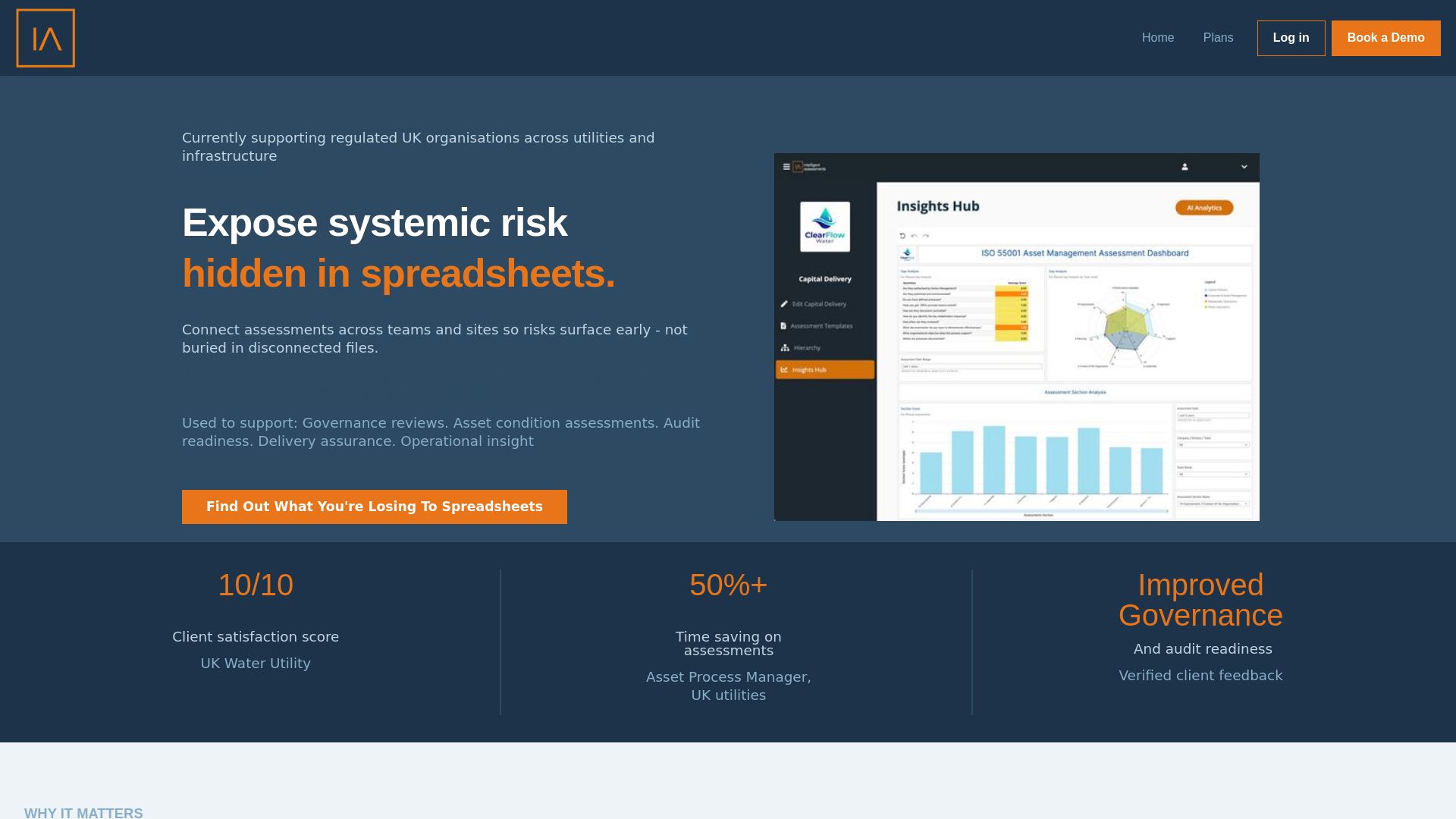
Every assessment produces a live dashboard alongside the PDF, so your committee sees the current position between formal reporting cycles. Evidence is stored in a secure repository with index links that map directly to each finding — the audit trail regulators expect, without the manual effort.
Book a pilot or demo to see the format in action with your own audit data, or review subscription options for organisational access.
Useful sources and further reading
- IIA auditing report writing toolkit — primary reference for the 5-Cs observation structure, executive summary guidance, and IIA Standard 2420 communications quality criteria. Use for Sections 2–4 of the template.
- IIA audit report template (executive tool) — IIA Standard 2410 requirements for objectives, scope, and results; use when drafting the objectives and scope section.
- ISA 700 (Revised) — mandatory content and ordering for external auditor reports, including the opinion-first requirement and Basis for Opinion; use when producing or reviewing external financial audit reports.
- SA 700 series implementation guide — structural changes to auditor reports and Key Audit Matters requirements for listed entities.
- Practical audit report template — useful starting point for objectives, scope, methodology, and observations fields; good for onboarding new report authors.
- Intelligentassessments platform — template libraries, evidence management, and automated RAG roll-ups for continuous assurance in regulated organisations.