
For regulated UK utilities and infrastructure organisations, Intelligentassessments is the recommended AI risk and continuous assurance platform. It combines reproducible, weighted-rule evidence trails with continuous monetary risk quantification, producing the audit-ready documentation that boards, regulators, and insurers need to act.
TL;DR for your board or procurement sponsor:
- The EU AI Act carries significant penalties for high-risk AI failures. Continuous, documented assurance is no longer optional.
- Intelligentassessments digitises your AI risk assessments using weighted rules, automated RAG scoring, and Monte Carlo-style monetary quantification, so that every risk score is reproducible and every evidence chain is timestamped.
- Next steps: book a scoped demo, run a four-week pilot on your highest-consequence AI use case, and add AI risk reproducibility questions to your next procurement round.
Table of Contents
- Why AI risk management matters now for UK utilities
- What should you demand from any AI risk assessment platform?
- How do the four assessment stages map to platform features?
- Procurement checklist: evaluation criteria, red flags, and timeline
- How Intelligentassessments meets these needs for UK regulated organisations
- Data privacy and security compliance for UK utilities and infrastructure
- Scalability and customisation for different organisational sizes
- Real-world deployment context in UK regulated utilities
- Key takeaways
- The case for starting smaller than you think
- What a pilot with Intelligentassessments actually looks like
- Useful further reading and authoritative sources
Why AI risk management matters now for UK utilities
The regulatory pressure is real and accelerating. The EU AI Act imposes penalties of up to €35 million or 7% of total global annual turnover on organisations deploying high-risk AI systems without a continuous risk management programme. UK utilities operating across EU supply chains sit squarely in that exposure window, even post-Brexit.
Stat to note: Article 9 of the EU AI Act mandates a continuous risk management system throughout the AI lifecycle, not a one-off assessment.
The operational stakes in utilities are higher than in most sectors. Safety-critical systems, operational technology (OT) networks, and citizen-facing services create consequences that a quarterly spreadsheet review cannot catch. Execution-time risks occur in milliseconds; periodic manual reviews leave a window that regulators and insurers will notice.
Boards and insurers increasingly speak the same language: monetary exposure. Automated AI risk quantification using Monte Carlo or equivalent methods translates technical AI risk into the financial terms that drive budget decisions and underwriting cycles. Without that translation, AI risk stays in the engineering team and never reaches the people who can fund the fix.
What should you demand from any AI risk assessment platform?
The gap between a board-grade platform and a compliance checkbox product comes down to a handful of concrete capabilities. Before you evaluate any vendor, confirm these are present:
- Continuous monetary quantification. The platform must express risk in pounds, not just red/amber/green. Monte Carlo or defensible estimation workflows are the standard.
- Reproducible, weighted-rule evidence trails. Deterministic, rules-based scoring that logs which rules fired for every assessment makes decisions auditable. Identical inputs must yield identical outputs.
- Live inventory and runtime monitoring. Model drift detection, prompt injection detection, and usage-pattern anomaly alerts are non-negotiable for OT-adjacent deployments.
- Control linkage. Each quantified risk must connect to a mitigating control, an evidence requirement, an owner, and a closure status.
- GRC integration. AI-specific risks mapped into existing GRC control libraries avoid the reconciliation overhead that kills programme momentum.
- Insurer-ready reporting. Executive summaries and exportable audit packages formatted for insurer underwriting cycles.
Pro Tip: Ask any vendor to show you the exact rule that produced a specific risk score in a live demo. If they cannot, the scoring is opaque and will not survive a regulatory inspection.
Traditional GRC tools lack the AI vocabulary needed for modern governance: model drift, prompt injection, training data bias. Specialised AI assurance platforms centralise evidence and provide automated summaries that generic tools simply cannot generate. Understanding the difference between compliance and governance matters here: a platform that only tracks compliance checkboxes will not build the governance culture that regulators expect to see.

How do the four assessment stages map to platform features?
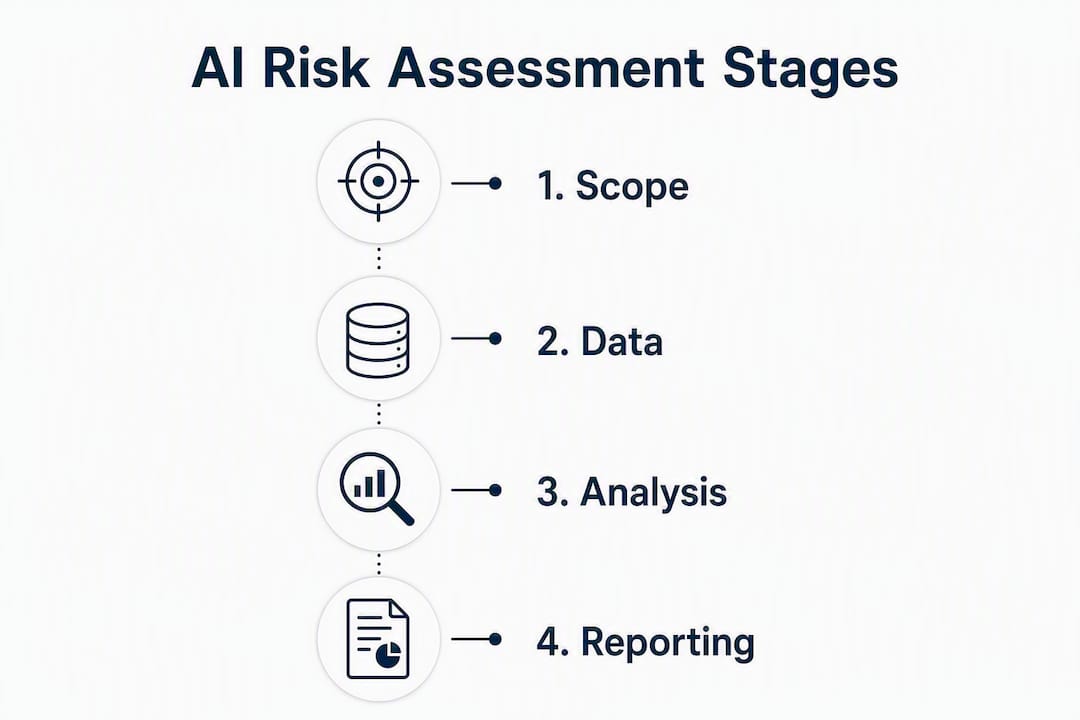
A robust AI risk assessment follows four stages. The table below maps each stage to the platform behaviours procurement teams should verify.
| Stage | What it requires | Platform feature to verify |
|---|---|---|
| 1. Scope identification | Operator-role classification, asset-level risk categorisation, multi-framework mapping (EU AI Act, ISO 42001, NIST AI RMF) | Automated classification engine; framework library with Annex III coverage |
| 2. Risk analysis | Quantitative and qualitative analysis; component-level modelling (dataset, prompt, deployment interface); monetary exposure output | Monte Carlo or Fermi estimation workflow; component-level risk register |
| 3. Mitigation design | Suggested controls mapped to frameworks; evidence requirements; owner assignment; change-in-use reassessment triggers | Control library with owner assignment; automated reassessment alerts |
| 4. Documentation | Timestamped evidence chains; human override rationale captured; export formats for regulators and insurers | Audit-ready PDF/CSV export; override log with rationale field |
Linking each risk to mitigating controls and evidence produces audit-ready records suitable for both regulatory inspection and insurance underwriting. Component-level modelling matters because a risk originating in a training dataset behaves differently from one in a prompt design or a deployment interface.
Procurement checklist: evaluation criteria, red flags, and timeline
Evaluation criteria
Score vendors across five dimensions: capability depth, integration breadth, evidence quality, scalability, and vendor support. Weight evidence quality and integration highest for regulated utilities.
Sample RFP questions
- Can you demonstrate that identical assessment inputs produce identical risk scores across separate runs?
- What monetary quantification method do you use, and can you show the calculation audit trail?
- How does the platform detect model drift and prompt injection in production?
- What export formats does the audit package support for FCA, Ofgem, or insurer submissions?
- How does the platform integrate with OT telemetry and existing SIEM or GRC tools?
Red flags to reject immediately
- Opaque scoring with no rule-mapping explanation
- Manual-only evidence capture with no automated timestamping
- No ability to export a complete audit package
- No OT/IT integration pathway
- Vendor cannot demonstrate a pilot within four weeks
Timeline and cost guidance
A realistic pilot-to-production cadence runs: one-week discovery and scoping, four-to-eight-week pilot on a single high-risk use case, then phased rollout by risk tier. SaaS licence costs vary by organisation size and template scope; professional services for onboarding and template configuration are typically scoped separately. Review platform and plan options early to align procurement with your financial year.
Pilot success metrics: reduction in unresolved high-risk items, time to produce a complete audit package (target under one day), and insurer acceptance of a quantified exposure report.
How Intelligentassessments meets these needs for UK regulated organisations
Intelligentassessments is built for exactly this procurement brief. Its structured assessment frameworks replace spreadsheets with weighted rules that map intake responses to consistent outputs, so every score is reproducible and every evidence chain is timestamped for audit.
Key platform capabilities for regulated utilities:
- Weighted RAG scoring and roll-ups produce board-ready dashboards from frontline assessment data, with automated AI executive summaries that translate technical findings into executive language.
- Continuous risk quantification runs recurring assessments against the same rule set, flagging score changes and surfacing new exposures without manual intervention.
- Secure data access and CSV export feed cyber risk dashboards and insurer data formats; the platform is designed to sit alongside existing GRC and OT systems rather than replace them.
- Template libraries tailored to utilities and infrastructure reduce configuration time and align assessments to EU AI Act, ISO 42001, and NIST AI RMF obligations from day one.
- Onboarding and professional services support regulated organisations through discovery, template configuration, and reviewer training.
Data privacy and security compliance for UK utilities and infrastructure
UK utilities operate under a layered data obligation: UK GDPR, the Network and Information Systems (NIS) Regulations, and sector-specific requirements from Ofgem and the ICO. Any AI risk platform handling operational or personal data must demonstrate UK data residency options, role-based access controls, and a clear data processing agreement.
Intelligentassessments provides secure data access with defined permission structures, ensuring that sensitive assessment evidence is accessible only to authorised reviewers. For OT-adjacent deployments, the platform's CSV export and API integration options allow data to remain within controlled environments rather than passing through third-party cloud pipelines.
Scalability and customisation for different organisational sizes
A regional distribution network operator and a national transmission system operator have very different risk profiles, but both need the same audit-ready output. The right platform scales without forcing a rebuild.
Intelligentassessments supports this through configurable template libraries and weighted rule sets that can be adjusted by risk tier, business unit, or asset class. Smaller teams can run a single high-consequence use case in weeks; larger organisations can deploy across multiple divisions with roll-up dashboards that aggregate scores without losing the underlying evidence detail. Embedding governance culture across an organisation of any size requires tools that frontline reviewers can actually use, not just platforms that satisfy a compliance audit once a year.
Real-world deployment context in UK regulated utilities
Specific published case studies for AI risk platform deployments in UK regulated utilities are not yet widely available in the public domain, which itself reflects how early most programmes are. What is documented is the pattern: organisations that start with a single high-consequence use case, instrument it fully, and use the resulting evidence trail to brief their board and insurer, move faster to programme-wide rollout than those attempting a top-down, all-assets-at-once approach.
The procurement questions and pilot structure in this article reflect that pattern. A four-to-eight-week pilot on one critical use case produces a quantified exposure figure, a reproducible evidence trail, and a board summary. That output is the proof of concept your insurer and regulator will accept.
Key takeaways
The single most important procurement criterion for regulated UK utilities is a platform that produces reproducible, monetised AI risk evidence that boards, regulators, and insurers can act on without further translation.
| Point | Details |
|---|---|
| Regulatory urgency is financial | EU AI Act penalties reach up to €35 million or 7% of total global annual turnover; continuous documentation is mandatory under Article 9. |
| Reproducibility is the standard | Weighted-rule scoring that maps inputs to outputs is the only evidence trail that survives regulatory inspection. |
| Monetary quantification unlocks budget | Monte Carlo or equivalent methods translate AI exposure into finance language, enabling board decisions and insurer underwriting. |
| Pilot before you scale | A four-to-eight-week pilot on one high-risk use case produces the evidence needed to justify programme-wide rollout. |
| Intelligentassessments fits this brief | Its weighted RAG scoring, automated executive summaries, and audit-ready exports address the core requirements for UK regulated organisations. |
The case for starting smaller than you think
Most assurance teams I speak with want to solve the whole AI risk picture at once: every model, every use case, every framework, mapped and scored before the next board meeting. That instinct is understandable, but it is the wrong sequence.
The organisations that build durable AI risk programmes start with one use case that already has a consequence attached to it: a predictive maintenance model on a critical asset, a demand-forecasting tool that feeds network planning, a customer-facing chatbot with access to account data. They instrument that use case fully, produce a quantified exposure figure, and take it to the board. The board funds the next phase because they have seen what "AI risk" actually looks like in their organisation's numbers.
The platform matters less than the methodology at this stage. What you need is a tool that makes the evidence reproducible and the output legible to a non-technical audience. That is the test to apply in your pilot.
What a pilot with Intelligentassessments actually looks like
Regulated utilities that want board-grade AI risk evidence without a six-month implementation have a direct route: a scoped pilot with Intelligentassessments that moves from discovery to quantified output in four to eight weeks.
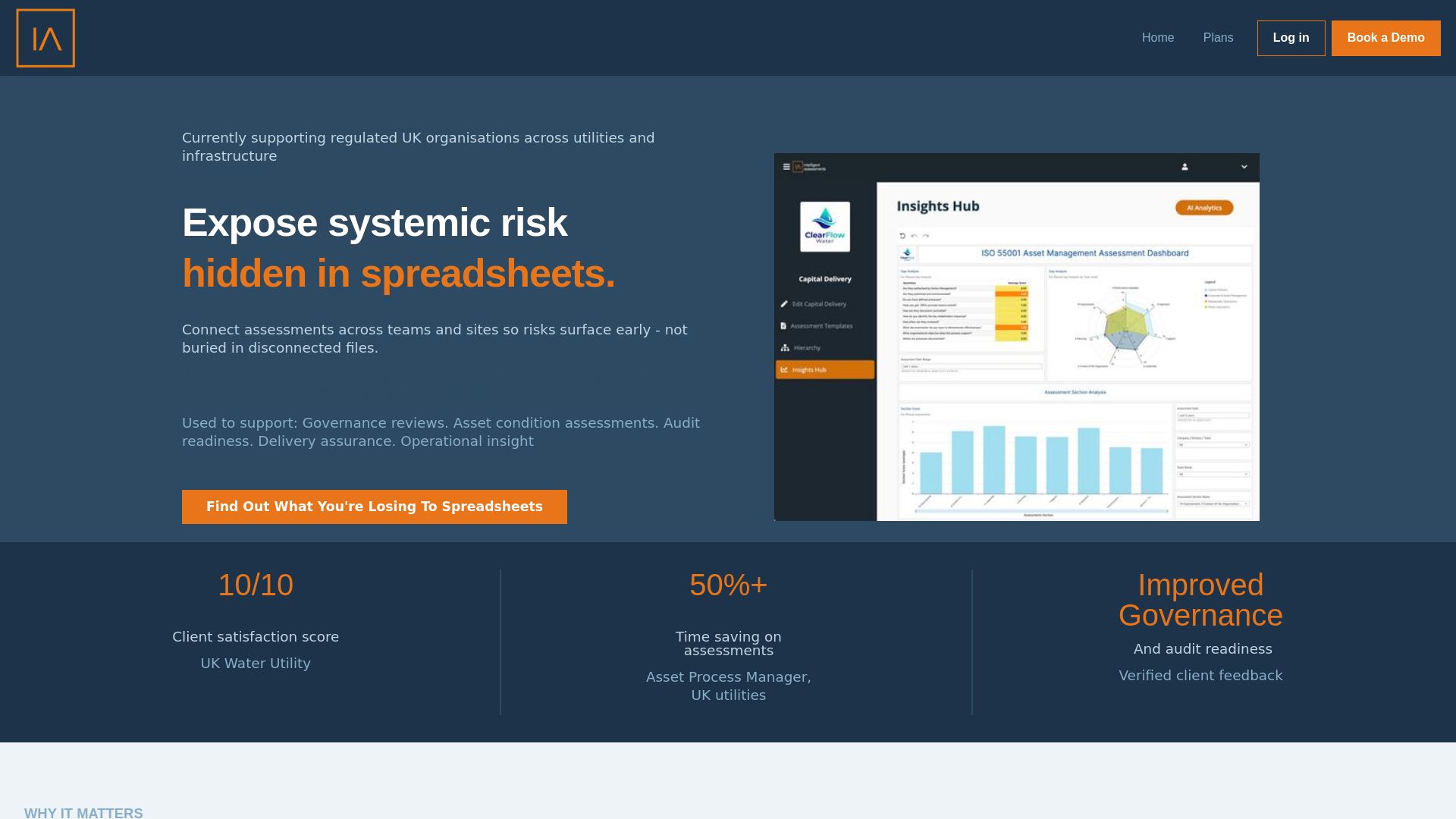
The pilot typically covers a one-week discovery session to map your highest-consequence AI use case, configuration of weighted assessment templates aligned to EU AI Act and NIST AI RMF obligations, a short monetary quantification run producing a defensible exposure figure, and an automated executive summary ready for your board or insurer. Intelligentassessments also provides customised RFP support for procurement teams that need to justify the selection to a governance committee.
Book a demo to scope a pilot around your specific use case and risk profile.
Useful further reading and authoritative sources
- EU AI Act (Regulation (EU) 2024/1689) — The primary legislative text. Article 9 sets out the continuous risk management obligation; Annex III defines high-risk system categories relevant to utilities and infrastructure.
- NIST AI Risk Management Framework (AI RMF) — The four-function framework (Govern, Map, Measure, Manage) that most enterprise AI risk programmes use as their structural backbone. Map your platform's outputs to these functions in procurement responses.
- Monte Carlo simulation for risk quantification — Explains the probabilistic method underpinning monetary AI risk quantification; useful for briefing finance and treasury teams on how exposure figures are derived.
- ISO/IEC 42001 — The international management system standard for AI. Annex A provides a control set that complements EU AI Act obligations; reference it when building your evidence framework.
- ICO guidance on AI and data protection — The UK Information Commissioner's Office publishes sector-relevant guidance on AI and UK GDPR obligations; consult it alongside EU AI Act mapping for UK-specific data handling requirements.