
For regulated UK utilities and infrastructure, Intelligentassessments is the standout choice for AI-driven continuous assurance. It combines explainable AI, auditor-friendly evidence workflows, and UK-focused regulatory mapping into a single platform that replaces spreadsheets with live scoring, structured frameworks, and immutable audit trails.
What you need from any serious contender:
- Continuous assurance with live RAG scoring, not periodic snapshot reports
- UK statutory coverage spanning UK GDPR, ECCTA 2023 awareness, and Companies House alignment
- Immutable, time-stamped evidence trail traceable to source documents
- Human-in-the-loop auditor workflows with a dedicated auditor portal
- ISO-aligned security with UK/EU data residency (AWS eu-west-2 or equivalent)
Book a demo with an auditor present. Validate the evidence export and auditor portal access before you commit.
Why it matters: Many compliance teams still rely on spreadsheets to track obligations from the UK FCA, UK PRA, and ICO. An automated platform with live scoring and regulatory mapping closes the gaps those spreadsheets hide.
Table of Contents
- What is the best compliance software for UK regulated organisations?
- How should evidence management and audit trails work?
- Why does the human-in-the-loop model matter for legal defensibility?
- Which features should you compare across compliance management platforms?
- What should you expect from deployment and integration?
- How do you evaluate UK compliance software vendors and spot red flags?
- What implementation challenges should you prepare for?
- What support and training do UK organisations need?
- What do UK utilities and infrastructure organisations gain in practice?
- What is the total cost of owning compliance management software?
- Intelligentassessments: see it working on your own evidence
- Key takeaways
What is the best compliance software for UK regulated organisations?
Legacy GRC tooling was built for periodic audits: you gather evidence, upload documents, run a review, and produce a report. The cycle repeats quarterly or annually. The problem for utilities and infrastructure is that your regulatory exposure changes continuously. A pipeline incident, a supplier failure, or a new ICO enforcement notice can shift your risk posture overnight. Legacy tools miss that entirely.
AI-driven continuous assurance works differently. Intelligentassessments scores your compliance position in real time using weighted RAG roll-ups, flags deteriorating controls before they become findings, and surfaces AI executive summaries that a board can read without a translator. Modern UK-focused compliance engines map activities against multiple distinct UK regulatory frameworks using hybrid document extraction and explainable AI to quantify civil, criminal, and reputational exposure in near real time. That is the baseline expectation now, not a premium feature.
How should evidence management and audit trails work?
Every finding must trace back to its source: a Companies House filing, a statutory register entry, or a scanned original document. Confidence labelling tells the auditor how certain the system is about each conclusion, and the chain of custody must be reconstructable without manual effort.
Intelligentassessments stores evidence against each assessment question with a time-stamp, links it to the relevant framework control, and generates instant PDF reports. Findings should trace to filings, registers, or statutes with full audit trails and probability scoring calibrated to UK supervisory guidance. If your platform cannot do that, it is document storage, not assurance.

Why does the human-in-the-loop model matter for legal defensibility?
AI platforms are designed to support auditor-led decision-making, not replace it. Platforms retain human-in-the-loop controls for legal defensibility and state explicitly that they do not substitute for independent audit or formal certification. For a regulated utility facing Ofwat, Ofgem, or the HSE, that distinction carries real weight in an enforcement conversation.
Intelligentassessments includes an auditor portal accessible via a magic link, giving your external assurance partner direct, read-only access to live scoring and evidence without requiring a platform licence. An audit-readiness score (0–100) on the dashboard reduces time spent preparing for certification visits. Require this from every vendor you evaluate.
Pro Tip: Bring your most recent audit finding to the demo. Ask the vendor to show you how that specific control gap would appear in the evidence trail and the auditor portal.
Which features should you compare across compliance management platforms?
The columns that matter for UK utilities and infrastructure:
| Dimension | What to look for |
|---|---|
| Assessment templates | Pre-built frameworks for UK GDPR and sector-specific packs |
| Evidence management | Time-stamped uploads linked to framework controls, not free-form file storage |
| Dashboards | Weighted RAG roll-ups, live scoring, exportable board reports |
| UK regulatory mapping | Named coverage of ECCTA 2023, Companies House, ICO, and sector regulators |
| AI capabilities | Explainable outputs with confidence labelling; automated executive summaries |
| Integrations | CSV import/export, API access, compatibility with HR and asset management systems |
| Security | UK/EU data residency, ISO-aligned controls, NCSC guidance alignment |
| Auditor involvement | Dedicated portal, magic-link access, no extra licence required |
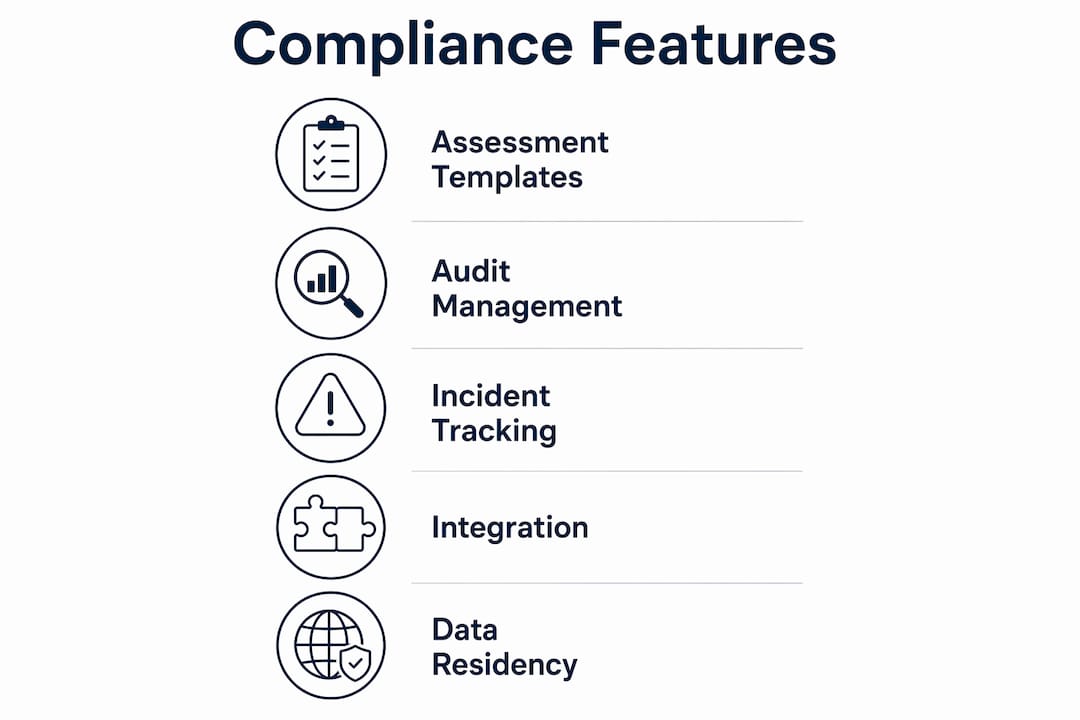
Compliance feature categories cited by UK buyers consistently include audit management, ISO support, incident and CAPA tracking, supplier control, and template libraries. Intelligentassessments covers all of these within a single subscription.
A harmonised control fabric with curated control libraries reduces the maintenance overhead when regulations change across multiple regimes simultaneously, which is routine in UK utilities.
What should you expect from deployment and integration?
Cloud SaaS deployment removes the infrastructure burden, but integration still takes planning. Expect a structured onboarding phase covering template configuration, user provisioning, and a first evidence import. For most regulated organisations, a working pilot is achievable within four to six weeks if internal data owners are engaged from day one.
Integration with existing systems matters more than vendors admit upfront. IT compliance tooling commonly supports centralised log collection, cross-event correlation, and out-of-the-box report templates for standards such as PCI DSS and SOX. Your compliance platform needs to sit alongside, not replace, your SIEM and asset management tools. Confirm CSV and API compatibility before signing.
Data residency is non-negotiable for UK regulated bodies. Security expectations include UK-hosted data (AWS eu-west-2 or equivalent), UK GDPR alignment, and demonstrable ISO or NCSC-recommended controls. Ask for the vendor's data processing agreement on day one, not after contract signature.
How do you evaluate UK compliance software vendors and spot red flags?
Start with the regulatory mapping. Ask the vendor to name every UK framework their platform covers and show you the control mapping for one you know well. Vague answers about "supporting UK regulations" without named frameworks are a red flag.
Then probe the AI explainability. AI compliance assistance in regulated contexts requires outputs that auditors can interrogate, not black-box scores. If the vendor cannot show you confidence labelling and source traceability for an AI-generated finding, the platform will not survive an enforcement review.
Other red flags: no UK data residency commitment in writing, no auditor portal, pricing that excludes template libraries and onboarding from the headline figure, and no reference customers in your sector.
What implementation challenges should you prepare for?
The most common obstacle is data quality. Compliance platforms surface gaps that spreadsheets obscure, and the first evidence import often reveals inconsistent naming conventions, missing documents, and controls that exist on paper but not in practice. Treat this as the point of the exercise, not a problem with the software.
Change management is the second challenge. Assurance teams accustomed to annual audit cycles resist continuous monitoring because it creates a permanent visibility into control performance. Frame the platform as audit preparation that runs year-round, not surveillance.
Template configuration takes longer than vendors estimate. Build in two to three weeks for framework alignment, especially if you are mapping to multiple sector regulators simultaneously.
What support and training do UK organisations need?
UK regulated organisations need more than a help centre. Look for dedicated onboarding support, a named customer success contact, and training that covers both the platform and the underlying framework logic. Generic software training that ignores the regulatory context leaves assurance teams unable to configure templates correctly.
Intelligentassessments provides professional services alongside the SaaS subscription, covering template build, evidence migration, and framework configuration. For organisations new to continuous assurance, that structured onboarding is worth more than a lower headline licence fee from a vendor who hands you a knowledge base and walks away.
What do UK utilities and infrastructure organisations gain in practice?
Regulated utilities using continuous assurance platforms consistently report the same shift: audit preparation time drops because evidence is already organised, time-stamped, and linked to framework controls. The auditor arrives with portal access rather than a document request list.
Infrastructure organisations managing asset condition assessments across distributed sites benefit from the dashboard roll-up: a single RAG score per site, per framework, per period, visible to the board without a manual consolidation exercise. Intelligentassessments supports asset condition assessments alongside compliance reviews within the same platform, which removes the duplication of effort that comes from running separate tools for each use case.
What is the total cost of owning compliance management software?
The licence fee is rarely the largest cost. Pricing drivers extend to user seats, template libraries, modules, onboarding, sector packs, professional services, and ongoing regulatory monitoring. A platform priced attractively at the headline often recovers margin through mandatory onboarding packages or per-template charges.
Hidden costs to probe during procurement: framework migration from existing spreadsheets or legacy GRC tools, annual re-certification of integrations after system updates, and the internal time cost of keeping regulatory mappings current. A vendor with a harmonised control library that updates automatically reduces that last cost significantly.
Data sovereignty adds another layer. Cross-border data access risks under instruments such as the CLOUD Act affect any platform hosted outside UK/EU jurisdiction. Factor legal review of the data processing agreement into your procurement timeline and budget.
Request a total cost of ownership breakdown, not just a per-seat price, before shortlisting.
Intelligentassessments: see it working on your own evidence
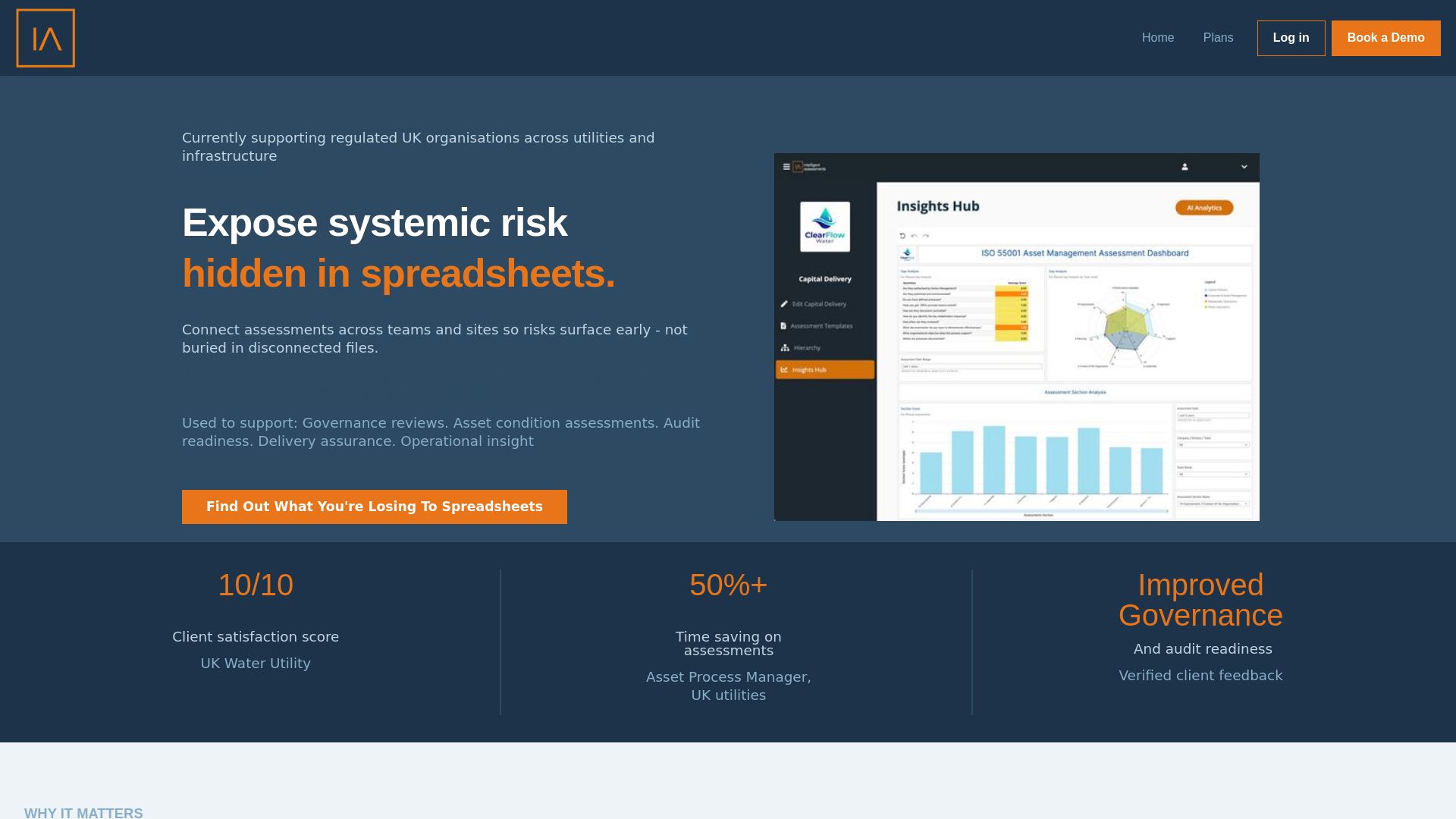
Intelligentassessments gives regulated UK utilities and infrastructure organisations something most compliance platforms cannot: a live Audit-Readiness Score, an auditor portal accessible by magic link, and UK regulatory framework mapping, all in a single subscription without a separate professional services engagement for every new framework.
A demo covers the full workflow: live scoring against your chosen frameworks, evidence export and traceability, auditor portal access, and integration with your existing data sources. Licensing is structured around user seats, template libraries, and modules, with a tailored quote following a short discovery call. View plans and pricing or book a demo to walk through a live evidence sample with your assurance team.
Pro Tip: Bring a live evidence sample and your most recent certification or audit checklist to the demo. It turns a product walkthrough into a genuine readiness test.
Key takeaways
AI-driven continuous assurance with UK regulatory mapping, immutable evidence trails, and an auditor portal is the minimum viable standard for regulated UK utilities and infrastructure in 2026.
| Point | Details |
|---|---|
| Continuous assurance over periodic GRC | Live RAG scoring flags control deterioration before it becomes an audit finding. |
| UK regulatory mapping depth | Expect named coverage of ECCTA 2023, Companies House, ICO, and sector regulators, not generic "UK compliance" claims. |
| Immutable evidence trail | Every finding must trace to a source document with a time-stamp and confidence label for legal defensibility. |
| Total cost of ownership | Licence fees exclude onboarding, template libraries, and regulatory monitoring; request a full TCO breakdown before shortlisting. |
| Intelligentassessments | Combines live Audit-Readiness Score, auditor portal, UK framework mapping, and evidence management in one platform. |