
For governance-led PMOs in regulated UK organisations, Intelligentassessments is the recommended platform. It replaces spreadsheet-based governance with structured assessment frameworks, AI-generated executive summaries, weighted RAG scoring, and real-time dashboards, giving PMO leaders a single source of truth across delivery, risk, and compliance.
Three reasons it stands out for regulated environments:
- Strategy-to-execution traceability: every programme links upward to strategic objectives and downward to evidence, so governance bodies see the full picture without chasing status updates.
- Automated portfolio reporting: AI-powered summaries and instant PDF outputs replace the manual consolidation that consumes PMO capacity each reporting cycle.
- Evidence-led governance: structured frameworks and audit trails satisfy the scrutiny that regulated UK sectors, from utilities to infrastructure, routinely face.
Pro Tip: Start your pilot with one programme type that already has a defined governance cycle. A constrained scope surfaces integration gaps and configuration needs before they affect the wider portfolio.
Ready to see it in action? Book a demo with Intelligentassessments and request a walkthrough tailored to your sector.

Table of Contents
- Which level of PMO software does your organisation actually need?
- What features must your PMO software actually include?
- How should you evaluate PMO software vendors?
- Why Intelligentassessments fits regulated UK PMO needs
- What does implementation actually cost and how long does it take?
- Key takeaways
- The gap between PMO software promises and what actually matters
- See Intelligentassessments in a live demo
- Useful sources and further reading
Which level of PMO software does your organisation actually need?
The answer depends almost entirely on programme volume and PMO maturity. Sizing guidance is clear: organisations with fewer than 20 programmes do not typically require enterprise-grade portfolio optimisation; those managing a larger number generally need specialised governance platforms.
Fewer programmes: lightweight, configurable platforms suit this band. The priority is speed to adoption and basic portfolio visibility, not heavyweight governance engines. A new PMO here benefits more from flexibility than from rigid process enforcement.
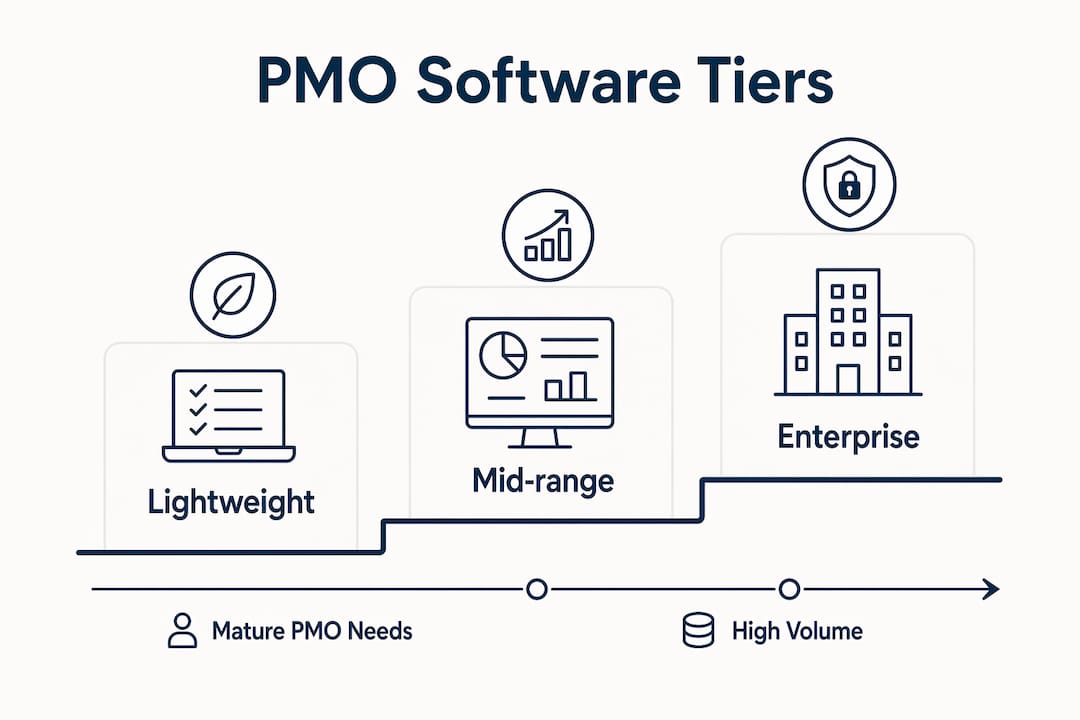
moderate programme volumes: this is where the real tension sits. Mid-range PMOs need platforms that balance governance depth with resource management. Too little governance and control slips; too much and adoption falters. Platforms that let you dial up governance incrementally are worth the premium at this scale.
50+ programmes: at this volume, manual consolidation is simply not viable. You need automated roll-ups, cross-programme resource capacity views, and intake workflows that enforce governance states before work enters the portfolio.
Maturity matters as much as volume. Mature PMOs need rigid governance and strategic alignment features; emerging PMOs should prioritise configurability and speed to value. A common procurement mistake is buying the most sophisticated tool available when the PMO function is not yet ready to operate it.
Watch for these operational signals that indicate you need to move up a tier: intake requests exceeding what a shared inbox can manage, CFO-level reporting demands that spreadsheets cannot satisfy reliably, and stakeholder counts that make manual status consolidation a weekly time sink.
What features must your PMO software actually include?
Contemporary PMO software must deliver five core capabilities to be worth shortlisting:
- Automated portfolio-level reporting with configurable dashboards and exportable outputs.
- Resource capacity planning that shows demand against availability across programmes.
- Risk and issue management with escalation paths and audit trails.
- Intake and prioritisation workflows that standardise how work enters the portfolio and enforces governance states.
- Strategy-to-execution traceability linking delivery activity to organisational objectives.
Integration is where many shortlists fall apart. Effective governance requires financial signals, resource capacity, and portfolio decisions to be unified rather than siloed. Demand finance system integration (general ledger feeds, budget variance), HR and workforce data (headcount, availability), and time or payroll systems. Each integration reduces the manual reconciliation that erodes PMO credibility with finance and executive stakeholders.
For diverse UK teams, accessibility matters. Look for WCAG 2.1-compliant interfaces, role-based dashboards that surface relevant data without overwhelming non-PMO users, and mobile access for field-based or hybrid workers.
| Feature group | Governance outcome |
|---|---|
| Automated reporting | Consistent, timely portfolio status without manual consolidation |
| Resource planning | Prevents over-commitment and surfaces capacity constraints early |
| Risk and issue management | Auditable escalation trails for regulated environments |
| Intake and prioritisation | Standardised demand management; reduces shadow portfolios |
| Strategy traceability | Connects delivery activity to organisational objectives |
Pro Tip: For regulated organisations, weight security and audit trail capabilities above usability scores during evaluation. A platform your team finds slightly harder to use but that produces a complete, tamper-evident evidence trail is worth more than a slick interface with no audit log.
How should you evaluate PMO software vendors?
Map your evaluation across eight dimensions: best fit for your size and use case, core features, integrations, security and compliance, deployment and hosting, pricing and total cost of ownership, ease of adoption, and reporting depth.
Demo checklist — ask vendors to show you:
- Live portfolio roll-up from programme level to executive dashboard.
- How RAG status is calculated and whether weighting is configurable.
- Evidence attachment and retrieval within a governance review.
- Resource capacity view across two or more concurrent programmes.
- Intake workflow from submission through approval to portfolio entry.
- Risk escalation path and audit trail for a closed issue.
- Report generation time for a portfolio of your approximate scale.
- Data export formats (CSV, PDF, API) and latency.
- Integration with a finance or HR system you currently use.
- User permission model and role-based access controls.
- Scenario modelling for a reprioritisation decision.
- How the platform handles a programme that breaches a governance threshold.
For deployment and data residency, confirm whether UK data residency is available and whether support operates in UK time zones. For regulated sectors, both are non-negotiable procurement criteria, not nice-to-haves.
Red flags that should stop shortlisting:
- No UK-hours support and no named UK account contact.
- Cloud-only with no data residency option for UK-regulated data.
- Audit trail limited to user-level logs with no evidence attachment.
- No sandbox or trial environment before contract signature.
- Pricing structures that bury governance features in add-on tiers, making the realistic cost two to three times the headline seat price.
When speaking to internal stakeholders, ask operations what manual steps they currently perform to produce a portfolio report, ask finance whether they trust the data they receive from the PMO, and ask your security team whether the vendor's data processing agreement meets your organisation's standards.
Why Intelligentassessments fits regulated UK PMO needs
Intelligentassessments is built specifically for the governance and assurance demands that regulated UK organisations face. Where generic project management tools answer "is this project on track?", Intelligentassessments answers the portfolio question: are we investing in the right programmes and are they delivering strategic value?
| Evaluation dimension | Intelligentassessments capability |
|---|---|
| Best for | Regulated UK utilities, infrastructure, and public-sector PMOs |
| Core features | Structured frameworks, weighted RAG scoring, AI executive summaries, evidence management, real-time dashboards |
| Integrations | CSV data exports; API-ready for finance, HR, and operational data feeds |
| Security and compliance | UK data protection compliance; secure data access controls; audit-trail evidence management |
| Deployment and hosting | SaaS with UK data considerations; confirm residency requirements at demo |
| Pricing model | Subscription SaaS; view plans for licensing tiers |
| Onboarding and support | Template libraries for rapid configuration; UK-based support |
| Reporting | Instant PDF reports; configurable dashboards; AI-generated summaries |
The platform's structured assessment frameworks replace the ad hoc spreadsheet grids that most PMOs rely on for governance reviews. Evidence is attached directly to assessment items, creating a traceable record that satisfies both internal governance bodies and external regulators. Workflow automation integrated into intake and review cycles removes the manual chasing that consumes PMO capacity.
For organisations managing contract and document evidence alongside delivery assurance, Intelligentassessments' evidence management layer connects directly to those artefacts, keeping governance reviews self-contained.
What does implementation actually cost and how long does it take?
Timeline and cost vary by scope, but three bands cover most UK PMO rollouts:
| Phase | Typical duration | Key activities | Primary owner |
|---|---|---|---|
| Pilot | a few weeks to a few months | Framework configuration, one programme type, user acceptance testing | PMO lead and vendor |
| Mid-market rollout | several months | Full portfolio onboarding, integrations, training, reporting sign-off | PMO lead, IT, finance |
| Enterprise implementation | half a year to over a year | Multi-directorate deployment, governance workflow design, change management | Programme board, IT, PMO |
Pricing structures vary widely across the market: expect subscription licensing, per-user tiers, and hidden costs including integration engineering, data migration, change management, and professional services for template and governance configuration. UK public-sector buyers should factor in procurement framework compliance and contract notice periods when planning timelines.
For ROI, measure three things: time saved on portfolio reporting each cycle, reduction in governance meetings needed to chase status, and how quickly risk issues are detected relative to your previous cycle. PMOs that adopt dedicated software report measurable improvements in on-time delivery and budget performance compared with spreadsheet-led programmes. The shift from static plans to connected, real-time platforms is the single biggest driver of that improvement, because static plans simply cannot capture execution reality in complex or regulated environments.
Key takeaways
Buying the largest tool available is the most common PMO procurement mistake; the right-fit platform for your programme volume and maturity will always outperform an over-engineered one your team avoids using.
| Point | Details |
|---|---|
| Match tool to programme volume | fewer programmes: lightweight platforms. 20–50: mid-market governance tools. 50+: enterprise-grade portfolio platforms. |
| Five features are non-negotiable | Automated reporting, resource planning, risk management, intake workflows, and strategy traceability must all be present. |
| Evaluate on TCO, not headline price | Hidden costs in integration, migration, and governance configuration routinely double the headline seat price. |
| UK compliance is a hard filter | Confirm UK data residency, UK-hours support, and audit trail depth before shortlisting any vendor. |
| Intelligentassessments for regulated UK PMOs | Structured frameworks, AI executive summaries, and evidence management make it the fit for governance-led UK portfolios. |
The gap between PMO software promises and what actually matters
Most PMO software evaluations get stuck on feature checklists and miss the harder question: will this platform change how your governance body makes decisions, or will it just give them a prettier version of the same incomplete picture?
The shift from spreadsheets to a connected platform matters most at the governance layer. When a director can open a dashboard and see weighted RAG status, attached evidence, and an AI-generated summary before a board meeting, the conversation changes. Instead of spending the first twenty minutes establishing what is true, the meeting starts with what to do about it. That is the real productivity gain, and it rarely appears in vendor ROI calculators.
Regulated UK organisations have an additional pressure: the audit trail. A spreadsheet that was edited the night before a review is not evidence. A timestamped, structured assessment with attached documents and a version history is. Procurement teams that treat this as a compliance checkbox rather than a governance asset tend to underweight it during evaluation, then regret it when an external audit arrives.
One honest note: published case studies from UK regulated sectors are not always available in the public domain. Ask vendors directly for references from organisations in your sector and at your programme scale. A vendor confident in their outcomes will arrange that conversation without hesitation.
See Intelligentassessments in a live demo
Governance-led PMOs in regulated UK organisations need more than a project tracker. Intelligentassessments delivers structured assessment frameworks, AI executive summaries, and real-time evidence management from a single platform, replacing the spreadsheet consolidation that slows every reporting cycle.
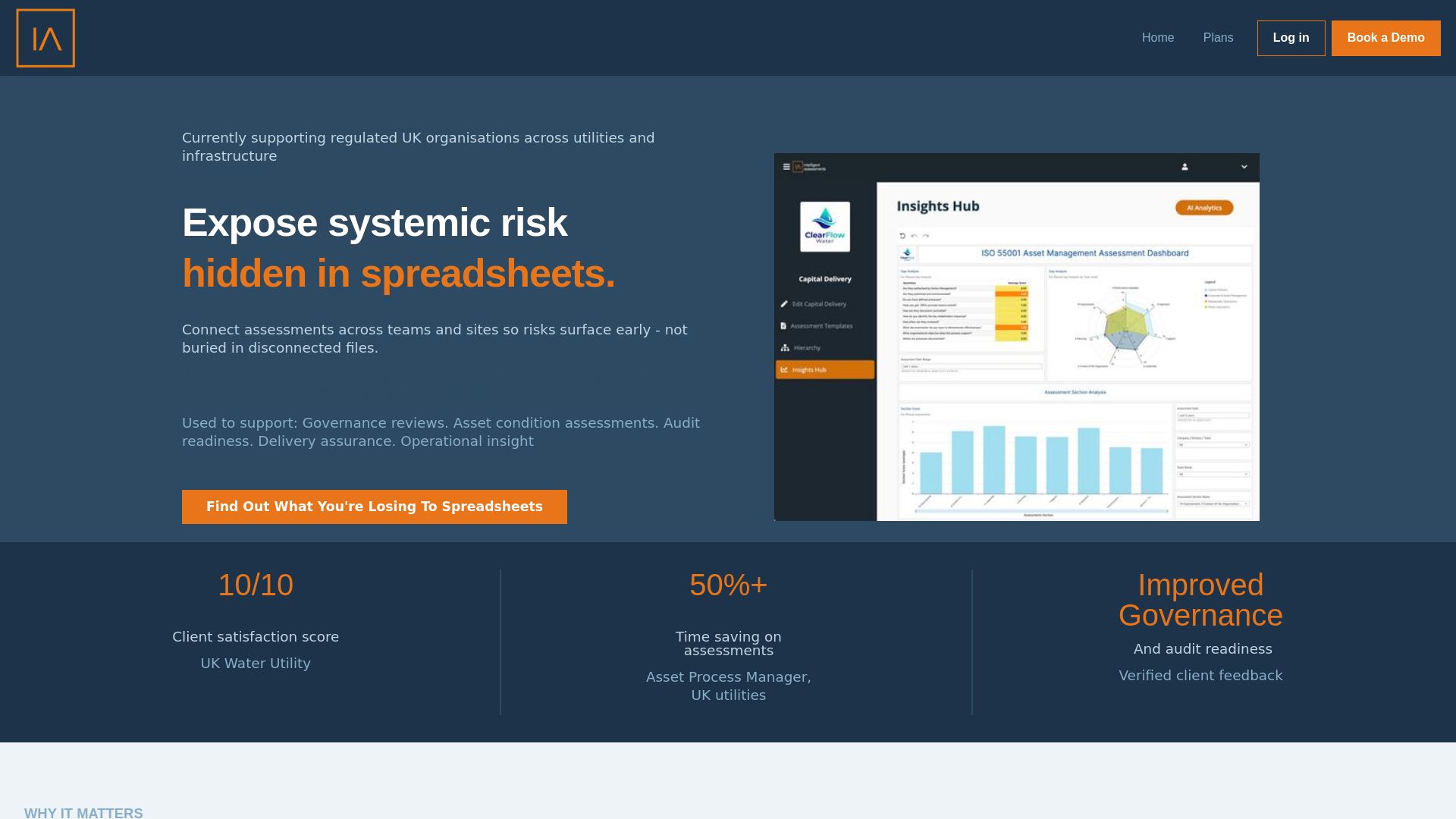
A demo includes a live walkthrough of the portfolio dashboard, evidence management in a governance review, and a discussion of your onboarding and configuration options. Demos are available in UK time zones, and you can request references from UK regulated-sector organisations during the session.
Book your demo and see how Intelligentassessments fits your portfolio governance needs.
Useful sources and further reading
- 10 Best PMO Software Platforms for 2026 — feature requirements and the case for connected platforms over static spreadsheets.
- Best PMO Software: Project Management Formula — sizing guidance by programme volume and maturity-based selection advice.
- Best Enterprise PMO Software: NimbleWork — readiness assessment for mature vs emerging PMOs.
- Best PMO Software 2026: Gitnux — pricing model analysis and UK deployment considerations.
- Intelligentassessments product overview — platform capabilities, sector focus, and regulated-UK positioning.
- Intelligentassessments subscription plans — licensing tiers and feature access for UK organisations.