
A risk control matrix (RCM) is a structured framework that maps identified organisational risks directly to the controls designed to mitigate them. Think of it as a grid where every significant risk sits alongside its control objective, the specific control activity addressing it, the person responsible, and how often that control is tested. Standard columns include risk description, control objective, control activity, control owner, and monitoring frequency.
The RCM serves as a single source of truth for audit, compliance, and risk teams. Rather than hunting across spreadsheets and email threads for evidence, professionals can see at a glance which risks are covered, by whom, and how well. Its core purpose is to clarify control responsibilities and enable effective risk mitigation across the organisation.
Key components of a well-structured RCM:
- Risk description: A plain-language statement of the risk event and its potential impact
- Control objective: What the control is designed to achieve (e.g., prevent unauthorised access)
- Control activity: The specific action taken, whether preventive, detective, or corrective
- Control owner: The named individual or team accountable for operating the control
- Testing frequency: How often the control is assessed for design and operating effectiveness
- Risk rating: Inherent and residual risk scores to track control impact
- Evidence reference: Links to documentation supporting audit validation
Table of Contents
- Why should your organisation use a risk control matrix?
- How to build a risk control matrix step by step
- Inherent risk versus residual risk: why the distinction matters
- Key benefits of using a risk control matrix
- How leading frameworks shape best practice for risk control matrices
- Digitising your risk control matrix with Intelligentassessments
- Risk control matrices across different industries
- Common risk and control categories you will find in most matrices
- UK standards and regulations that make an RCM essential
- Intelligentassessments: digitise your risk control matrix without the spreadsheet chaos
- Key takeaways
Why should your organisation use a risk control matrix?
The case for adopting an RCM goes well beyond ticking a governance box. Here is what it actually delivers in practice:
-
Standardised risk language across departments. Without a shared framework, finance and IT teams often rate the same risk differently, creating confusion and misallocated resources. An RCM standardises assessment language so everyone is working from the same definitions.
-
Prioritisation by severity and control effectiveness. Not every risk deserves equal attention. The matrix lets you rank risks by their inherent severity and then assess whether existing controls are adequate, directing effort where it matters most.
-
Efficient resource allocation. Limited audit and compliance budgets need to go where exposure is highest. The RCM makes that case visibly, with documented evidence rather than gut feel.
-
Regulatory compliance readiness. An RCM underpins SOX Section 404 requirements by connecting financial reporting risks to documented controls, giving auditors the evidence trail they need for validation and regulatory submissions.
-
Improved accountability and transparency. Named control owners cannot claim ambiguity about their responsibilities. Senior leadership gains visibility into the control environment without needing to interrogate individual teams.
-
Ongoing risk monitoring. The matrix is not a one-off exercise. Reviewed regularly, it tracks whether the control environment is keeping pace with operational and regulatory change.
How to build a risk control matrix step by step
Building an effective RCM requires discipline at each stage. Rushing the scoping or skipping ownership assignment are the two most common points of failure.
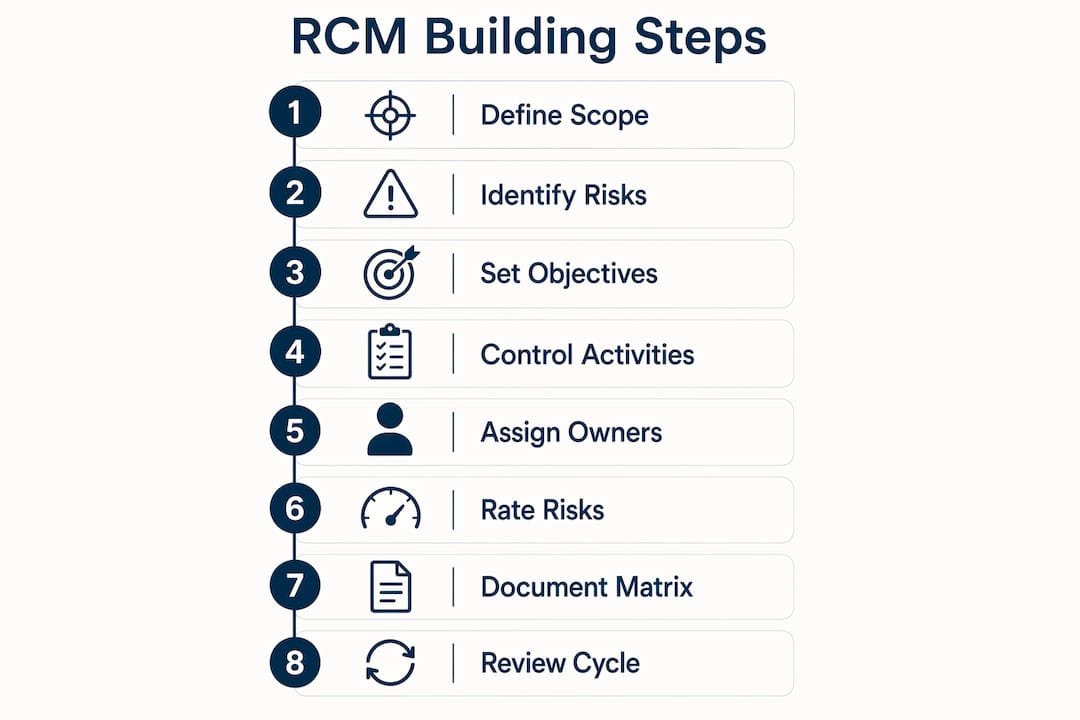
Step 1: Define scope and objectives. Align the matrix with specific organisational goals, a business unit, a process, or a regulatory requirement. A matrix trying to cover everything at once usually covers nothing well.
Step 2: Identify key risks. List the risks relevant to your scope: financial misstatement, cyber incidents, operational failures, regulatory breaches, and reputational events. Draw on existing risk registers, audit findings, and industry threat intelligence.

Step 3: Set control objectives. For each risk, write a clear statement of what a control must achieve. "Prevent unauthorised system access" is a control objective. "Have good IT security" is not.
Step 4: Specify control activities. Define the actual actions: access reviews, reconciliations, segregation of duties, automated alerts. Classify each as preventive (stops the risk), detective (identifies it after the fact), or corrective (remedies the impact).
Step 5: Assign ownership. Every control needs a named owner. Cross-departmental consensus at this stage prevents the siloed matrices that undermine real-world effectiveness.
Step 6: Rate risk severity and control effectiveness. Score inherent risk (before controls) and residual risk (after controls) using a consistent rating scale. The gap between the two reveals whether controls are working.
Step 7: Document in a clear matrix format. Use a structured template with consistent columns. The table below illustrates a basic layout.
| Risk description | Control objective | Control activity | Control type | Control owner | Inherent risk | Residual risk | Testing frequency |
|---|---|---|---|---|---|---|---|
| Unauthorised system access | Prevent data breach | Quarterly access reviews | Preventive | IT Security Manager | High | Medium | Quarterly |
| Financial misstatement | Accurate reporting | Three-way reconciliation | Detective | Finance Controller | High | Low | Monthly |
| Supplier failure | Continuity of supply | Dual-sourcing policy | Preventive | Procurement Lead | Medium | Low | Annual |
Step 8: Establish a review cycle. Update the matrix after major business changes and at least quarterly. Stakeholder engagement during updates maintains accuracy and organisational buy-in.
Pro Tip: Map a single control to multiple regulatory requirements where possible. Linking one access-review control to both ISO 27001 and UK GDPR obligations reduces control duplication and cuts compliance overhead without weakening either framework.
Inherent risk versus residual risk: why the distinction matters
The RCM's analytical power depends on correctly distinguishing two types of risk exposure.
Inherent risk is the level of exposure that exists before any controls are applied. It reflects the raw likelihood and impact of a risk event in the absence of mitigation. A financial services firm processing high volumes of transactions carries a high inherent risk of fraud regardless of what controls it has in place.
Residual risk is what remains after controls have been applied and are operating effectively. Comparing inherent and residual risk reveals whether controls are actually doing their job, and where remediation gaps exist that need addressing.

| Concept | Definition | Purpose in the RCM | Implication for auditors |
|---|---|---|---|
| Inherent risk | Exposure before any controls | Establishes baseline severity | Justifies the need for controls |
| Residual risk | Exposure after controls operate | Measures control effectiveness | Validates control design and operation |
| Control gap | Difference between inherent and residual | Identifies remediation priorities | Drives audit findings and recommendations |
Failing to distinguish the two undermines the matrix's usefulness to auditors and weakens the justification for security or compliance investment. If residual risk remains high despite controls being in place, that is a signal the controls are either poorly designed or not operating as intended. Auditors will want to see both scores, with documented rationale for each.
Key benefits of using a risk control matrix
A well-maintained RCM delivers concrete improvements across the risk and compliance function:
- Consistent risk identification: Structured templates prevent risks from being overlooked during assessments, particularly in complex or multi-site organisations.
- Clearer communication upward: Boards and senior leadership receive a coherent picture of the control environment rather than disconnected departmental reports.
- Focused effort on critical risks: By scoring and ranking risks, teams avoid spreading limited resources across low-priority areas.
- Audit readiness: Documented control activities and evidence references mean audit preparation takes hours rather than weeks.
- Continuous monitoring support: The matrix provides the structure for ongoing control testing, not just point-in-time reviews.
- Reduced control redundancy: Identifying overlapping controls allows organisations to consolidate, cutting cost without increasing exposure.
How leading frameworks shape best practice for risk control matrices
The most credible guidance on internal control design comes from three authoritative sources: COSO, GAO, and NIST. Each reinforces the RCM's role as a dynamic governance tool rather than a static compliance artefact.
The COSO Internal Control–Integrated Framework organises internal control across five components: control environment, risk assessment, control activities, information and communication, and monitoring. The RCM sits at the intersection of risk assessment and control activities, translating identified risks into documented, owned, and tested responses. COSO is explicit that an effective system demands more than policy adherence; it requires judgement in selecting, developing, and deploying controls.
"An effective system of internal control demands more than rigorous adherence to policies and procedures: it requires the use of judgment. Management and boards of directors use judgment to determine how much control is enough." GAO guidance reinforces this point, emphasising that professional judgement governs how much control is appropriate given the risk context. GAO's Green Book requires management to document risk assessments, including identification, analysis, and response, on both a periodic and ongoing basis. The RCM is the natural vehicle for meeting that documentation requirement.
The NIST Risk Management Framework takes a system-lifecycle approach, integrating security and privacy risk management from design through to continuous monitoring. For UK organisations with significant technology or data risk, NIST's structured steps (categorise, select, implement, assess, authorise, monitor) map directly onto the RCM's columns. The NIST Cybersecurity Framework 2.0 adds a GOVERN function that connects cybersecurity risk decisions to enterprise risk management, giving senior leaders the visibility they need to make cost-effective control authorisation decisions.
Mapping a single control to multiple frameworks simultaneously, for example aligning one access-management control to both NIST SP 800-53 and UK GDPR, reduces control bloat and keeps the matrix manageable as regulatory requirements grow.
Digitising your risk control matrix with Intelligentassessments
Spreadsheet-based RCMs have a well-documented failure mode: version chaos, siloed updates, and evidence that lives in someone's inbox rather than the matrix itself. Treating the RCM as a dynamic, automated data source rather than a static document avoids these operational silos and improves audit evidence quality significantly.
Intelligentassessments is built specifically for regulated UK organisations that need to move beyond spreadsheets without losing the structured rigour that auditors expect. The platform digitises the entire RCM lifecycle:
- Structured assessment frameworks: Pre-built and configurable templates align with COSO, ISO, and sector-specific standards, so you are not starting from a blank grid.
- Evidence management: Attach documents, screenshots, and test results directly to control records, creating an auditable trail in one place.
- Weighted RAG scoring: Inherent and residual risk scores roll up automatically, giving leadership a real-time view of the control environment without manual aggregation.
- AI executive summaries: The platform generates narrative summaries of assessment results, reducing the time between a control review and a board-ready report.
- Real-time dashboards: Control owners and senior risk teams see live status across all assessed risks, not a snapshot from last quarter's spreadsheet export.
- Continuous assurance: Rather than point-in-time audits, the platform supports ongoing monitoring, flagging control gaps as they emerge.
Pro Tip: When onboarding an RCM into a digital platform, start with your highest-inherent-risk controls first. Getting those mapped, evidenced, and tested early gives auditors confidence and surfaces any design weaknesses before they become findings.
Risk control matrices across different industries
The RCM's structure is consistent, but the risks and controls it captures vary considerably by sector.
Financial services RCMs typically focus on financial misstatement, fraud, liquidity risk, and conduct risk. Controls include segregation of duties, transaction monitoring systems, and mandatory dual authorisation for high-value payments. UK firms regulated by the Financial Conduct Authority (FCA) use RCMs to demonstrate compliance with the Senior Managers and Certification Regime (SM&CR), mapping individual accountability to specific control responsibilities.
Healthcare and NHS trusts prioritise patient safety risks, data protection under UK GDPR, and clinical governance. Control activities include clinical audit cycles, medicines reconciliation checks, and information governance training completion tracking. The Care Quality Commission (CQC) inspection framework effectively requires this kind of documented control evidence.
Technology and SaaS businesses centre their matrices on cyber risk, data integrity, and third-party supplier risk. Controls map to NIST CSF functions: access management under PROTECT, anomaly detection under DETECT, and incident response plans under RESPOND.
Local government and public sector bodies follow the COSO framework as recommended by the Government Finance Officers Association (GFOA), with RCMs covering procurement fraud, grant compliance, and asset management risks. The COSO framework provides the conceptual basis for designing and evaluating these controls.
Manufacturing and supply chain organisations focus on operational continuity, health and safety compliance, and quality control failures. Control activities include supplier audits, ISO 9001 non-conformance processes, and preventive maintenance schedules.
Common risk and control categories you will find in most matrices
Across industries, certain risk categories appear in almost every RCM. Understanding the standard categories helps practitioners build a complete matrix without missing obvious exposures.
Financial risks cover misstatement, fraud, and treasury exposure. Typical controls include reconciliations, approval hierarchies, and internal audit reviews.
Operational risks address process failures, system outages, and human error. Controls range from documented procedures and training records to automated system checks and business continuity plans.
Compliance and regulatory risks capture breaches of applicable law or regulation. Controls include regulatory horizon scanning, legal sign-off processes, and compliance monitoring programmes.
Cyber and information security risks cover data breaches, ransomware, and unauthorised access. Controls align with frameworks such as NIST CSF or Cyber Essentials, including patch management, multi-factor authentication, and penetration testing.
Reputational risks are harder to quantify but appear in matrices for regulated organisations and listed companies. Controls include media monitoring, crisis communication plans, and whistleblowing procedures.
People and HR risks include key-person dependency, misconduct, and skills gaps. Controls cover succession planning, training completion tracking, and disciplinary frameworks.
UK standards and regulations that make an RCM essential
Several UK-specific regulatory and governance requirements either explicitly require or strongly imply the kind of documented control evidence an RCM provides.
UK Corporate Governance Code (FRC): Listed companies must report on the effectiveness of their risk management and internal control systems. The RCM provides the documented evidence base for that board-level assertion.
Senior Managers and Certification Regime (SM&CR): FCA-regulated firms must map individual accountability to specific responsibilities. An RCM that names control owners by role satisfies much of this mapping requirement.
UK GDPR and Data Protection Act 2018: Organisations must demonstrate appropriate technical and organisational measures to protect personal data. An RCM documenting data-related controls and their testing history is a practical way to evidence compliance during an Information Commissioner's Office (ICO) investigation.
NHS and CQC frameworks: NHS trusts and care providers operate under CQC's Key Lines of Enquiry, which assess whether organisations have effective systems to manage risk. A maintained RCM supports the "Well-led" domain directly.
HM Treasury's Orange Book: The UK government's risk management guidance, the Orange Book, provides a framework for managing risk in public sector organisations. It explicitly supports the use of risk and control matrices as part of a structured risk management approach, making RCMs a natural fit for central government departments and arm's-length bodies.
ISO 27001: For organisations seeking or maintaining information security certification, the Statement of Applicability (SoA) functions as a specialised RCM, mapping information security risks to Annex A controls. Integrating the SoA into a broader organisational RCM avoids duplication.
Intelligentassessments: digitise your risk control matrix without the spreadsheet chaos
Regulated UK organisations that still manage their RCMs in spreadsheets face a concrete problem: evidence gets lost, versions diverge, and audit preparation becomes a fire drill. Intelligentassessments replaces that with a purpose-built platform where your risk control frameworks live in a single, auditable environment.
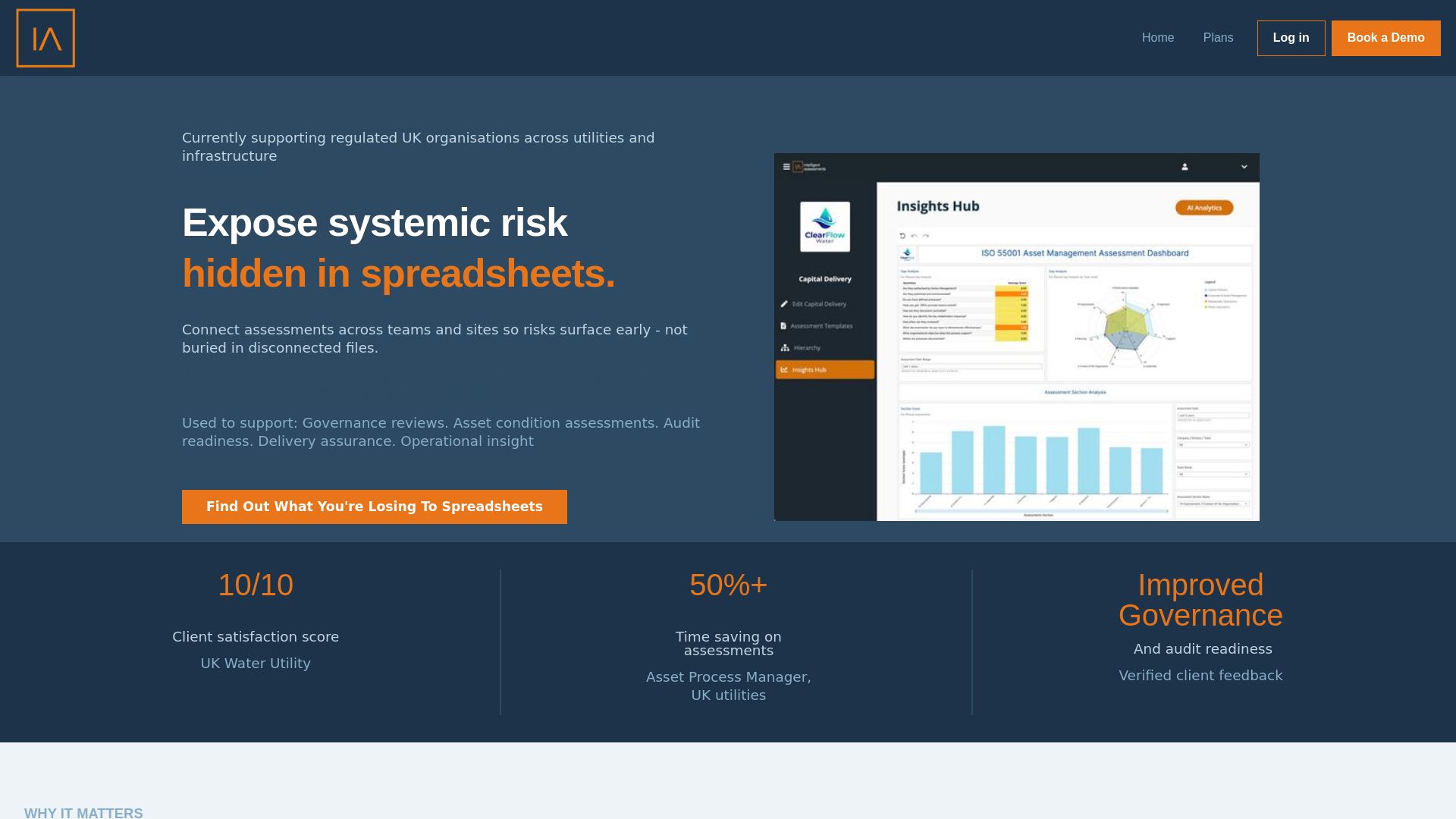
The platform gives risk, audit, and compliance teams structured templates aligned to COSO, NIST, and UK regulatory standards, with weighted RAG scoring that rolls up automatically to real-time dashboards. Control owners update evidence directly in the platform, AI summaries turn assessment results into board-ready reports in minutes, and every change is logged for audit trail purposes. For organisations subject to SM&CR, CQC inspection, or FRC reporting requirements, that level of documented control evidence is not optional.
The difference from a spreadsheet is not just convenience. It is the ability to run continuous assurance rather than quarterly snapshots, and to give senior leadership live visibility into residual risk across the organisation. Explore the platform plans to see which tier fits your organisation's scale, or book a demo to see the RCM workflow in action with your own risk categories.
Key takeaways
A risk control matrix is most effective when it maps inherent and residual risk explicitly, assigns named control owners, and is maintained as a live document rather than a periodic snapshot.
| Point | Details |
|---|---|
| RCM core structure | Every matrix needs risk description, control objective, control activity, control owner, and testing frequency as minimum columns. |
| Inherent vs residual risk | Comparing both scores reveals whether controls are working and where remediation gaps require attention. |
| Framework alignment | COSO, GAO, and NIST all support RCM use; mapping controls to multiple frameworks simultaneously reduces duplication. |
| UK regulatory relevance | FRC, SM&CR, UK GDPR, and HM Treasury's Orange Book all require or imply the documented control evidence an RCM provides. |
| Intelligentassessments | The platform digitises RCM frameworks with structured templates, evidence management, and real-time dashboards for regulated UK organisations. |