A single source of truth (SSoT) is the practice of maintaining one definitive, authoritative data repository so that every team across your organisation works from exactly the same information. Not a close approximation. Not last Tuesday's export. The same record, governed centrally, eliminating data silos and the discrepancies that arise when separate departments maintain their own versions of business metrics.
The business case is straightforward. When finance reports one revenue figure and sales presents another in the same board meeting, someone spends days tracing the gap back to a filter applied differently in two spreadsheets. That is a preventable problem. SSoT solves it by making one location the master, with every read and every update flowing through that single point.
Key elements of a well-implemented SSoT:
- One authoritative record: master data is edited in exactly one location; all other systems reference it rather than copy it
- Centralised governance: access controls, data ownership, and audit trails are defined and enforced at the repository level
- Standardised definitions: every team uses the same schema for revenue, headcount, project status, and any other shared metric
- Active maintenance: the repository is continuously validated, not archived and forgotten
- Compliance alignment: governance policies map to frameworks such as DAMA DMBOK, ISO 27001, and GDPR
How does centralised data management actually work?
Centralised data management organises critical business data in a single governed location so that definitions are standardised, access is controlled, and the numbers every team relies on are identical regardless of who is looking at them. The architecture rests on three layers: ingestion, storage, and consumption.

Ingestion is where data enters the system from source applications, operational databases, and third-party feeds. Getting this layer right matters enormously because errors introduced at ingestion propagate through every downstream report. Storage is the governed repository itself, whether a data warehouse, a data lake, or a master data management (MDM) hub. Consumption covers analytics, dashboards, and exported reports that teams use to make decisions.
Common infrastructure supporting this framework:
- Data warehouses (used as a de facto single version of truth for reporting to multiple stakeholders)
- MDM systems (act as a hub, determining which updates are authoritative and syndicating the golden record to subscribing systems)
- Enterprise service buses (ESBs) (allow source systems to publish changes on a regular cadence so the central repository stays current)
- Data virtualisation (creates a unified view without physically moving data, useful when consolidation is impractical)
Centralised management also improves security, governance, and compliance by applying unified policies across the entire data estate rather than patching each system individually. The DAMA DMBOK framework provides the governance backbone here, covering data quality, metadata management, and role-based stewardship across ten knowledge areas.
Pro Tip: Build schema validation and automated reconciliation into the ingestion layer from day one. Without it, incorrect data enters the repository faster than any manual review process can catch it, and the SSoT quietly becomes a source of false truth.
Why does SSoT implementation so often go wrong?
The most persistent misconception is that buying a software platform is sufficient. It is not. Technology is the container; organisational change management is what fills it correctly. Teams must agree on data definitions before a single record is migrated, and that agreement is harder to reach than any technical configuration.
Shadow data is the symptom that reveals this failure. When the central system is slower or less detailed than a team's local spreadsheet, users revert to private copies, breaking the single source of truth silently and immediately. The central platform must be more convenient and more granular than the departmental workaround, or adoption will not hold.
Common pitfalls to address before go-live:
- Misaligned data definitions across departments (finance and operations defining "revenue" differently)
- Integration complexity when hundreds of systems need connecting, placing a heavy burden on IT
- Cultural resistance from teams accustomed to owning their own datasets
- Latency in the central system that makes local spreadsheets feel faster and more responsive
- Absence of a named data owner for each domain, leaving governance in no one's hands
Red Hat's enterprise architecture guidance makes the point plainly: most executives mistake SSoT for a single technology, when it is actually operational alignment requiring shared schemas, governance policies, and cultural buy-in across the organisation.
Pro Tip: Before launch, audit whether your central reporting offers finer granularity and faster refresh than the departmental tools it is replacing. If it does not, fix that gap first. Shadow data will fill any convenience deficit within weeks.
What does ongoing governance actually require from leaders?
SSoT is not a project with a completion date. It is a continuous state that demands active leadership to prevent the repository from becoming a data graveyard: data stored, never maintained, and eventually distrusted by the teams it was meant to serve.
Data integrity, as defined by NIST, is the property that data has not been altered in an unauthorised manner since it was created, transmitted, or stored. Maintaining that property at scale requires automated validation at ingestion, not periodic manual audits. Without schema enforcement, incorrect data propagates through every downstream report faster than any silo-based error ever could.
Leadership governance duties:
- Define data ownership: assign a named steward for each data domain who is accountable for accuracy
- Enforce role-based access: limit write permissions to authorised sources; all others read only
- Maintain audit logs: immutable records of access, transformations, and user actions support GDPR and ISO 27001 compliance
- Run continuous validation: automated checks at ingestion catch schema violations before they reach reporting layers
- Review and remediate regularly: schedule quarterly data quality reviews with cross-functional stewards, not just IT
The GDPR and ISO 27001 obligations that regulated UK organisations carry make this governance non-optional. End-to-end encryption (AES-256 at rest, TLS in transit) has become the baseline, and granular audit logs are what allow organisations to demonstrate compliance during regulatory assessments.
How Intelligentassessments puts SSoT into practice for regulated organisations
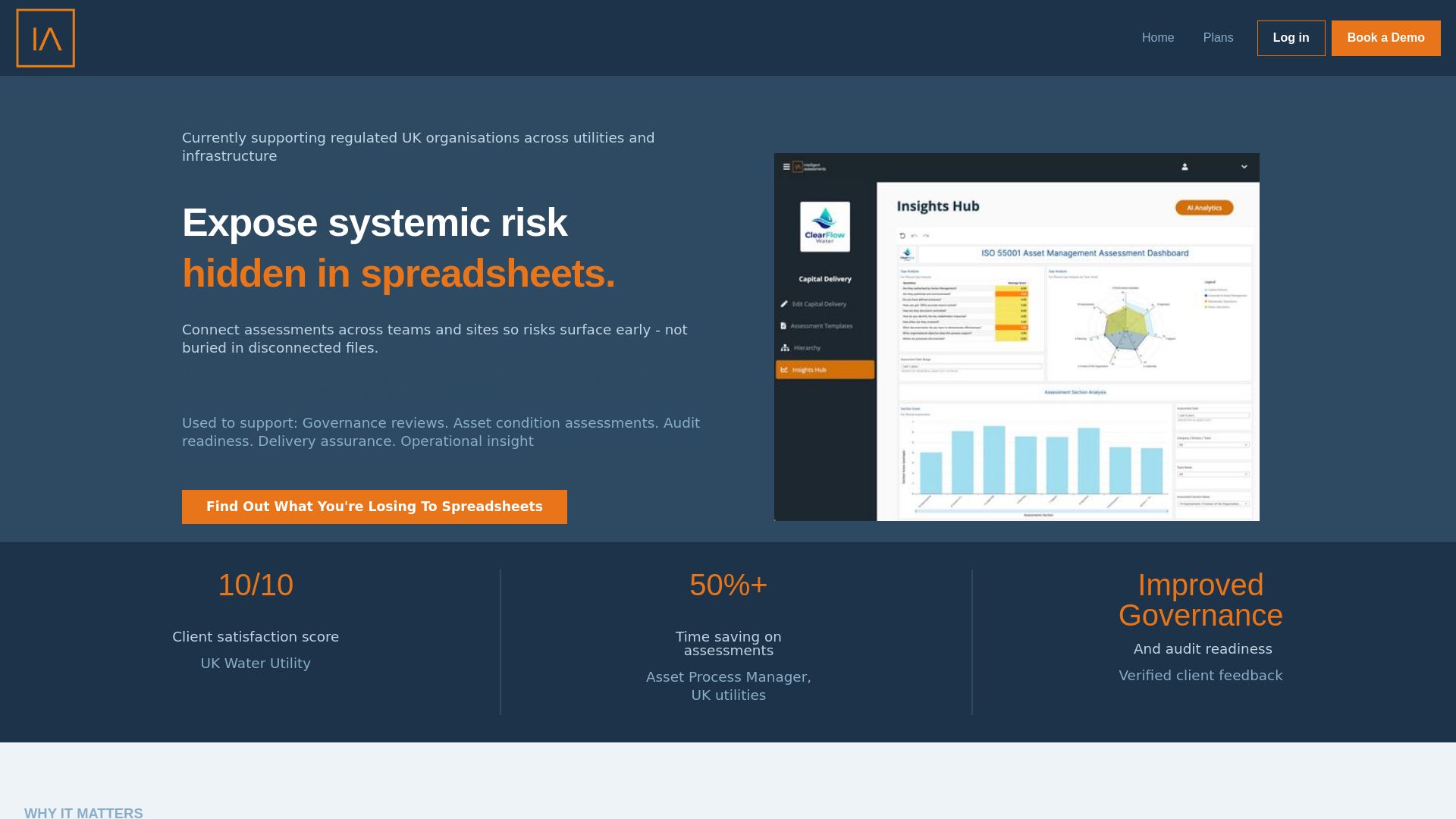
Intelligentassessments is an AI-powered continuous assurance platform built specifically for the governance challenge described above. It replaces fragmented spreadsheets with structured assessment frameworks, evidence management, and real-time dashboards, giving regulated organisations a single, consistent repository for risk, compliance, audit, and operational performance data.
Platform capabilities that directly support a truthful data source:
- Structured frameworks: every assessment, audit, and compliance review follows a defined schema, eliminating definitional drift between teams
- Evidence management: supporting documents are attached directly to findings, creating an auditable chain from data point to decision
- AI executive summaries: automated summaries surface patterns across assessments without requiring manual consolidation
- Weighted RAG scoring: red, amber, green roll-ups give executives an instant, consistent view of organisational health
- Real-time dashboards: all stakeholders see the same live data, removing the version-control problem that plagues spreadsheet-based reporting
- Secure access controls: role-based permissions and CSV exports support both operational use and regulatory audit requirements
For organisations in regulated sectors, the subscription plans cover template libraries for assessments, audits, governance reviews, pulse surveys, and asset condition assessments, all feeding into one governed repository rather than scattered across departmental drives.
Pro Tip: When evaluating any SSoT platform for compliance use, check whether evidence is attached at the finding level or only at the report level. Finding-level evidence is what survives a regulatory audit; report-level attachments rarely do.
A practical roadmap for implementing a single source of truth
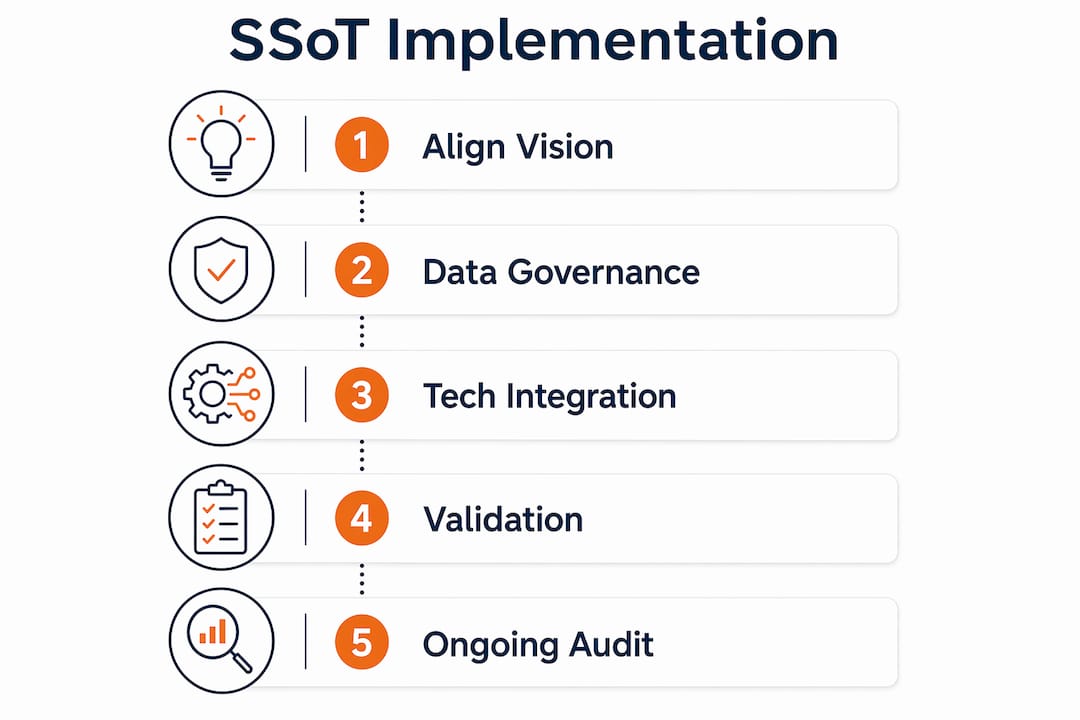
Getting from fragmented data to a governed SSoT follows a predictable sequence. The steps below reflect the consensus from MuleSoft, Airbyte, and RecordPoint's implementation guidance, adapted for executive decision-makers rather than data engineers.
-
Audit existing sources. Identify every system, database, and file that holds data your organisation relies on. Document ownership, update frequency, and known reliability gaps before touching anything.
-
Agree on definitions first. Convene data owners from finance, operations, HR, and any other domain to align on canonical definitions for shared metrics. This conversation is harder than the technology work and must happen before integration begins.
-
Select your repository architecture. Choose between a data warehouse, MDM hub, ESB, or data virtualisation layer based on your integration complexity and latency requirements. Most large organisations use a combination.
-
Build validation into ingestion. Implement schema enforcement and Change Data Capture (CDC) mechanisms at the point where data enters the repository. Automated reconciliation protocols should handle synchronisation failures with rollback capability.
-
Assign data stewards. Name a responsible owner for each data domain. Without accountability, governance erodes within months of go-live.
-
Pilot with one high-value domain. Start with the data domain that causes the most cross-functional friction, typically revenue or project status. A visible win builds the organisational trust that drives adoption elsewhere.
-
Monitor, validate, and remediate continuously. Track data lineage from source to consumption, run automated quality checks, and schedule regular cross-functional reviews. SSoT is sustained by process, not by the initial deployment.
Key takeaways
A single source of truth requires organisational alignment, active governance, and continuous validation, not just a technology deployment, to remain accurate and trusted across the organisation.
| Point | Details |
|---|---|
| SSoT is operational alignment | Technology is the container; agreed definitions, ownership, and governance policies are what make it work. |
| Shadow data signals a convenience gap | If the central system is less granular or slower than local spreadsheets, teams will revert to private copies. |
| Governance must be continuous | Without active validation and named data stewards, a repository becomes a data graveyard within months. |
| Ingestion validation is critical | Schema enforcement at ingestion prevents incorrect data from propagating through every downstream report. |
| Pilot one domain first | Starting with the highest-friction data domain builds visible trust and accelerates adoption across the organisation. |
Intelligentassessments is built for organisations that cannot afford data graveyard scenarios. If you are ready to replace spreadsheet-based reporting with a governed, auditable SSoT for risk, compliance, and operational performance, book a demo to see the platform in action.