
A weighted scoring model is a structured evaluation method that multiplies each criterion's score by its assigned importance weight, sums the results, and produces a comparable total for each option. For assurance and compliance teams in regulated UK organisations, the immediate verdict is this: use it for multi-factor decisions where transparency and traceability matter, but always define must-pass criteria outside the model before scoring begins.
Before you open a spreadsheet or platform, record three things:
- Weights agreed and documented, with stakeholder sign-off, before any scoring takes place
- A version stamp on the framework (date, owner, rationale for each weight)
- An explicit list of knockout criteria that disqualify any option regardless of its weighted total
Table of Contents
- What is a weighted scoring model and when should you use it?
- How to build and govern a model for regulated UK audits
- A worked example and template you can copy
- Pitfalls, limits and UK regulatory considerations
- What to require from an AI SaaS platform for digitised scoring
- How to validate the model and run sensitivity tests
- Key takeaways
- The governance habit that actually makes this work
- Intelligentassessments makes audit-ready weighted scoring straightforward
- Useful sources and further reading
What is a weighted scoring model and when should you use it?
The method sits within the multi-criteria decision analysis (MCDA) family, specifically the Weighted Sum Model. Each option is scored against defined criteria; each criterion carries a percentage weight reflecting its importance; partial scores (weight × score) are summed to produce a total. The option with the highest total is the mathematical front-runner.
Its core strength is traceability. The model forces separation between criteria selection, weighting, and rating, which surfaces where disagreements actually lie and produces a documented numeric result any auditor can follow.
Where it works well in assurance contexts:
- Vendor selection for compliance monitoring tools or data feeds
- Control prioritisation and remediation triage across a portfolio
- Supplier due diligence scoring against regulatory and operational criteria
- Maturity assessments where multiple dimensions must be weighed simultaneously
Where it does not belong: any decision governed by a single binary regulatory requirement. The model is compensatory by design: a low score on one criterion can be offset by a high score on another. That is entirely inappropriate when, say, a supplier fails a mandatory FCA data-residency check. Knock out those failures first; only then apply weighted scoring to what remains.
How to build and govern a model for regulated UK audits
Follow this sequence. Skipping steps, particularly the weight-before-score rule, is the single most common source of model failure.
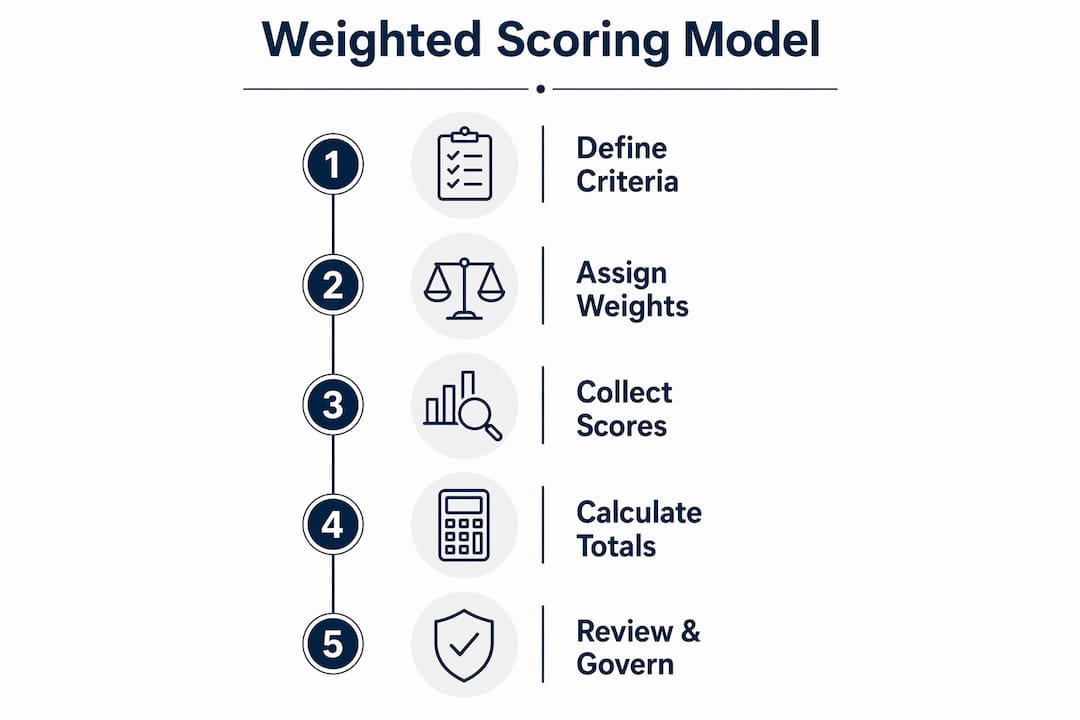
- Define the decision objective and knockout criteria. Write one sentence describing what the decision is optimising for. List every hard disqualifier. Eliminate any option that fails before touching the scoring template.
- Select 4–7 criteria. Best practice limits criteria to 4–7 to prevent weight dilution and over-complexity. Criteria must be independent, measurable, and non-overlapping. For assurance use cases, consider: regulatory fit, evidence quality, residual risk rating, control maturity, and cost of remediation.
- Frame criteria positively. Reword negative criteria into positive metrics so a high score always equals the preferred outcome. "Cost" becomes "Cost efficiency"; "Risk exposure" becomes "Risk mitigation strength."
- Elicit weights before scoring. Ask each stakeholder to distribute 100 points across criteria independently, then discuss divergences. For higher-stakes decisions, swing weighting produces more consistent results than simple ranking, though it requires more facilitation time. Weights must sum to 100%.
- Define a 1–5 rubric with verbal anchors. A 1–5 scale with anchors avoids the central tendency bias that wider scales encourage. Anchor each point: 1 = does not meet requirement, 3 = partially meets with documented gaps, 5 = fully meets with verified evidence.
- Score each option independently, then reconcile. Silent individual scoring rounds before group discussion reduce anchoring bias.
- Calculate: Weighted Score = Σ (weight% × score). Weights expressed as decimals (30% = 0.30). Document the full calculation, not just the totals.
- Governance checklist before sign-off: stakeholder sign-off log (name, role, date, rationale), version number, evidence links per score, and a sensitivity note if any two options sit within 10% of the maximum possible score.
| Governance document | What to record | Owner |
|---|---|---|
| Weight rationale log | Criterion, assigned weight, justification, sign-off date | Assurance lead |
| Version history | Framework version, change summary, approver | Governance manager |
| Evidence register | Score, linked evidence item, assessor | Assessor |
| Sensitivity log | Weight shifts tested, ranking outcomes | Assurance lead |
Pro Tip: Run weight elicitation as a separate session from scoring. Combining both in one meeting is where weight-shifting creeps in, consciously or not.
A worked example and template you can copy
Scenario: Three suppliers are shortlisted for a compliance monitoring data feed. All three passed knockout checks (UK data residency, ISO 27001, FCA registration). Now apply weighted scoring to the survivors.

| Criterion | Weight | Supplier A | Supplier B | Supplier C |
|---|---|---|---|---|
| Regulatory fit | — | 5 | 4 | 3 |
| Evidence quality | — | 4 | 5 | 3 |
| Control maturity | — | 3 | 4 | 5 |
| Cost efficiency | — | 2 | 3 | 5 |
| Integration readiness | 5% | 5 | 3 | 2 |
| Weighted total | 100% | 3.90 | 3.90 | — |
Calculation walkthrough for Supplier A: (0.35 × 5) + (0.25 × 4) + (0.20 × 3) + (0.15 × 2) + (0.05 × 5) = 1.75 + 1.00 + 0.60 + 0.30 + 0.25 = 3.90
Supplier B leads by a small margin on the scoring scale, well below the threshold that triggers mandatory sensitivity analysis. Before accepting Supplier B, vary the Regulatory fit weight by ±10 percentage points and check whether the ranking holds.
CSV fields to map when importing this template into a SaaS platform:
criterion_id— unique identifier per rowweight_pct— numeric, must sum to 100rubric_text— verbal anchor for each score pointscore_value— integer 1–5 per optionevidence_id— link to the supporting document or evidence item
Pitfalls, limits and UK regulatory considerations
The model's transparency is also its vulnerability: it is easy to manipulate if governance is weak.
- Weight-shifting: setting or adjusting weights after seeing scores is the most common failure. Independent elicitation sessions and a timestamped weight log are the only reliable mitigation.
- Too many criteria: beyond seven, individual weights shrink below 5% and barely influence the outcome. The model becomes noise.
- Inconsistent scales: mixing a 1–5 rubric for some criteria and a 1–10 for others distorts every partial score. Lock the scale in the framework before any scoring begins.
- False precision: a total of 3.87 versus 3.91 is not a meaningful difference. Treat close results as a prompt for deeper qualitative review, not a definitive verdict.
- Compensatory misuse in compliance decisions: a single failing metric can disqualify an option in regulated contexts. Never let a high score on cost efficiency compensate for a failed data protection check.
For UK regulated organisations, the FCA's Senior Managers and Certification Regime and Ofgem's audit expectations both require that decisions affecting risk management are traceable. Traceability means weights documented, sign-off recorded, evidence linked to each score, and version history preserved. A model that cannot produce that trail on demand will not survive regulatory scrutiny.
Statistic to note: if two options are within 10% of the maximum possible score, sensitivity analysis is not optional — it is the minimum standard for a defensible decision record.
What to require from an AI SaaS platform for digitised scoring
Automation should assist evidence assembly and visualisation. It must not define weights or set strategic criteria — those remain human decisions that reflect organisational risk appetite.
Non-negotiable platform features for regulated UK assurance:
- Immutable version history with timestamps and approver identity
- Per-score evidence links (each score cell traceable to a document or data point)
- Configurable knockout logic that eliminates options before weighted scoring runs
- Exportable calculation logs and CSV data for offline audit review
- Role-based approval flows so weight changes require sign-off before taking effect
"AI improves the efficiency of evidence collection and RAG aggregation, yet the strategic alignment of criteria and weights determines the quality of insights." — Towards Data Science
For a practical reference on what immutable logging looks like in a digitised audit context, the audit trail guide from Turntrack covers the core behaviours worth testing in a vendor demo.
Pro Tip: During vendor demos, ask the supplier to reproduce your sample template, export the full calculation log, and demonstrate what happens when a user attempts to change a weight after scores have been entered. The answer tells you everything about the platform's governance design.
How to validate the model and run sensitivity tests
A model that produces a clear winner is not automatically a robust one. Run these steps before any decision is finalised.
- Independent re-scoring: have a second assessor score the same options without seeing the first set of scores. Compare results and document any divergence above one point on the 1–5 scale.
- Evidence cross-check: for each score of 4 or 5, confirm the linked evidence item actually supports that rating. Unsupported high scores are the most common audit finding.
- Vary critical weights by ±10 percentage points: shift the highest-weighted criterion up and down by 10 points, redistributing the difference across remaining criteria. Recalculate totals.
- Vary uncertain scores by ±1: identify any score where the assessor expressed low confidence. Move it one point in each direction and recalculate.
- Check for ranking flips: if the winner changes under any realistic weight shift, the model is fragile. Document the finding, convene stakeholders to revisit the weighting, and record the outcome before proceeding.
Where two options sit within 10% of the maximum score, sensitivity analysis is required. On a 5.0 scale, that means a gap below 0.50 points demands a formal test.
Capture every test in a sensitivity log: the parameter changed, the new totals, and whether the ranking held. That log is part of the decision record.
Key takeaways
A weighted scoring model is only as defensible as the governance around it: document weights before scoring, lock knockout criteria outside the compensatory logic, and require a full audit trail from any platform you use.
| Point | Details |
|---|---|
| Weight before you score | Agree and document all weights before any scoring begins to prevent weight-shifting. |
| Knockout criteria are separate | Eliminate options that fail hard regulatory requirements before applying weighted scoring. |
| Use a 1–5 scale with anchors | Verbal anchors on a 1–5 scale reduce false precision and central tendency bias. |
| Sensitivity test close results | When two options are within 10% of the maximum score, run a formal sensitivity analysis. |
| Intelligentassessments for digitised scoring | Intelligentassessments provides version history, evidence linking, configurable knockout logic, and exportable audit logs for regulated UK assurance teams. |
The governance habit that actually makes this work
Most teams get the mechanics right. Where things quietly fall apart is in the rituals around the model, not the formula itself.
The habit worth building is a strict separation between the weight elicitation session and the scoring session. When both happen in the same meeting, the group unconsciously anchors weights to the option they already favour. Running them on separate days, with weights locked and version-stamped before any scores are entered, removes that pressure entirely.
The second habit is evidence-first scoring. Before an assessor assigns a score, they should locate and attach the supporting evidence. Scoring from memory produces optimistic numbers; scoring from documents produces defensible ones. In a digitised platform, this means the evidence field is mandatory, not optional.
Finally, treat the framework as a living document with a formal review cycle, not a one-off exercise. Regulatory expectations shift, organisational risk appetite changes, and criteria that were relevant eighteen months ago may no longer reflect current priorities. A quarterly version review, with sign-off recorded, keeps the model current and keeps auditors satisfied.
Intelligentassessments makes audit-ready weighted scoring straightforward
Replacing spreadsheet-based scoring with a governed, traceable process is exactly what Intelligentassessments is built for. The platform gives assurance and compliance teams in regulated UK organisations structured assessment frameworks with weighted RAG scoring and roll-ups, per-score evidence linking, immutable version history, and exportable calculation logs — everything the governance checklist in this article requires, without the manual overhead of maintaining it in Excel.

Knockout logic is configurable, so options that fail hard regulatory criteria are eliminated before weighted scoring runs. AI-generated executive summaries surface insights from completed assessments, while weight elicitation and criteria design remain firmly in human hands. Role-based approval flows mean no weight or score change takes effect without a timestamped sign-off.
If you have an upcoming vendor selection, control assessment, or remediation triage that needs a defensible, auditable scoring process, book a demo to see the template library, sensitivity analysis support, and audit trail in action.
Useful sources and further reading
- Decision matrix analysis — ASQ: practical guidance on positive criterion framing and rubric design
- Scoring model guide — SI Labs: covers compensatory logic, knockout criteria, and swing weighting with worked examples
- Weighted scoring model guide — ideaplan: step-by-step process, sensitivity analysis rules, and the 10% gap threshold
- Methods for weighting decisions — MDPI Applied Sciences: academic comparison of direct assignment, swing weighting, pairwise comparison, and rank-ordered centroid techniques
- Decision matrix analysis — MindTools: traceability requirements and audit trail expectations for regulated decision-making
- How to train a scoring model in the age of AI — Towards Data Science: boundaries for AI automation in evidence collection versus human-led weight setting
- Audit trail guide — Turntrack: practical reference on immutable logging behaviours for digitised audit environments