A continuous assurance framework is a system that replaces periodic, point-in-time audits with automated, evidence-based checks running continuously against operationalised policies. It works by turning control requirements into machine-readable rules, collecting evidence on a rolling basis, and scoring control health against thresholds rather than waiting for the next scheduled review.
If you're starting from spreadsheets and quarterly checklists, the fastest route in is a pilot: pick one critical control, codify it, and prove the model before scaling.
- Definition anchor: Frameworks like NIST's RMF and Internal Audit standards from the IIA both treat continuous monitoring as a lifecycle discipline, not a snapshot.
- Immediate next step: Choose one control with high business impact, assign an owner, and define success criteria (coverage percentage, false positive rate, time to detect) before writing a single line of policy-as-code.
- Authority markers: CSA control matrices and the ETSI CABCA specification both describe this shift from episodic testing to lifecycle evidence.
Key Takeaways
Continuous assurance works when policy-as-code, immutable evidence and independent third-line testing operate together, not as separate initiatives.
| Point | Details |
|---|---|
| Start with one control | Pilot a single critical control with defined owners and success criteria before scaling. |
| Codify policy as rules | Convert control statements into machine-readable, deterministic checks that produce PASS/WARN/BLOCK outputs. |
| Track five KPIs | Monitor pass rate, time to detect, time to remediate, coverage and false positive rate. |
| Preserve three-lines independence | Let internal audit test the monitoring itself, not just re-perform first and second line checks. |
| Move beyond spreadsheets | Platforms like Intelligent Assessments replace manual trackers with structured evidence, RAG roll-ups and real-time dashboards. |
Table of Contents
- Why continuous assurance matters now
- What are the core components of a continuous assurance framework?
- How do you measure control performance and pick the right KPIs?
- Which controls should you monitor first?
- What technology actually enables continuous assurance?
- What's a realistic roadmap to implement continuous assurance?
- How does the three lines of defence model apply to continuous assurance?
- What challenges should you expect, and how do you fix them?
- How do you prove continuous assurance to auditors and regulators?
- See how Intelligent Assessments supports continuous assurance
- Sources
Why continuous assurance matters now
Boards are tired of finding out about control failures three months after they happened. The Cloud Security Alliance argues that continuous assurance exists precisely because compliance scaled faster than the people checking it, especially in AI-enabled systems where conditions change weekly, not annually.
The business case rests on four measurable gains:
- Faster detection of control failures, often within hours rather than at the next audit cycle.
- Better risk quantification, because codifying assets and controls converts compliance data into qualified risk data leadership can actually act on.
- Lower audit overhead, since testers sample and validate monitoring rather than re-performing every check from scratch.
- Sharper board reporting, with dashboards replacing static slide decks.
Statistic callout: Regulatory pressure is compounding this. ETSI's guidance on AI-enabled systems argues that continuous assessment is becoming necessary simply to keep pace with dynamic conformity requirements tied to evolving regulation such as the EU AI Act. Static annual audits cannot capture systems that retrain or reconfigure between review cycles.
What are the core components of a continuous assurance framework?
Five parts have to work together, or the whole thing collapses into a reporting exercise nobody trusts. Policy statements get operationalised into metrics, evidence flows in automatically, an analysis engine scores that evidence against thresholds, dashboards surface the results, and an audit interface lets the third line test what the second line is monitoring.
The building blocks look like this:
- Control catalogue — a structured register of what's being assured and why.
- Policy-as-code engine — turns control statements into rules producing deterministic outputs, as the PMC research on policy-as-code describes.
- Collectors and agents — pull evidence from systems, logs and configurations without manual intervention.
- Immutable evidence store — evidence that can't be edited after the fact.
- Analytics layer — scores evidence against thresholds and flags exceptions.
- Reporting and governance workflows — routes findings to owners and closes the loop.
Pro Tip: Hash every evidence item at the point of collection and store the hash alongside a timestamp, source system, collector version, and control reference. That minimum metadata set is what turns a log file into something an auditor will actually accept as tamper-evident.
How do you measure control performance and pick the right KPIs?
Vanity metrics kill trust in continuous assurance fast. Report five numbers that actually mean something, and skip the rest.
- Pass rate — successful checks divided by total checks run, the simplest signal of control health.
- Time to detect — how long between a control drifting out of tolerance and the system flagging it.
- Time to remediate — how long between flag and fix.
- Coverage — percentage of the control catalogue actually under continuous monitoring, versus still manual.
- False positive rate — how often flagged exceptions turn out to be nothing, which erodes confidence quickly if it's high.
Roll these up by weighting each control's score by its criticality, then aggregate to a domain score and finally an executive assurance score. That's what feeds board reporting instead of a slide someone built the night before the meeting.
Which controls should you monitor first?
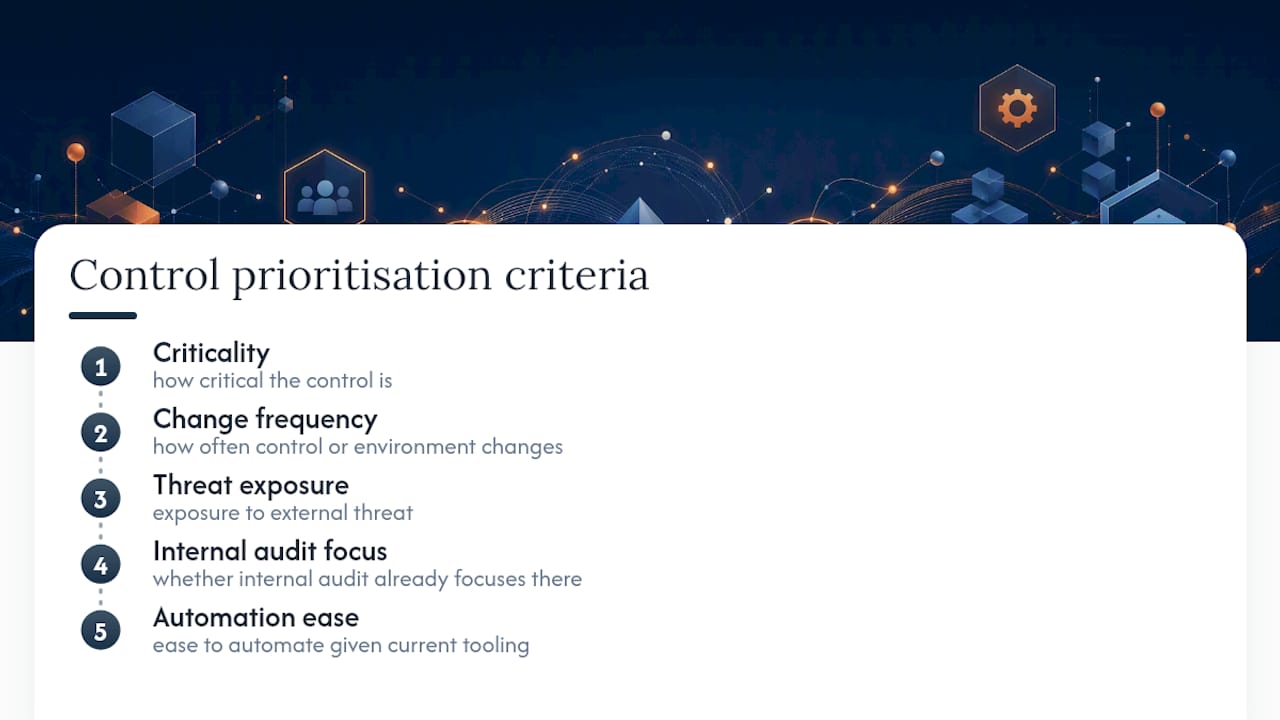
Not every control deserves automation on day one. Prioritise by criticality, how often the control or its environment changes, exposure to external threat, whether internal audit already focuses there, and how easy the control is to automate given current tooling.
A workable mapping template runs: control statement → observable artefact → measurement method → threshold → remediation playbook.
Two examples make this concrete. A process control like vendor risk reassessment maps to a signed attestation record as the artefact, a date-check against the review cycle as the measurement, "no reassessment overdue by more than 30 days" as the threshold, and an escalation to procurement on breach. Standardised, machine-readable formats such as OSCAL make this mapping far less bespoke across teams.

What technology actually enables continuous assurance?
No single tool does this end to end. Most working frameworks stitch together several patterns:
- Policy-as-code engines that convert rules into deterministic PASS/WARN/BLOCK outputs.
- CI/CD gates that block a deployment when a control check fails, rather than catching it after the fact.
- CSPM tools for continuous cloud configuration checks.
- RPA for pulling evidence out of systems that have no API, screenshots and PDFs included.
- Telemetry collectors and log analytics for behavioural and event-based signals.
AI genuinely helps with classification, anomaly detection and extracting structured data from unstructured evidence. It's weaker at judgement calls about materiality or intent, which is exactly where human review still earns its place; treat AI output as a first-pass filter, not a verdict.
Pro Tip: Embed checks into the pipeline as gates that warn before they block. Teams abandon continuous assurance fast if the first thing it does is halt a release over a false positive.
What's a realistic roadmap to implement continuous assurance?
Trying to automate everything at once is the single most common way these programmes stall. A phased approach works better:
- Discovery and scope (four to six weeks): inventory controls, pick one critical, high-visibility control for the pilot, and agree success criteria upfront.
- Pilot codification (six to eight weeks): write the policy-as-code rule, connect one collector, and run it in shadow mode against manual checks to validate accuracy.
- Pipeline integration (four to six weeks): move the check into CI/CD or a scheduled job, start routing exceptions to an owner, and track false positive rate closely.
- Operational monitoring (ongoing): expand coverage control by control, tuning thresholds as real data comes in.
- Scale and governance (three to six months onward): formalise the governance forum, extend to additional domains, and let internal audit begin sampling the automated evidence.
Good pilot success criteria include high measurement accuracy against manual checks, a declining false positive rate over the shadow period, and a demonstrable reduction in audit findings in the piloted control area during the following review cycle. Resist the urge to pilot five controls simultaneously. One done well builds the case for the next ten.
How does the three lines of defence model apply to continuous assurance?
Clarity on who owns what stops continuous assurance turning into duplicated, contradictory monitoring. The IIA's guidance on continuous auditing is explicit that the first and second lines own monitoring, while the third line validates it independently.
- First line (operational teams): owns day-to-day control execution and initial exception handling.
- Second line (risk and compliance functions): designs the monitoring framework, sets thresholds, and owns policy.
- Third line (internal audit): tests the monitoring itself, samples evidence for integrity, and performs audit-by-exception rather than re-testing everything manually.
That third-line independence matters more, not less, once automation arrives. Auditors need to validate that the monitoring system itself is trustworthy, not just verify past transactions, or the whole assurance chain rests on an unverified assumption.
What challenges should you expect, and how do you fix them?
Every rollout hits the same handful of obstacles.
- Poor data quality → invest in collector validation before trusting any dashboard number.
- Too many false positives → tune thresholds against a shadow period before going live, not after.
- Vaguely written controls → rewrite control statements as testable, binary conditions before automating anything.
- Change management resistance → involve the teams being monitored in defining thresholds, not just informing them afterwards.
- Tooling fragmentation → standardise on one evidence store even if collectors vary.
- Skills gaps → pair risk analysts with engineers early; neither group alone tends to build this well.
Build a small cross-functional delivery team spanning risk, IT and internal audit, with a governance forum meeting monthly to resolve disputes over thresholds. One warning worth repeating: automated evidence without a sound policy-to-metric mapping behind it is just noise with a nicer dashboard.
How do you prove continuous assurance to auditors and regulators?
Auditors want a defensible chain, not a dashboard screenshot. That chain runs: measurement → analysed findings → reports → auditor testing, with audit-by-exception replacing full re-performance.
Prepare an evidence bundle containing:
- The operationalisation specification showing how the policy became a rule.
- Raw and signed measurement files with timestamps.
- Thresholds applied and any exceptions raised.
- Remediation logs showing closure.
- A mapping back to the specific standard or regulatory clause.
Recommended methodology and practical guidance
A repeatable methodology beats ad hoc scripts every time:
- Write the operationalisation specification for the control.
- Gather evidence continuously via collectors.
- Run automated analysis against thresholds.
- Report findings to owners and governance forums.
- Iterate the specification as systems change.
Codify one access control this way and you get a measurable readiness score within weeks, not a quarterly guess. Pro Tip: This is exactly the gap Intelligent Assessments is built to close, replacing spreadsheet trackers with structured frameworks, weighted RAG roll-ups and evidence management so assurance leaders reach decisions faster and with a clearer audit trail.
Is your organisation ready for this shift?
Readiness shows up in a few tells: reasonable data maturity, an existing CI/CD practice, and an audit function willing to test automated evidence rather than insist on manual re-performance. Organisations with none of these still benefit, but only through a slower, phased build. Teams moving off spreadsheets toward structured, evidence-backed assurance are exactly where a platform like Intelligent Assessments earns its place.
See how Intelligent Assessments supports continuous assurance
Intelligent Assessments gives assurance, risk and compliance teams the structured framework layer that continuous assurance depends on: evidence management, weighted RAG scoring and roll-ups, AI-generated executive summaries, and real-time dashboards that replace the spreadsheet trail most teams are still running on.
If you've read this far and recognised your own organisation in the common adoption challenges above, the pilot approach outlined earlier is worth trying with structured tooling behind it rather than a spreadsheet and a shared drive. See what a pilot control looks like inside the platform and book a demo to walk through it with your own control catalogue.
Sources
- Continuous Assurance and Compliance Automation
- Continuous Auditing: Coordinating Continuous Auditing and Monitoring to Provide Continuous Assurance
- TS 104 008 - Methods for Testing & Specification (MTS); Continuous Auditing Based Conformity Assessment for AI-enabled systems
- PMC article on policy-as-code and continuous assurance
- Risk Management Framework for Information Systems and Organizations: A System Life Cycle Approach for Security and Privacy
Recommended
- Real time compliance monitoring for regulated organisations
- Risk control matrix: a practical guide for audit and compliance professionals
- Intelligent Assessments — Assessment Management Platform for Regulated Organisations
- Intelligent Assessments — Assessment Management Platform for Regulated Organisations