
Real time compliance monitoring is the practice of continuously checking controls against regulatory requirements as your environment changes, rather than capturing a snapshot once a year and hoping nothing drifts in between. For regulated UK organisations, the bottom line is straightforward: continuous compliance finds control failures the moment they occur, not six months later during an audit. If you are responsible for meeting UK GDPR obligations, FCA conduct requirements, ISO 27001 controls, or NCSC Cyber Essentials guidance, the question is no longer whether to adopt continuous assurance but where to start. The answer is a focused pilot on a high-regret area, typically access management or data privacy, before expanding scope.
Table of Contents
- How does real time compliance monitoring actually work?
- What features should you require in a compliance monitoring solution?
- What are the business benefits and expected ROI?
- How do you implement real time compliance monitoring?
- What are the common implementation challenges and how do you avoid them?
- How do you measure success with KPIs and regulator-ready reporting?
- How do you choose a vendor and why does Intelligentassessments fit?
- Intelligentassessments in practice: outcomes and proof points
- Key takeaways
- The case for treating compliance as an operational capability
- Intelligentassessments: from pilot to continuous assurance
- Useful sources and further reading
How does real time compliance monitoring actually work?
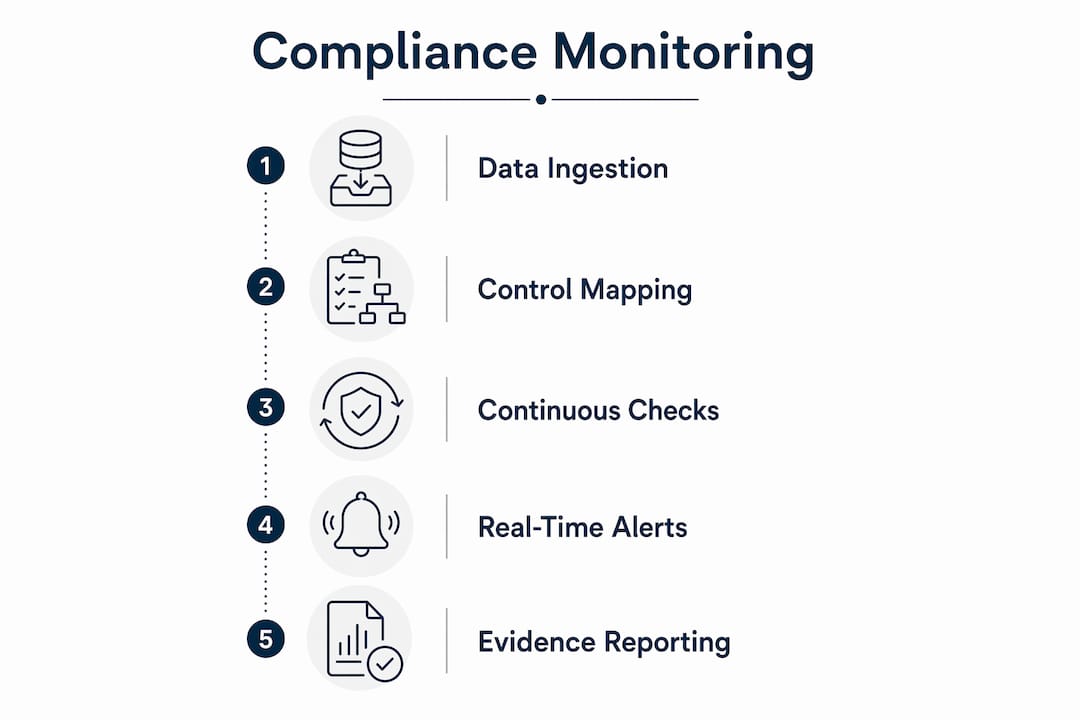
The architecture behind continuous compliance monitoring has three distinct layers, and understanding them helps you ask the right questions of any vendor.

Data ingestion and integration sits at the foundation. Your cloud providers (AWS, Azure, GCP), identity platforms (Okta, Azure AD), code repositories, SIEM tools, EDR agents, and HR systems all emit state data continuously. A well-designed platform connects to these sources via APIs and webhooks, pulling configuration state, access logs, and policy artefacts into a centralised evidence pipeline.

Control mapping and policy engine sits in the middle. Raw data means nothing until it is evaluated against a policy. Continuous monitoring follows a six-step cycle: policy definition, infrastructure integration, continuous scanning, violation detection, remediation, and measurement. The policy engine translates regulatory controls from ISO 27001 clauses, UK GDPR articles, and FCA rules into machine-readable checks. One control definition can satisfy multiple frameworks simultaneously, which is where the real efficiency gain lives.
Detection, alerting, and evidence storage closes the loop. Monitoring runs at three levels: scheduled polling for baseline hygiene, change-triggered scanning when a configuration event fires, and evidence-layer AI classification that scopes expensive inference only to meaningful changes. When a violation is detected, the platform raises an alert, creates a timestamped evidence record, and routes the exception to the right owner. The audit evidence store accumulates tamper-evident before/after snapshots that auditors can inspect directly.
Continuous monitoring does not replace external audits. It makes them faster, cheaper, and far less stressful by eliminating the scramble to reconstruct evidence at audit time. The infrastructure you build for day-to-day assurance becomes the audit package.
Pro Tip: Map your control ownership before you connect a single integration. Engineering, IT Ops, and the compliance function each own different data sources. Agreeing the RACI upfront prevents evidence gaps and ownership disputes later.
What features should you require in a compliance monitoring solution?
The market is crowded, and feature lists blur quickly. For regulated UK organisations, the capabilities below are the ones that genuinely separate a production-grade platform from a dashboard bolted onto a data feed.
Core capability checklist
- Real-time control checks with configurable scan frequency per control family
- Deep integrations covering your actual stack (cloud, identity, SIEM, HR), not just the popular ones
- Multi-framework evidence mapping so a single evidence artefact satisfies ISO 27001, UK GDPR, and FCA requirements simultaneously, as recommended practice for reducing duplicated effort
- Automated evidence management with timestamped, tamper-evident logs and exportable evidence packages
- Severity-based alerting with tiered escalation: critical failures to executives immediately, lower-severity items batched for weekly triage
- Remediation workflows including exception tickets, playbooks, and owner-led sign-off
- Role-based access controls so auditors, engineers, and executives each see only what they need
- UK data residency with encryption at rest and in transit, aligned to NCSC guidance
Operational and security requirements
| Capability | Why it matters for UK regulated organisations |
|---|---|
| Multi-framework control mapping | Satisfies ISO 27001, UK GDPR, and FCA with one evidence set |
| Auditor-ready evidence exports | Reduces audit prep from weeks to hours |
| Severity-tiered alerting | Prevents alert fatigue and executive noise |
| UK data residency | Meets ICO expectations and FCA data handling rules |
| AI executive summaries | Converts raw control data into board-level insight |
| Weighted RAG scoring | Gives assurance leads a single prioritised risk view |
Pro Tip: Prioritise features that produce reusable evidence mapped to multiple frameworks. Every hour your team spends collecting evidence twice for two different audits is an hour that could go into fixing actual control gaps.
What are the business benefits and expected ROI?
The financial case for continuous compliance monitoring rests on three categories of saving: labour, audit cost, and incident cost.
On labour, the gains are substantial. AI-driven compliance monitoring has demonstrated an 80% reduction in time spent on manual review activity and full visibility across monitored interactions in enterprise deployments. Translating that into FTE terms: a compliance team spending a significant amount of hours per week on manual evidence collection and review could recover most of those hours for higher-value work.
Audit preparation is the second lever. Continuous evidence collection compresses audit preparation from weeks to hours because evidence is already mapped, timestamped, and packaged. Organisations that previously spent several weeks preparing for an ISO 27001 surveillance audit typically report that preparation shrinks considerably once continuous monitoring is in place.
The third lever is incident cost. Faster mean time to remediation (MTTR) directly reduces the window of exposure. A control failure that previously sat undetected for months until an annual audit is now surfaced within hours or days, limiting both regulatory exposure and the cost of remediation.
| ROI metric | Typical outcome |
|---|---|
| Manual review time reduction | 80% reduction (enterprise deployments) |
| Audit preparation time | Reduced from weeks to hours |
| MTTR for control failures | Days rather than months |
| Evidence collection effort | Single collection satisfies multiple frameworks |
| Audit finding frequency | Fewer qualified findings per cycle |
Pro Tip: When building your business case, quantify the cost of your last audit preparation cycle in FTE hours. That figure alone usually justifies the platform investment.
How do you implement real time compliance monitoring?
A phased approach is the only realistic path for a regulated UK organisation. Trying to monitor everything on day one produces noise, burnout, and a failed programme. Start with high-regret areas such as access management and data privacy, stabilise those controls, then expand.
Implementation phases
-
Scoping and policy translation (weeks 1–4). Define which regulatory frameworks apply (ISO 27001, UK GDPR, FCA rules, NCSC guidance). Translate each control into a machine-readable policy. Agree ownership using a risk control matrix and RACI. Identify your two or three highest-regret control families for the pilot.
-
Integrations and baseline (weeks 3–8). Connect your priority data sources. A well-architected evidence pipeline connects to existing tools such as GitHub, Okta, AWS, and CrowdStrike, computes a state hash, compares it to the previous state, and only invokes AI analysis when a change is detected. This keeps compute costs manageable from the start.
-
Pilot on high-regret controls (weeks 6–12). Run the platform against your chosen control families. Measure MTTR, alert volume, false-positive rate, and evidence coverage. Refine severity thresholds and escalation paths. A realistic target is a short baseline connection timeframe for priority integrations.
-
Scale and automation (months 3–6). Expand to additional control families and frameworks. Introduce automated remediation playbooks for low-complexity failures. Build auditor-ready evidence packages for your next ISO 27001 or FCA review.
-
Ongoing optimisation (continuous). Review policy definitions quarterly. Update mappings when regulations change. Track KPIs and report to the audit committee.
Primary cost drivers
- Integration complexity and the number of distinct data sources
- Volume of assets and configurations under monitoring
- AI inference costs (mitigated by hashing/diff engines that limit inference to genuine changes)
- Professional services for policy translation and framework mapping
- Data residency and security requirements (UK hosting adds cost but is non-negotiable for many regulated organisations)
| Phase | Typical duration | Key milestone |
|---|---|---|
| Scoping and policy translation | Weeks 1–4 | Agreed control inventory and RACI |
| Integrations and baseline | Weeks 3–8 | Priority sources connected, baseline established |
| Pilot | Weeks 6–12 | MTTR and evidence coverage measured |
| Scale and automation | Months 3–6 | Full framework coverage, playbooks live |
| Ongoing optimisation | Continuous | Quarterly policy review cadence |
What are the common implementation challenges and how do you avoid them?
The most common failure mode is not a technical one. It is the alert trap: a platform configured to flag every minor deviation, producing hundreds of notifications per day, until the team stops reading them.
The five challenges to plan for
-
Alert fatigue. Too many low-severity alerts drown out critical ones. The mitigation is tiered severity: critical failures escalate to executives immediately, medium-severity items go to the responsible owner within 24 hours, and low-severity items are batched for weekly triage. Never configure a system where every alert looks the same.
-
Incomplete integrations. A control that cannot be checked automatically creates a false sense of coverage. Maintain a register of manual controls alongside automated ones, and be explicit about coverage gaps in your dashboard.
-
Mis-mapped controls. A policy that does not accurately reflect the regulatory requirement produces either false positives or missed violations. Involve your compliance counsel in policy definition, not just your engineers.
-
Ownership gaps. If no one owns a control, no one fixes it when it fails. A RACI agreed before go-live is the only reliable mitigation.
-
Compute cost creep. AI inference at scale is expensive. Hashing and diff engines that limit analysis to genuine state changes keep costs predictable.
Pro Tip: Design your alerting so that an executive receiving a notification knows it is genuinely critical. If executives start ignoring alerts, the governance model has already failed.
Governance and operating model checklist
- Agreed RACI for every monitored control family
- Defined SLAs for remediation by severity tier
- Runbook ownership for each exception type
- Quarterly policy review cycle with compliance and legal sign-off
- Escalation path documented and tested before go-live
How do you measure success with KPIs and regulator-ready reporting?
Measuring the effectiveness of your continuous compliance programme requires a small set of KPIs that are meaningful to three audiences: your assurance team, your audit committee, and your regulators (FCA, ICO, and NCSC in the UK context).
Core KPIs for your dashboard
- Percentage of automated evidence coverage: the proportion of controls with machine-collected, timestamped evidence versus those still relying on manual collection. A realistic target is 80% for mature programmes.
- Mean time to remediation (MTTR): average time from violation detection to confirmed fix, tracked by severity tier.
- Violation frequency by severity: trend data showing whether your control environment is improving, stable, or degrading.
- Evidence freshness: age of the most recent evidence artefact per control. Stale evidence is a red flag for auditors.
- Open exceptions by owner: the number of unresolved exceptions per control owner, useful for accountability reporting.
For FCA and NCSC engagements, the most useful exports are evidence packages mapped to specific regulatory obligations, with timestamps and change history intact. ISO 27001 auditors want evidence mapped to Annex A clauses. UK GDPR reviews require evidence mapped to specific articles, particularly Articles 5, 25, and 32 on data minimisation, privacy by design, and security of processing.
Reporting cadence matters as much as the metrics themselves. A weekly operational report for the compliance team, a monthly summary for the CISO or Head of Assurance, and a quarterly board-level view covering trend data and open exceptions by risk tier is a workable structure for most regulated UK organisations. For audit report formatting that meets committee expectations, the structure of the export matters as much as the underlying data.
How do you choose a vendor and why does Intelligentassessments fit?
Vendor selection for a continuous compliance platform is a procurement decision with long-term consequences. The checklist below is designed for RFPs and structured evaluation processes.
Evaluation checklist
- Integration coverage for your actual stack (not just the headline logos)
- Multi-framework mapping (ISO 27001, UK GDPR, FCA, NCSC Cyber Essentials)
- Evidence management with tamper-evident logs and auditor-ready exports
- UK data residency with documented encryption and access controls
- Severity-tiered alerting with configurable escalation paths
- Pricing model clarity: per-asset, per-user, or subscription with no hidden inference costs
- SLA for alert delivery and remediation workflow initiation
- Support for GDPR-compliant AI processing within the platform itself
Questions to ask in an RFP or demo
- Which specific integrations are production-ready versus in beta?
- Where is data stored, and can you confirm UK residency in writing?
- How does your evidence package map to ISO 27001 Annex A clauses and UK GDPR articles?
- What is your false-positive rate on access management controls in a typical enterprise environment?
- How do you handle policy updates when a regulation changes?
- What does your onboarding timeline look like for a 50-control pilot?
Pro Tip: Ask vendors to show you a real evidence export from a previous audit engagement, not a demo environment. The quality of that export tells you more about audit readiness than any feature slide.
Why Intelligentassessments fits regulated UK organisations
Intelligentassessments is an AI-powered continuous assurance platform built specifically for regulated UK organisations. It replaces spreadsheet-based compliance reviews with structured assessment frameworks, automated evidence management, weighted RAG scoring, and real-time dashboards. The platform covers assessments, audits, compliance reviews, governance reviews, and pulse surveys from a single source of truth, which means your ISO 27001 evidence and your FCA conduct review evidence live in the same place, mapped and exportable. AI executive summaries convert raw control data into board-ready insight without manual synthesis. For procurement teams evaluating cost, the subscription plans page sets out licensing options clearly.
Intelligentassessments in practice: outcomes and proof points
The shift from periodic audits to continuous assurance produces measurable operational change. Organisations that have moved to continuous monitoring report that audit preparation, previously measured in weeks of staff time, compresses to hours because evidence is already collected, timestamped, and mapped to the relevant framework clauses.
The 80% reduction in manual review time cited in enterprise deployments reflects a consistent pattern: the bulk of compliance team effort in a traditional model goes into gathering and formatting evidence, not analysing it. Continuous monitoring inverts that ratio.
Automation creates the evidence trail, but it does not replace the judgement of a qualified auditor or the authority of a third-party certification body. ISO 27001 certification still requires an accredited external audit. What continuous monitoring does is make that audit faster, less disruptive, and more likely to produce a clean result.
For a regulated UK utility or infrastructure organisation, a realistic pilot outcome over 30–90 days includes: a measurable baseline for MTTR on access management controls, an automated evidence coverage rate above average for the pilot scope, and a reduction in manual evidence collection hours that is visible in team capacity. Intelligentassessments supports this with template libraries for common UK regulatory frameworks, instant PDF reporting, and secure CSV exports that auditors can work with directly.
AI in internal audit is evolving rapidly, and the evidence-layer AI classification that Intelligentassessments applies to assessment data is a practical example of how AI inference can be scoped to meaningful changes rather than running continuously across all data, keeping both costs and noise manageable.
Pro Tip: Before your first demo, pull your last audit preparation timeline and count the FTE hours spent on evidence collection. That number is your baseline. Any credible platform should be able to show you how it reduces it.
Key takeaways
Real time compliance monitoring delivers continuous assurance by detecting control drift as it happens, reducing audit preparation from weeks to hours and cutting manual evidence effort by up to 80% in enterprise deployments.
| Point | Details |
|---|---|
| Start with high-regret controls | Pilot on access management or data privacy before expanding scope to avoid alert fatigue. |
| Map controls once, satisfy many frameworks | Multi-framework evidence mapping covers ISO 27001, UK GDPR, and FCA from a single evidence set. |
| Tiered alerting prevents the alert trap | Critical failures escalate immediately; lower-severity items batch for weekly triage. |
| Measure MTTR and evidence coverage | Track percentage of automated evidence and mean time to remediation as your primary KPIs. |
| Intelligentassessments for UK regulated organisations | The platform digitises assessments, automates evidence management, and delivers real-time dashboards for regulated UK organisations. |
The case for treating compliance as an operational capability
The conventional framing of compliance monitoring as an audit-preparation activity is the wrong mental model, and it produces the wrong investment decisions. Organisations that treat compliance as something you do before an audit will always be reactive. They will always face the scramble. They will always find that the control that failed was the one nobody was watching.
The more useful frame is compliance as an operational capability, the same way you treat availability monitoring or change management. You do not run availability checks once a year. You do not review your change log the week before an audit. The same logic applies to regulatory controls, and the technology now exists to make continuous assurance practical at the cost and complexity level that a mid-sized regulated UK organisation can absorb.
What I find underestimated in most discussions of this topic is the governance change required alongside the technology. The platform is the easier part. Agreeing ownership, defining escalation paths, and building a quarterly policy review cycle into your operating model is where programmes succeed or fail. Agentic AI workflows, which embed explainable reasoning and traceable actions into compliance operations, will accelerate the automation side further over the next two to three years. But the human-over-the-loop governance model they require is exactly the operating model you should be building now.
UK regulators, particularly the FCA and the ICO, are moving towards expectations of demonstrable, continuous control assurance rather than periodic attestation. Organisations that build this capability now will find regulator engagement materially easier. Those that do not will find the gap between what regulators expect and what a point-in-time audit can demonstrate growing wider each year.
Intelligentassessments: from pilot to continuous assurance
Regulated UK organisations that want to move from spreadsheet-based compliance reviews to a live, evidence-driven assurance model have a practical starting point with Intelligentassessments.
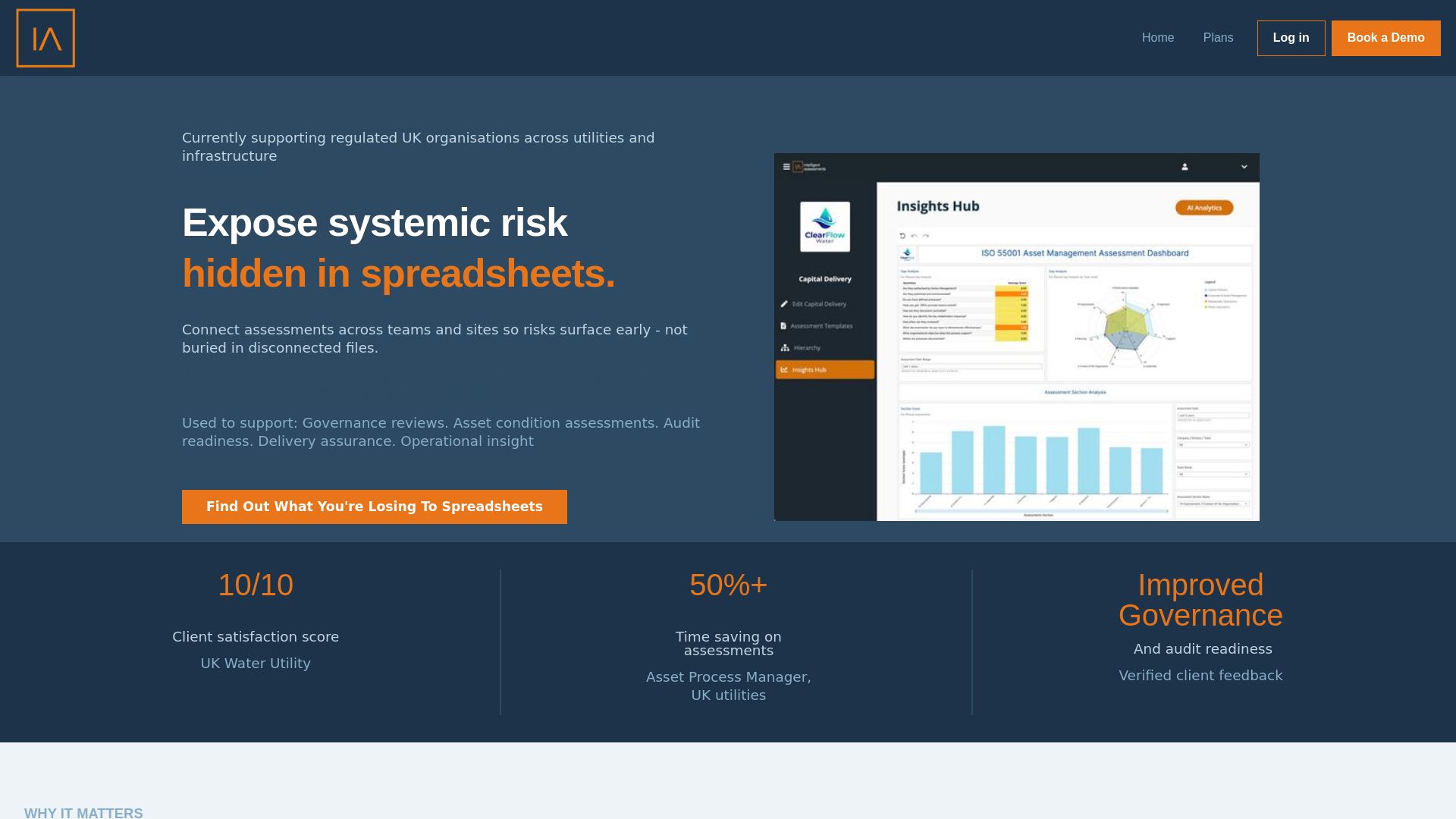
The platform gives you structured assessment frameworks, automated evidence management, weighted RAG scoring, and real-time dashboards from day one. Your ISO 27001 controls, UK GDPR obligations, and FCA conduct requirements sit in a single source of truth, with AI executive summaries that turn raw control data into board-ready reporting. Evidence is collected continuously, mapped to framework clauses, and exportable in formats that auditors and regulators can work with directly. UK data handling is built in, not bolted on.
The fastest way to see whether it fits your organisation is a focused pilot on one or two high-regret control families. Book a demo with the Intelligentassessments team to scope a 30–90 day pilot, or review the platform capabilities to understand the full feature set before your first conversation.
Useful sources and further reading
The sources below are the primary references used in this guide, selected for their authority on continuous compliance architecture, UK regulatory requirements, and assurance practice.
- ISO 27001 standard (iso.org) — The authoritative source for information security management system requirements. Annex A controls are the primary mapping target for most UK regulated organisations.
- Splunk: continuous compliance — Practical explanation of the shift from point-in-time to continuous assurance, with architecture context.
- Elitex Systems: continuous compliance monitoring guide — Detailed walkthrough of the six-step continuous compliance cycle, useful for implementation planning.
- Xorabyte: continuous compliance monitoring — Technical architecture detail on detection modes, hashing/diff engines, and cost control.
- Sentie: compliance monitoring guidance — Practical advice on pilot scoping and avoiding alert fatigue in early-stage deployments.
- Real-Time Compliance Monitoring: Transforming Audit Practice (eajournals.org) — Academic review of how continuous monitoring is changing audit methodology, with evidence on efficiency gains.
- Intelligentassessments platform overview — Full feature set, evidence management capabilities, and real-time dashboard detail for regulated UK organisations.
- AI in internal audit: a practical guide — Covers AI-assisted evidence classification and executive summaries in the context of UK internal audit practice.
- Audit report format for UK utilities — Practical guidance on structuring audit committee exports from continuous monitoring platforms.