
A defensible audit trail rests on six non-negotiables: named author and timestamp for every record, immutable version history, a metadata envelope linking each artefact to its regulation tag, cross-references from findings to evidence, HIA-controlled access with documented release approvals, and a written retention and disposal schedule. Get all six right and your files survive regulatory scrutiny. Miss one and the whole trail unravels.
Immediate action checklist:
- HIA: approve and sign the retention schedule and access policy within 30 days
- Audit lead: confirm every working paper carries author, role, timestamp and version ID before the file closes
- Evidence custodian: verify cross-reference matrix links each finding to its evidence IDs
- IT/platform owner: enable write-once or equivalent immutable storage for closed audit files
- Legal: confirm legal-hold triggers are documented and communicated to the evidence custodian
- QA reviewer: sign off the final file completeness check before the 60-day assembly deadline
Key takeaways
A defensible audit trail requires all six controls to be in place simultaneously: one gap in the chain is enough to undermine the whole file under regulatory scrutiny.
| Point | Details |
|---|---|
| Six non-negotiables | Author/timestamp, immutable versioning, metadata envelope, cross-references, HIA-controlled access, and retention schedule must all be present. |
| Assembly deadline | Final file assembly should be completed promptly after the audit report date, with HIA sign-off before file lock. |
| Retention floor | UK internal audit records are held under retention schedules aligning with legal and sector requirements, which may require keeping records for several years. |
| Evidence quality | System exports rank above screenshots under ISA (UK) 500; screenshots must show hostname, user, full timestamp and scope to be usable. |
| Intelligentassessments | The platform enforces the six non-negotiables through evidence taxonomy, immutable logs, signed export bundles and a built-in retention engine. |
Table of Contents
- What are the core aims of internal audit records management?
- What must every audit trail record as a minimum?
- How should you organise audit files and link findings to evidence?
- How do you control access and prevent tampering with audit records?
- What retention schedules and disposal rules apply in the UK?
- How does ISA (UK) 500 shape your evidence quality standards?
- How do you assemble and safeguard the final audit file?
- Who is responsible for maintaining the audit trail?
- What should you require from a digital audit-trail platform?
- The audit trail failure most teams never see coming
- Intelligentassessments and audit-trail best practices
- Sources
What are the core aims of internal audit records management?
Internal Audit Records Management guidance sets five policy aims: records must be relevant, reliable, authentic, complete, and usable. Each aim maps directly to an operational control.
| Policy aim | Operational control |
|---|---|
| Relevant | Scope tag on every artefact; out-of-scope material excluded at ingest |
| Reliable | System exports preferred; screenshots qualified with hostname, user, timestamp |
| Authentic | Named author, role, timestamp and version ID on every record |
| Complete | PBC calendar reconciled to control register before sampling |
| Usable | Consistent naming convention; cross-reference matrix; searchable repository |
Confidentiality and availability sit alongside these five. The HIA controls who can read, copy or release files; retention schedules document how long each record class is kept, with some records held up to six years under Limitation Act considerations.
What must every audit trail record as a minimum?
The minimum metadata envelope for each artefact is: author, role, timestamp, source system, regulation tag, integrity hash, and version ID. Without all seven fields, a reviewer cannot confirm the record is authentic or trace it back to the control it evidences.
Required artefact classes:
- Working papers and analytical schedules
- Signed meeting minutes and management responses
- Provided-by-client (PBC) mapping, reconciled to the population
- System exports and reperformance outputs
- Approval and authorisation records (including HIA sign-off)
- Post-report additions log (who changed what, when, why, and who reviewed it)
On versioning: keep the original ingest version, every materially amended version, and the final closed version. Intermediate drafts with no substantive change can be purged, but the deletion itself must be logged. A minimum viable metadata schema includes regulation_tag, integrity_hash, approved_by, created_at, version_id and source_id — the envelope that makes artefacts searchable by regulation and testable by auditors.
How should you organise audit files and link findings to evidence?
A clear file structure lets any reviewer navigate from finding to evidence in under two minutes. Organise by: current file (active engagement papers), permanent file (standing data, prior-year comparatives, entity background), appendices (supporting schedules), and regulatory buckets (sector-specific evidence classes).
The cross-reference matrix is the connective tissue. Every finding ID maps to one or more evidence IDs; every evidence ID maps back to the metadata envelope.
Naming conventions should encode engagement code, artefact class, version and date: ENG-2026-001_AccessReview_v2_20260315. That single string answers who, what, when and which version without opening the file. The ECA methodology on documenting an audit recommends clear cross-referencing of findings to evidence as a baseline documentation standard.
How do you control access and prevent tampering with audit records?
The HIA owns access. No one releases audit files to external parties without HIA and, where legally sensitive, legal counsel approval. That is not a bureaucratic preference — it is the control that protects privilege and prevents inadvertent disclosure.
Access and tamper-evidence checklist:
- Role-based access: read, annotate, approve and admin tiers, assigned by role not individual
- Write-once or WORM-equivalent storage activated on file closure
- Integrity hash computed at ingest and re-verified on every access
- Chain-of-custody log recording every read, copy and export event
- Authorised-change workflow: requester states reason, HIA approves, reviewer countersigns, event logged with before/after hash
For authorised post-closure edits, the workflow is: (1) requester submits written reason; (2) HIA approves in writing; (3) change made with full version increment; (4) reviewer countersigns; (5) custody log updated. Any edit that bypasses this sequence is a tamper event, not a correction.
What retention schedules and disposal rules apply in the UK?
Retention is governed by the longest applicable rule. For most internal audit records in regulated UK organisations, the Limitation Act 1980 creates a practical floor of six years for contract-related matters; sector regulators (Ofwat, Ofgem, FCA) may extend this further. Legal holds override all scheduled retention periods until the hold is lifted.
| Record class | Minimum retention | Trigger | Authorised disposal |
|---|---|---|---|
| Audit working papers | up to six years | Engagement close | HIA written approval |
| Permanent file | Duration of entity + up to six years | Entity dissolution | HIA + legal approval |
| Management responses | up to six years | Report issue date | HIA written approval |
| Legal-hold records | Until hold lifted | Legal notice received | Legal counsel release |
When an artefact reaches end-of-retention, deletion must itself be logged: record the artefact ID, deletion date, authorising officer and the rule that triggered disposal. That deletion log is an auditable record and must be retained for at least as long as the next shortest retention class. The "longest rule wins" principle means a single artefact touching multiple regulatory regimes inherits the longest period across all of them.
How does ISA (UK) 500 shape your evidence quality standards?
ISA (UK) 500 splits evidence quality into two dimensions: appropriateness (quality and reliability of the source) and sufficiency (quantity relative to risk and materiality). System-generated exports rank higher than screenshots; direct inspection ranks higher than inquiry alone.
Evidence quality checklist:
- Prefer system exports over manual extracts; document the export parameters
- Retain originals where the original format carries legal weight (signed contracts, board minutes)
- Screenshots are low-reliability; when unavoidable, they must show hostname/URL, logged-in user, full timestamp and scope within the frame
- Document significant judgements in a separate decision record: what was considered, what was concluded, who approved
- Record meeting minutes with named attendees, date, agenda items, decisions and action owners
- Post-report additions require the full authorised-change workflow described in the access control section
Sufficiency is a judgement call, not a formula. The question to ask is: could an experienced auditor, seeing only this file, understand the procedures performed, the evidence obtained and the conclusions reached? The ECA documentation standard frames it the same way.
How do you assemble and safeguard the final audit file?
ICAEW guidance identifies file assembly and safeguarding as a frequent weakness. For statutory UK audits, the administrative assembly deadline is normally no later than 60 days after the audit report date. Internal audit good practice mirrors that discipline even where no statutory deadline applies.
| Assembly step | Owner | Timing | Output |
|---|---|---|---|
| Completeness check | Audit lead | Within 5 days of report issue | Signed checklist |
| Cross-reference verification | Evidence custodian | Within 30 days | Updated matrix |
| Version history review | QA reviewer | Before the 60-day assembly deadline | QA sign-off memo |
| HIA final approval | HIA | Within 30 days | Signed closure certificate |
| File lock and WORM activation | IT/platform owner | At HIA approval | Custody log entry |
Once locked, the file is read-only. Any post-closure edit requires the authorised-change workflow. Paper files go into locked, fire-rated storage with a custody log on the cover. Digital files sit in a governed repository with role-gated access and integrity verification on every retrieval.
Who is responsible for maintaining the audit trail?
Roles must be defined by function, not by name. Staff change; the responsibility must not.
- Head of Internal Audit (HIA): owns the audit trail policy, approves retention schedules, controls external release, signs the closure certificate
- Audit lead: responsible for completeness of working papers, cross-reference matrix and version history for each engagement
- Evidence custodian: manages the repository, enforces naming conventions, logs custody events and flags gaps to the audit lead
- IT/platform owner: configures and maintains immutable storage, access controls and integrity verification
- Legal counsel: advises on legal holds, privilege and authorised disposal; countersigns releases to external parties
Pro Tip: Run a quarterly completeness review against the PBC calendar rather than waiting until file closure. Teams that do this catch missing population reconciliations and unsigned management responses weeks before the QA gate, not hours before the deadline.
An evidence-first PBC calendar keyed to control frequency prevents last-minute evidence scrambles and reduces gaps that expand audit scope.
What should you require from a digital audit-trail platform?
Translating the operational checklist into platform requirements gives procurement a clear specification. Continuous auditing guidance from the IIA is clear that technology is a collection multiplier, not a replacement for human sign-offs and authored decision records. The platform must support both.
| Requirement | Why it matters |
|---|---|
| Metadata envelope at ingest | Makes artefacts searchable by regulation and testable by auditors |
| Immutable change log / WORM storage | Provides tamper evidence for regulators and quality reviewers |
| Role-gated access with audit log | Enforces HIA control and records every access event |
| Cross-reference matrix | Links findings to evidence IDs without manual spreadsheets |
| Signed export bundles | Lets auditors verify integrity offline without platform access |
| Retention engine with legal-hold override | Automates schedule enforcement and prevents premature deletion |
| Authoritative timestamps | Establishes sequence of events for chain-of-custody |
| AI executive summaries and RAG scoring | Surfaces risk signals without replacing human judgement |
Intelligentassessments provides an evidence taxonomy, auditor portal, signed export bundles and a retention engine that map directly to these requirements. The NAO Code of Audit Practice requires timely reporting and documented changes to planned work; a platform with real-time dashboards and version-controlled frameworks satisfies both without manual chasing. For a broader view of compliance tooling selection criteria, the internal link covers the evaluation framework in detail.
The audit trail failure most teams never see coming
The most common audit trail failure is not a missing document. It is a complete set of documents with no coherent thread between them. Evidence assembled in the final week, minutes that record attendance but not decisions, management responses filed without a cross-reference to the finding they answer — these are the gaps that turn a quality review into a rework exercise.
Teams that adopt continuous ingestion, where evidence enters the repository at the point of collection rather than at file closure, cut the assembly phase from weeks to hours. The discipline is cultural as much as technical: the audit lead who treats the evidence repository as a live record rather than a filing cabinet at the end of the engagement rarely faces a last-minute scramble.
The harder observation is this: most assurance functions invest heavily in the audit report and almost nothing in the trail that supports it. Regulators and quality reviewers read both.
Intelligentassessments and audit-trail best practices
Intelligentassessments is built for exactly the gap described above: the distance between a well-written report and a defensible evidence trail. The platform digitises the entire assurance cycle, from structured assessment frameworks and weighted RAG scoring, through to evidence management, AI executive summaries and instant PDF reporting, all held in a single governed repository with role-gated access and signed export bundles.
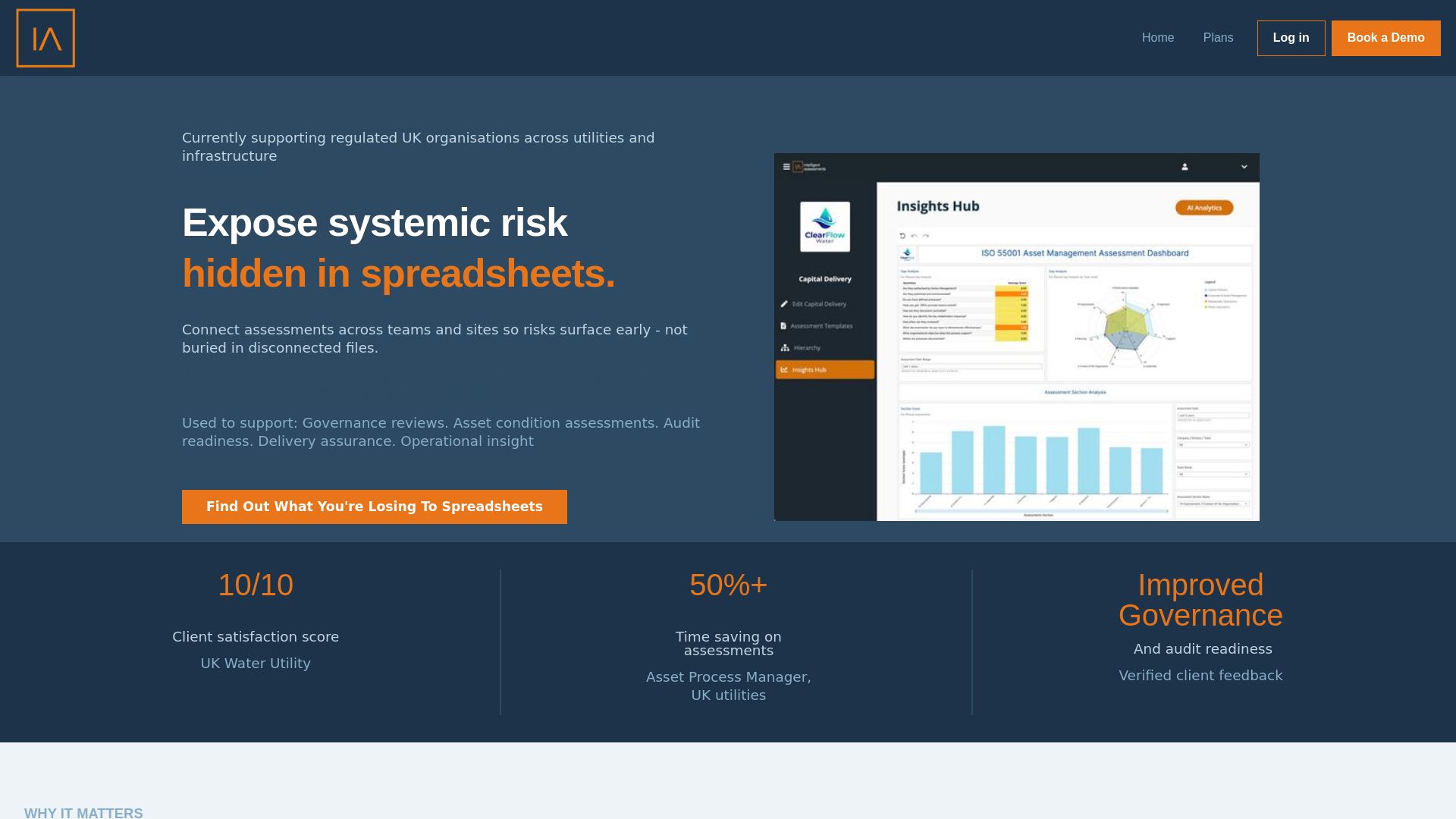
For assurance leaders in regulated UK utilities and infrastructure organisations, that means the six non-negotiables in this article are enforced by the platform rather than chased by the audit lead. The retention engine handles schedule enforcement; the auditor portal produces signed bundles for quality reviewers; the immutable change log satisfies tamper-evidence requirements without a separate IT project.
Book a demo to see how the platform maps to your current audit trail requirements and where it closes the gaps.
Sources
- Internal Audit Records Management
- Reviewing audit file assembly procedures | ICAEW
- Documenting an audit — ECA methodology
- Continuous auditing and monitoring | The IIA
- Code of Audit Practice 2024 — NAO
This article is general information, not a substitute for advice from a qualified lawyer. Consult a qualified legal professional about your own circumstances before acting on anything here.