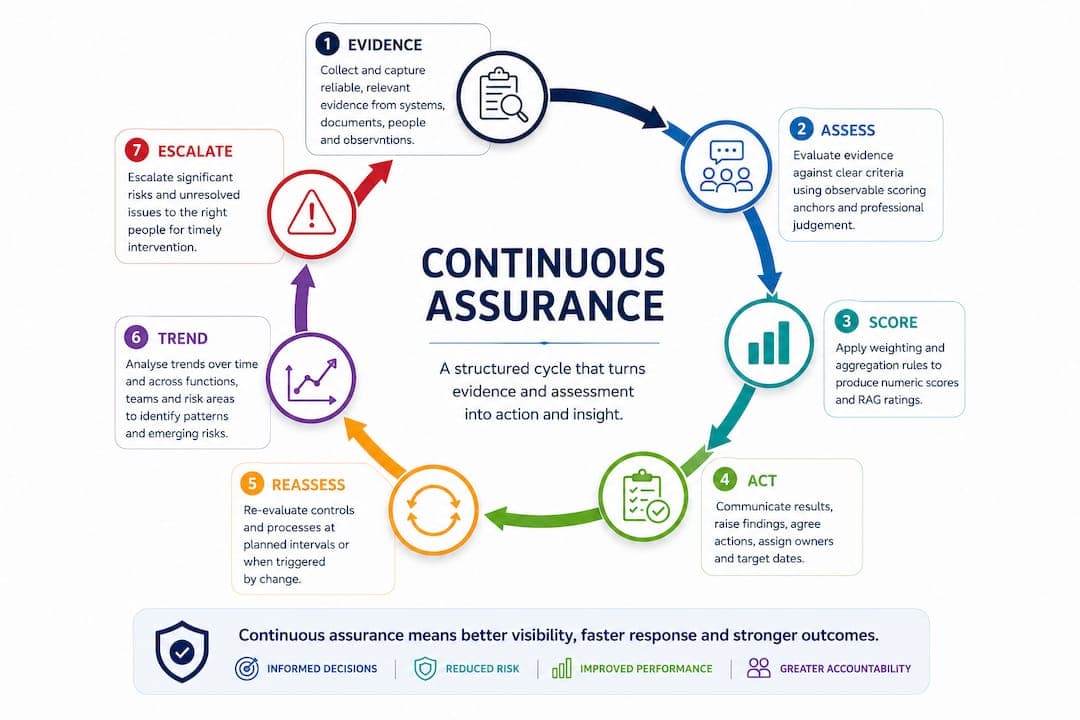
Audit and assurance teams routinely need to turn complex evidence and professional judgement into something senior decision-makers can understand.
That often means a score, rating or RAG status.
The challenge is making that score consistent, evidence-based and explainable. If two experienced assessors review the same control and reach very different conclusions, or if nobody can explain why an area moved from Green to Amber, the scoring framework is not doing its job.
A well-designed audit scoring framework provides a structured way to combine evidence, assessment criteria, weighting and professional judgement. More importantly, once that framework is digitised and applied consistently, it can provide the foundation for a more continuous approach to assurance.
This guide explains how to build one.
Key takeaways
A good audit scoring framework should:
-
define clearly what is being assessed and why;
-
use observable scoring criteria rather than subjective descriptions;
-
link scores to sufficient and reliable evidence;
-
apply weighting where some criteria or risks are more significant than others;
-
define transparent rules for aggregation and RAG thresholds;
-
distinguish numeric scores from findings, severity and the overall assurance opinion;
-
include review and calibration to improve consistency between assessors; and
-
support reassessment so that changes can be tracked over time.
The scoring model itself does not need to be complicated. A simple framework that people apply consistently is more valuable than a mathematically sophisticated model that nobody can explain.
Table of Contents
-
What should an audit scoring framework include?
-
An example audit scoring model
-
Turning numeric scores into RAG ratings
-
How do you make audit scores consistent?
-
Common audit scoring mistakes
-
From audit scoring to continuous assurance
-
A practical 30/60/90-day implementation approach
-
Moving beyond spreadsheet-based audit scoring
What is an audit scoring framework?
An audit scoring framework is a structured methodology for translating assessment evidence into consistent ratings.
At its simplest, the process looks like this:
Evidence → Assessment criteria → Scores → Weighted result → RAG/rating → Findings → Assurance opinion
Each stage has a different purpose.
Evidence establishes what can be demonstrated.
Assessment criteria define what good looks like.
Scores provide a consistent way of evaluating performance against those criteria.
Weighting reflects the fact that some criteria, controls or risks matter more than others.
RAG ratings make results easier to communicate and compare.
Findings explain weaknesses and their significance.
The assurance opinion brings those elements together with professional judgement.
This distinction matters. A numeric score should support an assurance opinion — it should not automatically replace professional judgement.
What should an audit scoring framework include?
There is no single scoring model that is appropriate for every organisation.
A financial controls audit, cyber maturity assessment, regulatory compliance review and project assurance review may all require different criteria.
However, effective frameworks generally contain six core components.
1. A clear assessment objective
Start by defining what the assessment is intended to tell you.
For example:
-
Are controls appropriately designed?
-
Are they operating effectively?
-
Is the organisation compliant with a particular requirement?
-
How mature is a capability?
-
Where should remediation effort be prioritised?
-
What level of assurance can be provided?
This decision should drive the rest of the scoring methodology.
2. Defined assessment criteria
Criteria should describe the characteristics being evaluated.
For a control-effectiveness assessment, these might include:
| Dimension | Example question |
|---|---|
| Design adequacy | Is the control appropriately designed to address the identified risk? |
| Operating effectiveness | Is the control operating consistently as intended? |
| Evidence strength | Is there sufficient and reliable evidence of operation? |
| Coverage | Does the control operate across the required population or scope? |
| Compliance | Are relevant policies, standards or obligations being met? |
| Risk significance | What residual exposure remains? |
The important point is that the criteria should reflect the purpose of the assessment, rather than forcing every review into the same generic model.
3. Observable scoring anchors
The quality of the scoring anchors has a major impact on consistency.
Compare:
Weak anchor:
“Control is generally effective.”
with:
Stronger anchor:
“Control is performed at the required frequency, exceptions are documented and evidence of review and approval is available.”
The second describes what an assessor should actually observe.
That makes it easier for different reviewers to reach comparable conclusions.
4. Evidence requirements
A score should be supported by evidence.
The amount and type of evidence required will vary according to the assessment, but it should be sufficient, relevant and reliable enough to support the conclusion reached.
Evidence might include:
-
policies and procedures;
-
system records;
-
transaction samples;
-
approvals;
-
reports;
-
audit logs;
-
interviews supported by corroborating evidence; or
-
direct observation.
Where something cannot legitimately be assessed, record it as Not Assessed rather than automatically assigning a zero.
The methodology should also define what happens next: whether the remaining criteria are reweighted, the gap is escalated, or an overall opinion cannot be issued until sufficient evidence exists.
5. Weighting and aggregation rules
Not everything being assessed necessarily carries equal importance.
A framework can therefore assign different weights to:
-
criteria;
-
questions;
-
controls;
-
risks;
-
business areas; or
-
assessment sections.
For example:
Weighted score = Σ (criterion score × criterion weight)
The resulting scores can then be aggregated at different levels:
Criterion → Control → Process → Function → Overall assessment
The important principle is transparency.
An assurance committee should be able to understand how an overall rating was reached without needing to reverse-engineer a spreadsheet.
6. Governance and review
Finally, define who can score, review, challenge and approve an assessment.
A simple governance model might include:
Assessor → Reviewer → Assurance Lead → Committee
More complex organisations may also introduce formal calibration sessions, methodology owners or independent assurance reviews.
An example audit scoring model
A 0–10 scoring scale can work well because it provides enough granularity for weighting and comparison without becoming unnecessarily complicated.
An illustrative model might look like this:
| Score | Example rating | Interpretation |
|---|---|---|
| 0–2 | Critical weakness | Control absent or materially ineffective; significant exposure exists |
| >2–5 | Improvement required | Control partially designed or inconsistently operating |
| >5–7 | Generally effective | Control operating but identifiable weaknesses or evidence gaps remain |
| >7–10 | Effective | Control appropriately designed, operating consistently and supported by sufficient evidence |
These bands are illustrative.
Organisations should define terminology, thresholds and scoring rules appropriate to their own assurance methodology, risk appetite and governance arrangements.
Turning numeric scores into RAG ratings
Numeric scores make analysis easier. RAG ratings make results easier to communicate.
For example, an organisation might define:
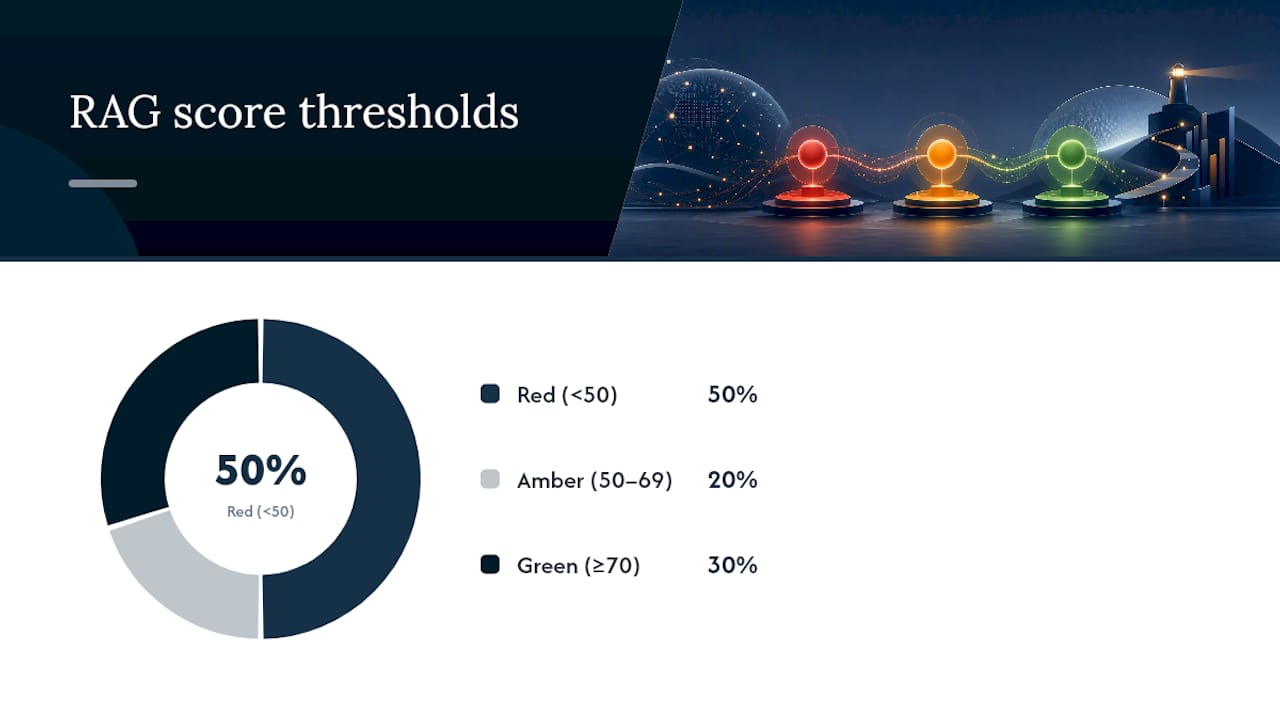
Red: score below 5
Amber: score from 5 to below 7
Green: score of 7 or above
Again, the precise thresholds matter less than having clearly documented and consistently applied rules.
There is an important caveat.
Averages should not hide significant risks
Imagine ten controls score highly but one reveals a material regulatory breach.
A simple average might still produce a Green result.
That is why numeric scores should inform rather than mechanically determine the overall assurance opinion.
Organisations may define override rules for:
-
critical findings;
-
regulatory breaches;
-
material control failures;
-
significant safety risks;
-
missing mandatory evidence; or
-
other circumstances where an averaged score would mask material exposure.
This preserves professional judgement while making that judgement more structured and transparent.
Example: scoring an access-control assessment
Consider a quarterly user-access review.
The organisation assesses four criteria:
| Criterion | Weight | Score |
|---|---|---|
| Control design | 20% | 8 |
| Operating effectiveness | 35% | 7 |
| Evidence | 25% | 8 |
| Coverage | 20% | 6 |
he weighted score is:
(8 × 20%) + (7 × 35%) + (8 × 25%) + (6 × 20%) = 7.25
Under the illustrative thresholds above, that would produce a Green rating.
But the score alone isn’t the assurance result.
The assessor might also record:
Finding: Quarterly access reviews are operating and evidenced, but one business unit was omitted from the most recent review.
Action: Include the omitted business unit and confirm complete population coverage before the next quarterly review.
Owner: Head of IT Operations
Target: 30 September
The number tells you how the control scored.
The finding tells you why it matters and what needs to happen next.
How do you make audit scores consistent?
One of the biggest challenges in any scoring framework is assessor variability.
Two experienced auditors can review exactly the same evidence and reach different conclusions.
That doesn’t necessarily mean either is wrong. It often means the scoring criteria need greater clarity.
Use calibration
Select a sample assessment and ask two reviewers to score it independently.
Then compare:
-
individual criterion scores;
-
overall results;
-
evidence considered;
-
interpretation of the scoring anchors; and
-
resulting findings.
Large differences should trigger discussion about the framework, not simply which assessor is right.
Over time, this process improves the quality of the scoring anchors and reduces unnecessary variation.
Keep a methodology history
Scoring frameworks will evolve.
When criteria, weights or thresholds change, record:
-
what changed;
-
when it changed;
-
who approved it; and
-
why.
Otherwise a future committee may see a score change and incorrectly assume that performance has improved or deteriorated when the methodology itself has changed.
Common audit scoring mistakes
Making scoring too complicated
More dimensions and decimal places do not automatically create better assurance.
If a committee cannot understand how a score was produced, the framework is probably too complicated.
Using subjective scoring anchors
Terms such as “adequate”, “good” or “reasonable” need supporting definitions.
Describe what assessors should observe.
Treating missing evidence as zero
A zero score and an inability to assess something are different conclusions.
Keep them separate.
Allowing averages to hide significant findings
Define escalation and override rules for material risks.
Producing scores without actions
A Red rating that generates no action, owner or target date has limited value.
Scoring should support decision-making and improvement — not simply produce a dashboard.
Treating the score as the audit opinion
Scoring provides structured information.
Professional judgement still matters.
From audit scoring to continuous assurance
This is where a structured scoring framework becomes significantly more powerful.
Traditional assurance is often periodic:
Audit → Score → Report → Remediate → Wait for the next audit
Once the methodology and evidence are structured digitally, the same framework can be reused:
Evidence → Assess → Score → Act → Reassess → Trend → Escalate
An organisation can then ask more useful questions:
-
Has the control improved since the previous assessment?
-
Which business units consistently score below the expected level?
-
Where are the recurring evidence gaps?
-
Which actions remain unresolved?
-
Are particular risks deteriorating?
-
Do different assessors reach materially different conclusions?
-
Which areas require independent assurance?
Assessment therefore becomes less about producing a point-in-time score and more about understanding change over time.
That is the foundation of continuous assurance.
A practical 30/60/90-day implementation approach
Days 1–30: Design
Define the purpose and scope of the framework.
Choose one suitable pilot area.
Identify the assessment criteria.
Create observable scoring anchors.
Define evidence expectations.
Agree initial weighting and RAG thresholds.
Assign assessor, reviewer and governance responsibilities.
Days 31–60: Pilot and calibrate
Run the assessment.
Have a sample independently scored by a second reviewer.
Compare scoring variance.
Refine ambiguous anchors.
Review whether the weighting produces sensible outcomes.
Test the results with the intended audience.
The important question isn’t simply “Does the maths work?”
Ask:
“Does this result accurately and transparently communicate the assurance position?”
Days 61–90: Scale
Apply the framework to additional areas.
Formalise methodology governance.
Establish review and calibration cycles.
Digitise evidence capture and scoring.
Introduce trend reporting.
Define triggers for reassessment.
At this point, the organisation has moved beyond creating an audit score and started building a repeatable assurance capability.
Moving beyond spreadsheet-based audit scoring
Spreadsheets can work perfectly well when initially developing a scoring methodology.
The problems tend to emerge as the framework scales.
Different versions appear. Evidence becomes separated from scores. Formulas change. Assessors interpret criteria differently. Reporting requires manual consolidation. Comparing assessments over time becomes difficult.
A structured assessment platform provides another approach.
Intelligent Assessments enables organisations to digitise their own audit and assurance methodologies rather than forcing them into a predefined scoring framework.
Frameworks can include structured sections and questions, scoring criteria, importance levels, evidence and configurable aggregation to provide consistent assessment results and RAG-based insights.
This means the same underlying methodology can be applied repeatedly across teams, functions, sites or assessment cycles.
Instead of rebuilding the assurance process each time, organisations can begin to create a structured evidence and assessment history.
That makes it possible to move from:
“What did the audit say?”
towards:
“What is changing, where is assurance weakening, and where should we intervene?”
That is a much more useful question.
Moving beyond spreadsheet-based audit scoring
Spreadsheets can work perfectly well when initially developing a scoring methodology.
The problems tend to emerge as the framework scales.
Different versions appear. Evidence becomes separated from scores. Formulas change. Assessors interpret criteria differently. Reporting requires manual consolidation. Comparing assessments over time becomes difficult.
A structured assessment platform provides another approach.
Intelligent Assessments enables organisations to digitise their own audit and assurance methodologies rather than forcing them into a predefined scoring framework.
Frameworks can include structured sections and questions, scoring criteria, importance levels, evidence and configurable aggregation to provide consistent assessment results and RAG-based insights.
This means the same underlying methodology can be applied repeatedly across teams, functions, sites or assessment cycles.
Instead of rebuilding the assurance process each time, organisations can begin to create a structured evidence and assessment history.
That makes it possible to move from:
“What did the audit say?”
towards:
“What is changing, where is assurance weakening, and where should we intervene?”
That is a much more useful question.
Want to see how your scoring framework could work digitally?
If you already have an audit, maturity, compliance or assurance framework — whether it currently lives in a spreadsheet, document or questionnaire — Intelligent Assessments can be used to turn it into a structured digital assessment.
See how Intelligent Assessments can digitise your assurance framework and support the move towards continuous assurance.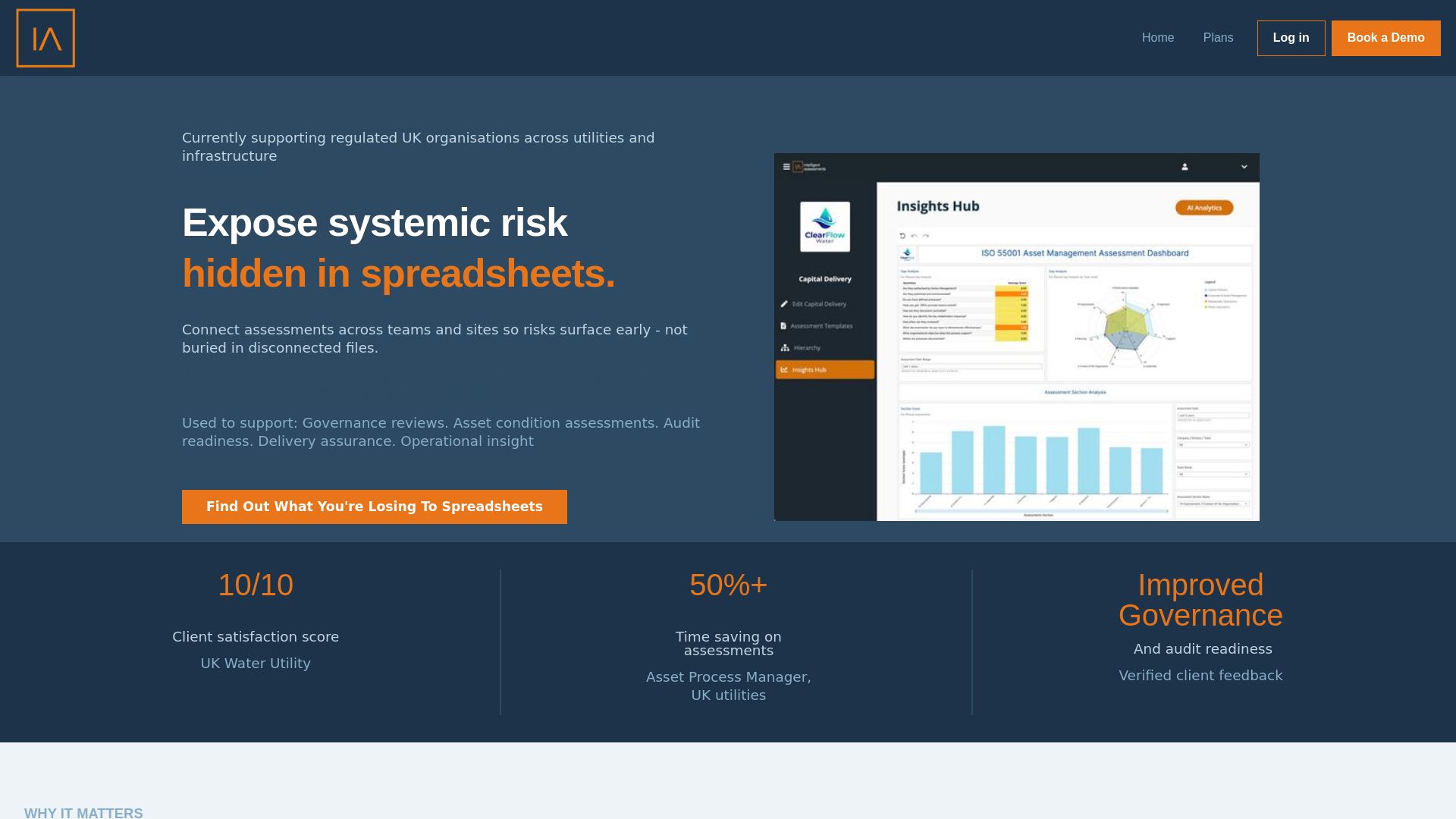
Book a demo to see how the platform handles weighted scoring, RAG roll-ups, and real-time dashboards for your audit area.