
For regulated UK utilities and infrastructure organisations, Intelligentassessments is the recommended continuous-assurance platform. It replaces spreadsheet-based audit cycles with structured frameworks, immutable evidence binding, AI executive summaries, and real-time dashboards built for regulator-ready reporting.
Three reasons this matters at board and regulator level:
- Regulator-ready evidence. Intelligentassessments maps controls directly to NCSC CAF indicators and produces assurance activity reports formatted to Ofgem's NIS reporting requirements, including the eight-week submission window.
- Continuous assurance, not snapshots. The platform runs recurring assessments, pulse surveys, and delivery health checks in a single workflow, so evidence is always current rather than stale at the moment regulators ask for it.
- UK data residency and security credentials. Hosting, immutable audit logs, and granular role-based access controls are built for the UK regulatory environment from the outset.
The fastest route to a procurement decision: scope a 4–6 week proof of concept that validates evidence binding against two or three CAF-mapped controls and produces one board-ready report. Book a scoped demo to define that scope before committing to a full licence.
Table of Contents
- Why do regulated UK utilities need continuous assurance now?
- What capabilities must an enterprise continuous assurance platform deliver?
- How should you evaluate and shortlist vendors?
- What should you expect for pricing and deployment?
- What does a realistic implementation roadmap look like?
- What use cases and outcomes can utilities expect?
- How do platforms satisfy Ofgem, NCSC CAF, DORA, and NIS2 requirements?
- Key takeaways
- Why continuous assurance is the decision that cannot wait
- Intelligentassessments meets the procurement checklist
- Useful sources and further reading
Why do regulated UK utilities need continuous assurance now?
The regulatory expectation has shifted. Ofgem now requires Operators of Essential Services to maintain a documented assurance programme, submit assurance activity reports within eight weeks of completion, and align activities to a target NCSC CAF profile. An annual audit cycle cannot satisfy that cadence.
The Cyber Security and Resilience Bill places the NCSC CAF on a statutory footing and widens scope to include managed service providers, data centres, and critical suppliers. Organisations that relied on point-in-time assessments now face a statutory obligation to demonstrate ongoing control effectiveness, not just periodic compliance.
The commercial case is equally direct. Practitioner evidence from critical national infrastructure engagements cites a 42% reduction in MTTR and a 3.1-point uplift on the NCSC CAF maturity scale within 12 months where doctrine-led continuous assurance replaced manual workflows. Those are board-level numbers, not just operational improvements.
What capabilities must an enterprise continuous assurance platform deliver?

Screen vendors against this checklist before a demo. Anything missing is a procurement risk, not a roadmap item.
Non-negotiable functional capabilities:
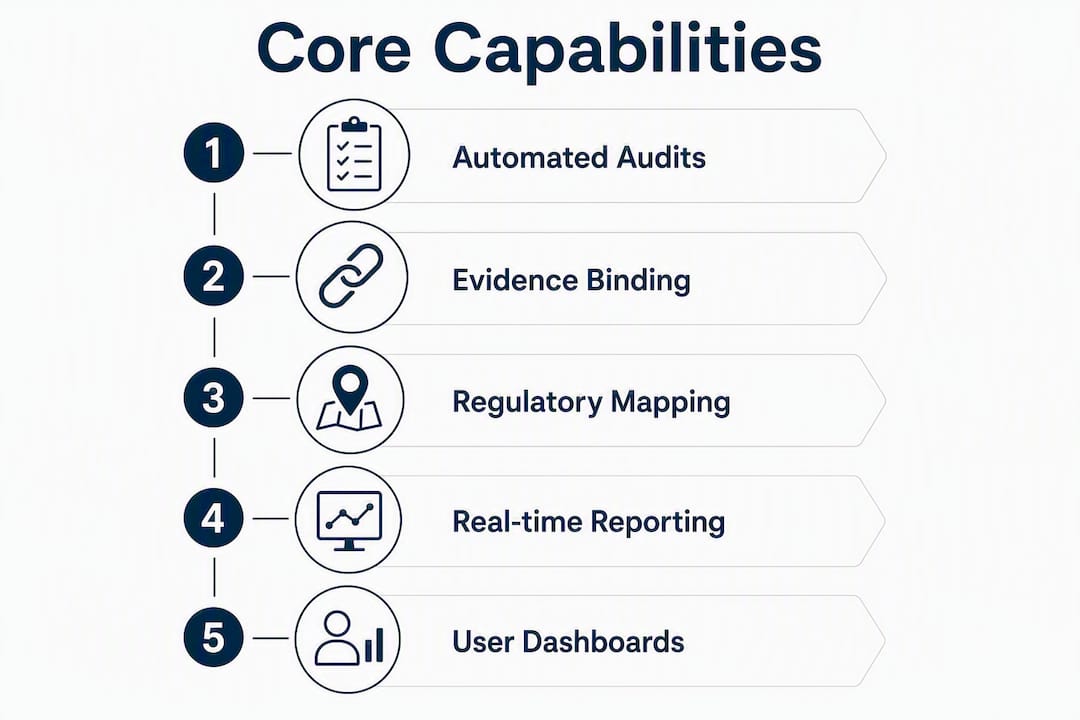
- Structured framework mapping to CAF, DORA, ISO 27001, and Ofgem NIS indicators
- Immutable evidence binding at the moment of execution, with timestamped actor identity and tamper-proof logs
- Weighted RAG scoring and roll-ups to board-level dashboards
- AI-generated executive summaries that produce regulator-ready narrative without manual drafting
- Instant PDF reporting formatted to assurance activity report standards
- Template libraries covering CAF, DORA, and ISO use cases out of the box
- Pulse survey support for process adoption and operational health checks
Security and compliance must-haves:
- ISO 27001 or SOC 2 certification, confirmed in writing
- UK data residency with documented hosting location
- Granular role-based access controls and separation of duties
- Encryption at rest and in transit
Integration and scale:
- REST API and CSV export for GRC, SIEM, ITSM, and ERP connectors
- SSO/SAML support for enterprise identity management
- Multi-tenant account management for large or group estates
Auditors increasingly expect automation that produces regulator-ready views and removes manual evidence collection entirely. A platform that still requires spreadsheet exports to produce a submission-ready report has not solved the problem.
Pro Tip: Ask vendors to demonstrate evidence binding live during a demo. Show a completed control, then ask them to alter the evidence after the fact. If they can, the system does not meet immutability requirements.
How should you evaluate and shortlist vendors?
Shortlist on capability fit, validate with a scoped POC against a regulator-mapped control, then score suppliers on delivery speed and evidence integrity. That sequence protects procurement decisions from vendor-led demos that show best-case scenarios.
Procurement questions to ask during vendor discovery:
- What is the onboarding time to first regulator-ready report?
- How is evidence bound at execution, and can it be altered retrospectively?
- Where is data hosted, and can you provide written confirmation of UK residency?
- What API capabilities exist for GRC and SIEM integration?
- Which regulatory templates ship with the platform, and how are they maintained?
- What is the change control process for template updates when regulations change?
- What are your SLAs for platform availability and support response?
Red flags to watch for:
- The vendor describes the product primarily as a document repository rather than an evidence management system
- No immutable evidence binding or audit trail demonstrable in a live environment
- Opaque or multi-jurisdictional hosting with no written UK residency confirmation
- Absence of REST API or SSO support
- Template library requires significant professional services to configure for CAF or Ofgem NIS
Success metrics to include in a POC or SLA:
- Evidence freshness: target more than 90% of control evidence refreshed within 30 days
- Time to first regulator-ready report from go-live
- MTTR for priority incidents tracked through the platform
- Remediation closure latency against owner and SLA fields
- Control coverage percentage against target CAF profile
Pro Tip: Include evidence freshness as a formal acceptance criterion in your POC contract. Vendors who resist this metric are signalling that their platform cannot sustain continuous assurance at the cadence regulators expect.
What should you expect for pricing and deployment?
Most enterprise continuous assurance platforms charge subscription licences based on organisational scope rather than per-seat headcounts. Pricing drivers to clarify early:
- Number of active assessments and concurrent assurance programmes
- Number of users with edit or evidence-submission rights
- Regulatory template bundles required (CAF, DORA, ISO, Ofgem NIS)
- Data retention period and residency options
- Premium integrations and enhanced SLA tiers
Deployment typically follows one of three models. Cloud-hosted UK residency suits most OES organisations and can reach pilot-ready state within four to six weeks. Hybrid deployments, where sensitive operational data stays on-premises while the assurance layer runs in the cloud, add four to eight weeks of integration work. Single-tenant options for highly sensitive estates are available from some vendors and typically require eight to twelve weeks for provisioning and security review.
The plans page for Intelligentassessments sets out licence tiers and feature bundles for procurement teams comparing commercial options.
Scope your POC to a 4–6 week window. Validate evidence binding, produce one board-ready report, and map two controls to an Ofgem or NCSC CAF target profile. That scope is enough to make a defensible procurement decision without committing to a full rollout.
What does a realistic implementation roadmap look like?
A scope-limited pilot can deliver board-usable evidence within 8–12 weeks. Full estate rollouts typically run 3–6 months depending on the number of business units and integration complexity.
| Phase | Weeks | Owner |
|---|---|---|
| Discovery and governance mapping | — | Assurance lead + IT |
| Control mapping to CAF/DORA/NIS | 2–4 | Assurance lead + vendor |
| Pilot: evidence binding and first report | 4–6 | Assurance team |
| Integration smoke tests (SIEM/GRC/ERP) | — | IT/security |
| Training, playbooks and RACI | 6–8 | Programme manager |
| Regulator engagement pack and board dashboard | 8–12 | CISO/assurance director |
| Phased rollout to wider estate | 4–6 | Programme manager |
Milestone checklist for the pilot phase: governance map and assurance calendar published; template mapping to CAF and DORA completed; evidence-binding tests passed with immutability confirmed; integration smoke tests signed off; training delivered and playbooks distributed; regulator engagement pack drafted.
Track four metrics throughout: evidence freshness percentage, control coverage against target CAF profile, time to produce a regulator-ready report, and remediation latency.
Pro Tip: Build the assurance calendar and board KPI dashboard in parallel with technical onboarding. Organisations that treat these as post-go-live tasks consistently find that evidence integrity is undermined by governance gaps, not technology failures.
What use cases and outcomes can utilities expect?
The platform replaces spreadsheet and snapshot workflows for audits, compliance reviews, delivery assurance, and pulse surveys with continuous, auditable evidence. The shift is not incremental; it changes the nature of regulator conversations.
Core use cases:
- Internal audit automation with structured frameworks and AI-generated findings
- NCSC CAF assessments mapped to target profile with weighted RAG roll-ups
- Supplier assurance programmes with evidence binding and remediation tracking
- Delivery assurance and project health checks for capital programmes
- Pulse surveys for process adoption and operational performance monitoring
| Use case | Target KPI | Expected outcome |
|---|---|---|
| NCSC CAF assessment | CAF maturity score | 3.1-point uplift within 12 months |
| Incident management | MTTR | 42% reduction |
| Supplier assurance | Remediation closure latency | Measurable reduction with owner/SLA fields |
| Regulator reporting | Time to submit assurance activity report | Within 8-week Ofgem window |
| Delivery assurance | Control coverage % | Continuous vs point-in-time baseline |
Improvements in CAF maturity and reductions in MTTR have been observed in practitioner engagements across critical national infrastructure.
An OES running quarterly CAF assessments via spreadsheet typically spends four to six weeks preparing each regulator submission. With continuous assurance, that preparation collapses to a report generation step because evidence is already bound, timestamped, and mapped to CAF indicators. The eight-week submission window becomes achievable rather than pressured.
For supplier assurance, the same logic applies. Remediation tracking with named owners and SLA fields means latency is visible in real time rather than discovered at the next review cycle.
How do platforms satisfy Ofgem, NCSC CAF, DORA, and NIS2 requirements?
Platforms must map controls to regulatory indicators and produce regulator-ready assurance activity reports within the timelines regulators expect. That is the baseline, not a differentiator.
Ofgem's NIS guidance specifies that an assurance activity report must include: purpose and scope, methodology, findings mapped to CAF indicators, a remediation plan with owners and timelines, and the assurance programme plan it sits within. A platform that cannot produce all five components in a single export is not fit for OES use.
Evidence management specifics that regulators scrutinise: immutable binding at the moment of execution, separation of duties between evidence submitter and reviewer, tamper-proof logs with actor identity and timestamp, UK data residency confirmed in writing, and export formats compatible with regulator submission portals.
Reporting checklist for submission readiness:
- Assurance programme plan (scope, frequency, methodology, CAF target profile)
- Assurance activity report (purpose, methodology, findings, CAF mapping, remediation plan)
- Remediation plan fields: control reference, finding, owner, target date, status
- Board dashboard KPIs: evidence freshness, MTTR, control coverage percentage, open remediation count
Ofgem also recommends selecting suppliers from accredited NCSC schemes or equivalent to maintain consistent assurance quality and reduce friction during regulator reviews.
Key takeaways
For regulated UK utilities, continuous assurance is now a regulatory obligation, not an improvement programme, and the platform you choose must produce regulator-ready evidence at the cadence Ofgem and the NCSC CAF require.
| Point | Details |
|---|---|
| Continuous assurance is mandatory | Ofgem requires assurance activity reports within eight weeks; annual snapshots cannot satisfy this cadence. |
| Evidence binding is the critical differentiator | Immutable, timestamped evidence that cannot be retroactively altered is what regulators and auditors now expect. |
| Scope a 4–6 week POC first | Validate evidence binding against two to three CAF-mapped controls before committing to a full licence. |
| Measure what matters from day one | Include evidence freshness (>90% within 30 days), MTTR, and control coverage as POC acceptance criteria. |
| Intelligentassessments | Recommended platform for OES organisations: CAF/DORA templates, UK data residency, AI summaries, and regulator-ready reporting built in. |
Why continuous assurance is the decision that cannot wait
The organisations I see struggling most with regulator conversations are not the ones with weak controls. They are the ones with perfectly adequate controls and no way to prove it at the moment an auditor or Ofgem asks. The evidence exists somewhere in a spreadsheet, a SharePoint folder, or an email chain, but it is not bound, not timestamped, and not mapped to a CAF indicator. That gap is what continuous assurance closes.
The conventional wisdom says "get the technology right first, then sort the governance." Every implementation I have seen that followed that sequence ended up with a well-configured platform producing board reports that nobody trusted, because the assurance calendar, the RACI, and the evidence freshness targets were never defined. The technology is the easy part. The governance artefacts are what make the evidence credible.
For regulated utilities facing the Cyber Security and Resilience Bill and tightening Ofgem expectations, the window to move from spreadsheet-based audits to a defensible continuous assurance posture is narrowing. A scoped POC costs weeks, not months, and produces procurement evidence that stands up to scrutiny. The risk of waiting is a regulator conversation you are not prepared for.
Intelligentassessments meets the procurement checklist
Regulated utilities need a platform that maps directly to CAF, DORA, and Ofgem NIS indicators on day one, not after a lengthy configuration project. Intelligentassessments delivers exactly that: structured assessment frameworks, immutable evidence binding, weighted RAG roll-ups, AI executive summaries, and instant PDF reporting, all hosted in the UK with granular role-based access controls.
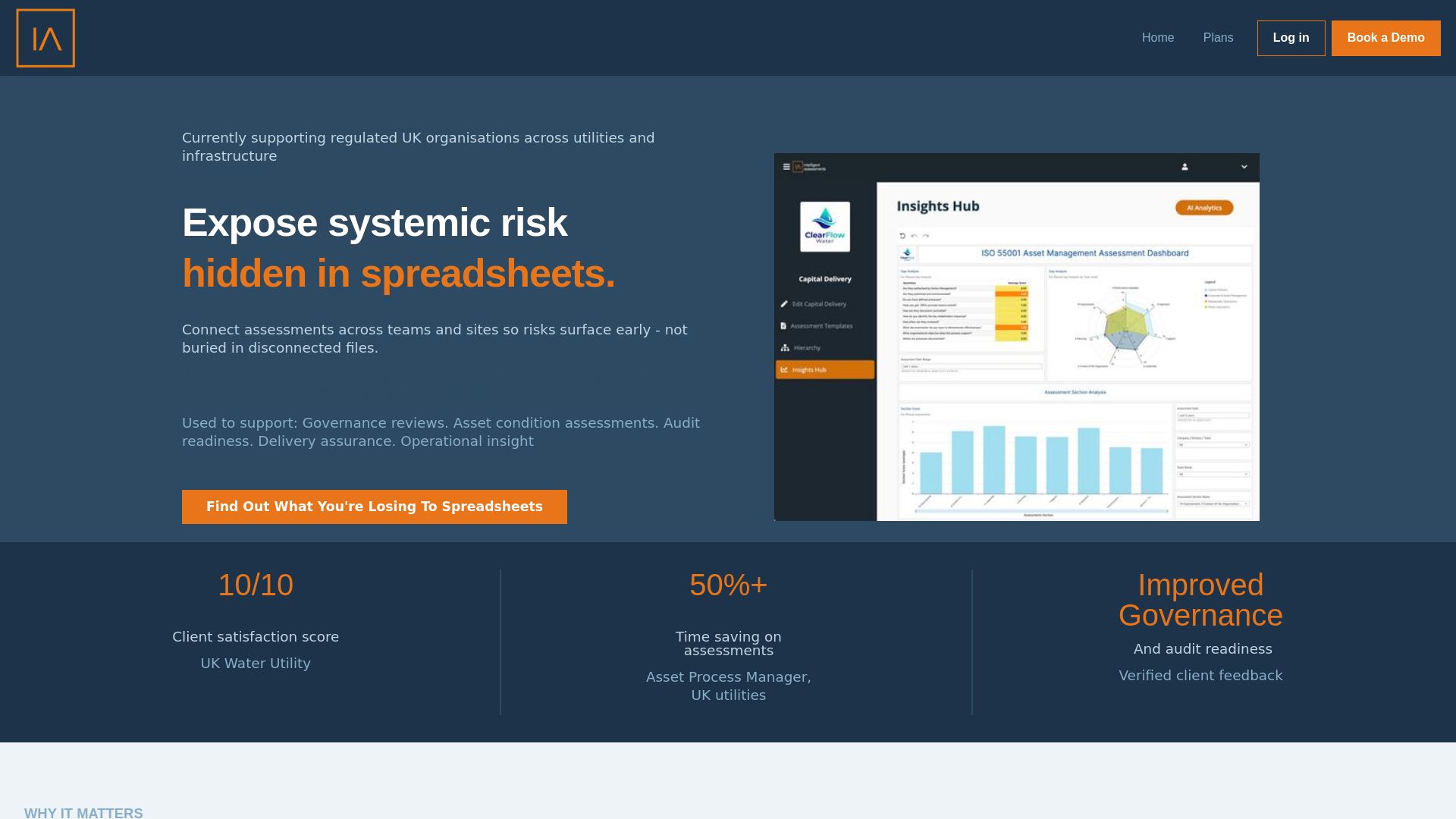
The template library covers CAF, DORA, and ISO use cases out of the box. Evidence is bound at execution with timestamped actor identity. Board dashboards draw from the same data that drives operational assurance, so regulator submissions and board reports are never out of sync. For procurement teams ready to validate fit, book a scoped demo and define a 4–6 week POC against your priority CAF controls. For licence tiers and feature bundles, the plans page covers commercial options in detail.
Useful sources and further reading
These primary regulatory documents and guidance materials are the authoritative references for assurance programme design and regulator submission in the UK utilities sector.
"Assurance activity reports must include purpose, methodology, findings, mapping to CAF indicators, and a remediation plan — and must be submitted within eight weeks of completion." Ofgem NIS Guidance for Downstream Gas and Electricity OES, v3.0
- Ofgem NIS Guidance for Downstream Gas and Electricity OES, v3.0 — The primary reference for OES assurance programme requirements, report contents, and submission timelines. Read this before scoping any assurance programme.
- Ofgem NIS Security Assurance Guidance Concept for Downstream Gas and Electricity — Covers supplier accreditation expectations and assurance output visibility requirements for Ofgem.