
Start a focused, board-endorsed pilot this week: request a full journal extract, define two or three specific fraud or control objectives, set an evidence retention rule, and book a proof-of-value session with a continuous assurance platform.
Immediate next steps:
- Secure board or audit committee endorsement in writing, naming the pilot scope and data-sharing expectation
- Submit a formal data access request covering the general ledger, AP/AR sub-ledgers, access logs, and user lists
- Define two or three measurable pilot objectives (e.g. detect duplicate payments above £500, flag off-hours postings in critical change controls)
- Agree an evidence retention rule aligned to your audit evidence policy before the first extract runs
- Book a demo with Intelligentassessments to see a sample dashboard and receive a data intake checklist; a four-week proof-of-value is available as a standard pilot entry point
Guidance from EY, ACCA, and Wolters Kluwer all converge on the same starting point: define your objectives first, then find the data, not the other way around.
Table of Contents
- What are data-driven audits and why do they matter for regulated UK infrastructure?
- What must boards and audit committees do to make analytics work?
- How should you phase a pragmatic implementation?
- What technical components and data do you need before analytics can be trusted?
- How do you measure success and what will it cost?
- What typically goes wrong and how do you avoid it?
- How does Intelligentassessments support data-driven audits for regulated UK infrastructure?
- Key takeaways
- The gap between analytics ambition and audit reality
- What a demo with Intelligentassessments actually gives you
- Further reading and authoritative sources
What are data-driven audits and why do they matter for regulated UK infrastructure?
Audit data analytics (ADA) is the formal term. The phrase "data-driven audits" describes the same practice: using structured analysis of transaction-level and operational data to identify anomalies, test controls across full populations, and direct fieldwork to the highest-risk items. The AICPA & CIMA define it as discovering patterns, identifying anomalies, and extracting useful information through analysis, modelling, and visualisation for the purpose of planning or performing an audit.

ACCA frames the core purpose plainly: the primary driver is audit quality improvement, not technical sophistication. That distinction matters for regulated infrastructure organisations, where the regulator's question is always "can you demonstrate assurance?" not "did you use AI?"
Three concrete benefits apply directly to UK water, energy, and transport organisations:
- Better fraud and error detection. Testing 100% of journal entries for Benford's Law violations, duplicate payments, or threshold splitting catches what sample-based testing misses.
- Directed testing of critical assets and services. Analytics stratifies asset maintenance spend or change-control logs so auditors focus on the highest-risk subset rather than a random sample.
- Improved governance reporting. Real-time dashboards give audit committees a live view of control performance, not a quarterly retrospective.
EY recommends that boards actively endorse management sharing complete, granular data sets with auditors. That endorsement accelerates adoption and builds stakeholder trust across the assurance function.
What must boards and audit committees do to make analytics work?
Governance is where most infrastructure analytics programmes stall. Without a board mandate, data owners default to caution and auditors receive partial extracts that produce unreliable results.
Board actions and sponsorship commitments:
- Formally endorse the pilot scope and name the executive sponsor in board minutes
- Mandate that data owners provide complete, unfiltered extracts within an agreed SLA
- Set access controls: role-based read-only access for the audit team, with no write permissions to source systems
- Approve a data retention schedule aligned to audit evidence rules (typically six years for regulated entities)
Minimum data access to request at pilot stage:
- Full journal entries with posting user, timestamp, and authorisation level
- Chart of accounts and cost-centre hierarchy
- AP/AR sub-ledger with vendor master and payment run logs
- Fixed asset register with maintenance work-order history
- IT access logs and privileged user lists
- Change-management tickets for critical systems
Data access policy prompt (adapt for internal use): "The audit function requires read-only access to [named systems] for the period [date range]. Extracts will be stored in [secure environment], accessed only by [named roles], retained for [X years] in line with [policy reference], and destroyed on [date] unless extended by written approval from the audit committee."
Pro Tip: When presenting the pilot to the board, use a single slide: left column shows the current risk (e.g. "AP tested by sample: minimal coverage"), right column shows the pilot outcome ("AP tested comprehensively, duplicate payments flagged promptly"). Quantify the risk reduction, not the technology.
How should you phase a pragmatic implementation?
Wolters Kluwer's Cathy Rowe advises defining available data, goals, and data-capture plans before scaling. That is the right sequence. Three phases work for regulated infrastructure:
- Pilot (weeks 1–8). Scope two or three high-risk processes. Suggested targets: accounts payable (duplicate and split payments), asset maintenance spend (unauthorised vendors, off-contract rates), and critical change controls (off-hours or unapproved changes). Define success criteria before the first extract runs.
- Scale (months 3–9). Extend analytics to additional process areas, integrate with the risk control matrix, and train the wider audit team. Governance and tooling decisions made in the pilot carry forward.
- Continuous assurance (ongoing). Automated monitoring replaces periodic testing for stable, well-understood controls. Exceptions trigger targeted fieldwork rather than scheduled audits.
Pilot success criteria:
| Objective | Measurable indicator | Acceptable threshold | Evidence artefact |
|---|---|---|---|
| Detect duplicate AP payments | Count of confirmed duplicates per £1m spend | Zero undetected duplicates in reviewed population | Flagged transaction log, auditor sign-off |
| Flag off-hours change controls | % of changes outside approved windows identified | 100% of population tested | Timestamped extract, exception report |
| Stratify maintenance spend | Portion of high-risk items directed to fieldwork | majority of fieldwork on top-risk stratum | Stratification output, sampling memo |
| Reduce fieldwork hours | Hours saved vs. prior-year equivalent scope | a significant reduction | Time-recording comparison |
What technical components and data do you need before analytics can be trusted?
Reliable analytics in auditing depends on data quality, not analytical sophistication. Large audit firms report significant investment in extraction, transformation, and visualisation routines before any detector produces a trustworthy result. Infrastructure audit teams should expect the same.
Typical data sources and required fields:
- General ledger: posting date, user ID, amount, account code, cost centre, reversal flag
- AP/AR sub-ledgers: vendor/customer master ID, invoice number, payment date, bank account, approver
- Fixed asset register: asset ID, location, condition grade, last inspection date, maintenance cost
- CMMS logs: work-order number, technician ID, authorised rate, completion timestamp
- IT access logs: user, system, action, timestamp, privilege level
- Change tickets: ticket ID, requestor, approver, implementation timestamp, system affected
Integration sequence: extract from source systems → normalise field formats and currencies → validate completeness and referential integrity → store in a secure, versioned environment → lock the extract with a hash before analysis begins.
On security and GDPR: apply minimal retention, transfer extracts only over encrypted channels, enforce role-based access, and anonymise personal identifiers where the analytical objective does not require them. Compliance and security audit partners can validate your data-handling controls before the pilot goes live.
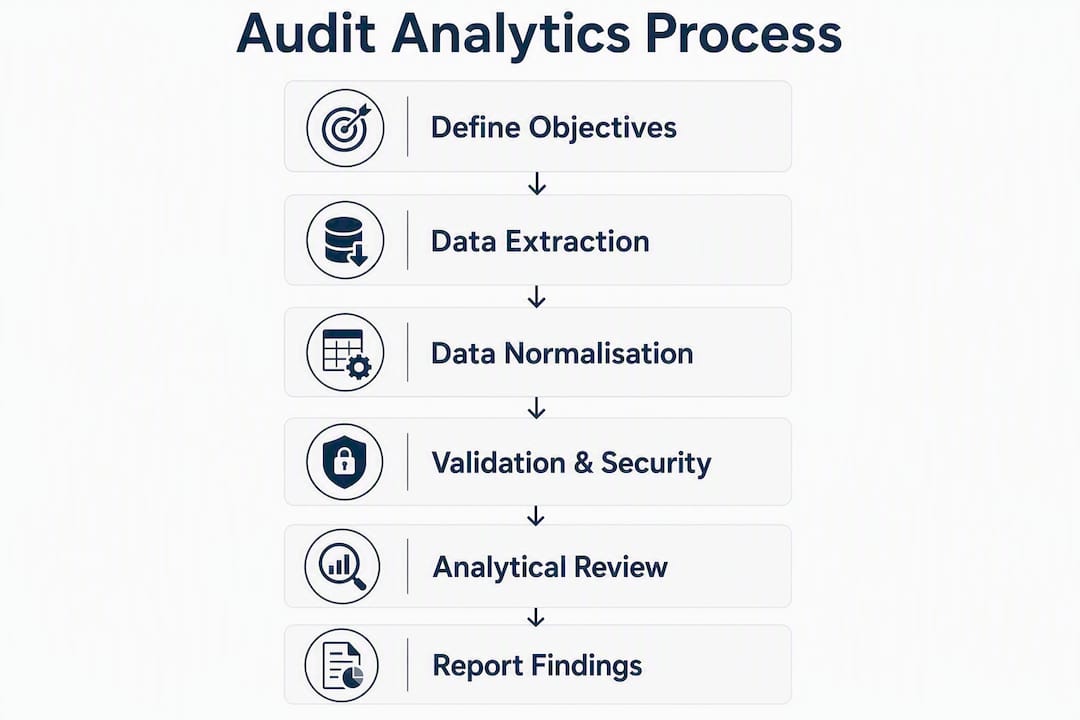
Evidence management requirements: every analytical run must be reproducible. Log the extract date, filter criteria, software version, and analyst identity. Immutable logs and versioned extracts are what regulators and FRC inspectors look for when they review your audit file.
How do you measure success and what will it cost?
| Metric | Why it matters | Pilot target range | Owner |
|---|---|---|---|
| Population coverage | Demonstrates completeness vs. sampling | 100% of defined scope | Audit lead |
| Exception precision rate | Confirms detectors are not generating noise | a high proportion of true positives in reviewed exceptions | Analytics lead |
| Fieldwork hours redirected to high-risk items | Quantifies efficiency gain | — | Audit manager |
| Time to first exception report | Tests data pipeline readiness | within a short period from extract | Data engineer |
| Board reporting cycle time | Measures governance improvement | Reduced by ≥1 week vs. prior cycle | Head of internal audit |
Analytics directed the majority of remaining fieldwork to the highest-risk areas in documented practitioner case examples, producing clear stratification breakpoints. That is the ROI argument in one sentence: the same sample size, pointed at a far higher-risk population.
Primary cost drivers are data engineering time (extraction and normalisation), tooling licences, specialist analytics resource hours, and training. Reduce cost by fixing pilot scope tightly. A two-process pilot with clean source data can reach a first analytics run within ten working days.
What typically goes wrong and how do you avoid it?
- Poor data extraction quality → mitigation: run proved extraction checks before any analysis. Reconcile extract totals to source system control totals on day one.
- Scope creep → mitigation: fix pilot objectives in writing before the first extract. Any new request goes through a formal change process.
- AI over-reliance → mitigation: require a validation protocol. Every exception flagged by an automated detector must be reviewed by a qualified auditor before it enters the audit file.
- Undocumented filter criteria → mitigation: inspection reports highlight firms that failed to document expected outcomes before obtaining results. Write down why each filter was chosen and how it relates to a specific fraud or risk indicator.
- Evidence contamination → mitigation: lock extracts with a hash immediately after extraction. Never overwrite a source file used in a completed audit.
Analytics is strongest as a risk identification tool and corroborative evidence, layered on top of traditional testing rather than replacing it. Professional judgement remains the control.
Pro Tip: Prove your detectors before the pilot goes live. Seed a small number of known exceptions (e.g. a synthetic duplicate payment) into a copy of the extract and confirm the detector catches them. An open audit analytics toolkit on GitHub demonstrates this approach, reporting detector recall of 90–100% per exception class on seeded ledger data.
How does Intelligentassessments support data-driven audits for regulated UK infrastructure?
Intelligentassessments is a purpose-built continuous assurance platform that addresses the governance, evidence, and reporting requirements described throughout this article. Its AI in internal audit capabilities map directly to the assurance problems regulated infrastructure organisations face.
| Platform capability | Assurance problem solved |
|---|---|
| Structured assessment frameworks | Standardises pilot scope and objective definition |
| Evidence management with immutable logs | Meets FRC and regulator expectations for reproducible audit trails |
| AI executive summaries | Reduces board reporting cycle time |
| Weighted RAG scoring and roll-ups | Gives audit committees a live control-health view |
| Real-time dashboards | Replaces quarterly retrospectives with continuous monitoring |
| Template libraries | Accelerates pilot setup for AP, asset maintenance, and change-control testing |
A four-week proof-of-value typically delivers: a completed data intake checklist, a first analytics run against the agreed pilot scope, an AI-generated executive summary, and a pilot evidence pack ready for committee review.
Key takeaways
Data-driven audits succeed when board endorsement, defined objectives, and reproducible evidence management are in place before any analytics tool is deployed.
| Point | Details |
|---|---|
| Board endorsement is non-optional | Secure written board or audit committee approval naming the pilot scope and data-sharing mandate before requesting any extract. |
| Objectives before analytics | Define two or three specific, measurable fraud or control objectives before selecting tools or running any detector. |
| Prove your detectors | Seed known exceptions into a copy of the extract to confirm detector recall before the pilot goes live. |
| Analytics directs, not replaces | Direct the majority of fieldwork to the highest-risk stratum; retain traditional testing and professional judgement for all conclusions. |
| Intelligentassessments as next step | Book a four-week proof-of-value to receive a data intake checklist, sample dashboard, and pilot evidence pack. |
The gap between analytics ambition and audit reality
The conversation about analytics in auditing has been running for a decade, and the honest observation is that most regulated infrastructure organisations are still at the starting line. Not because the technology is hard, but because the governance conversation never happened properly.
Boards approved digital transformation programmes and assumed audit would benefit automatically. It rarely does. The data owners who control the extracts answer to operations, not to the audit committee. Without a specific board mandate naming the audit function's right to complete, unfiltered data, auditors get what operations is comfortable sharing, which is rarely enough to run a reliable detector.
The second gap is between what analytics promises and what a first pilot actually delivers. The value is real: directing fieldwork to the highest-risk population, testing 100% of transactions rather than a sample, catching the duplicate payment that a three-week sample audit would never reach. But that value only materialises when the data is clean, the objectives are fixed, and the evidence is locked before analysis begins. Skipping any one of those steps produces findings that cannot be defended in an inspection.
The organisations that get this right start small, prove the detector, and build the governance case from a documented result. That is a more persuasive argument to a board than any technology demonstration.
What a demo with Intelligentassessments actually gives you
Regulated infrastructure organisations that want to move from intent to a working pilot in four weeks have a direct route through Intelligentassessments.
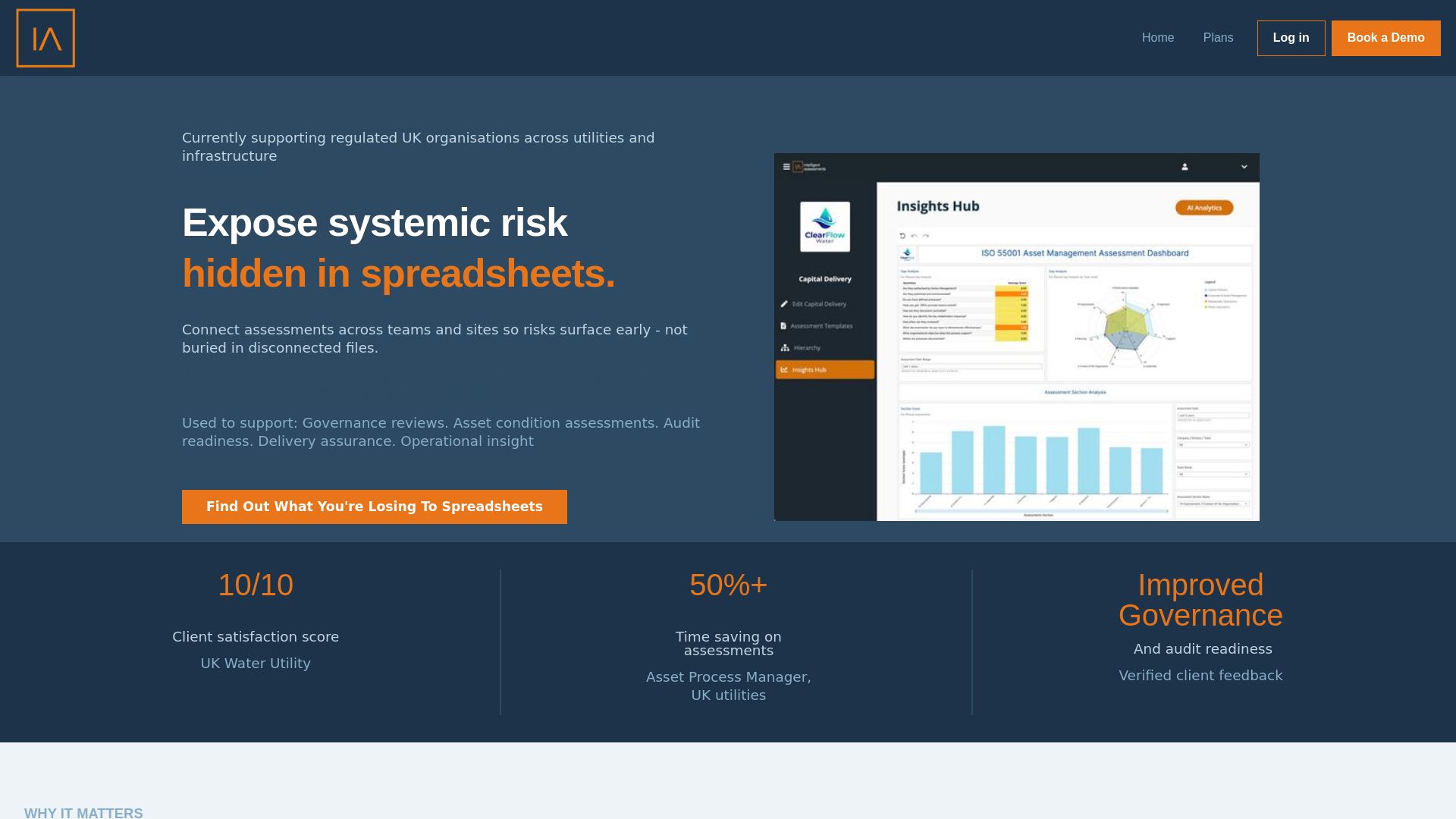
A standard demo covers the platform's structured frameworks, evidence management, and real-time dashboards in the context of your organisation's assurance scope. From there, a four-week proof-of-value includes:
- A completed data intake checklist tailored to your source systems
- A first analytics run against your agreed pilot scope
- An AI-generated executive summary and weighted RAG dashboard ready for committee review
Book your demo to receive the pilot scope template and data request checklist directly from the Intelligentassessments team.
Further reading and authoritative sources
- EY: What boards should know about data-driven audits — board endorsement expectations and data-sharing governance
- ACCA: Data analytics and the auditor — audit quality as the primary driver; programme tailoring to risk profiles
- Wolters Kluwer / Journal of Accountancy: The data-driven audit — pragmatic, iterative adoption with clear objectives
- AICPA & CIMA: Guide to audit data analytics — phase-by-phase ADA application and data reliability considerations
- Ciferi: Data analytics in audit — practical guide — inspection deficiencies, evidence documentation, and fieldwork direction examples
- GitHub: Audit analytics toolkit — open toolkit for seeded detector testing and recall validation
- Intelligentassessments: Book a demo — request the data intake checklist, pilot scope template, and proof-of-value commercial terms