Governance risk reporting is the board-facing synthesis that turns risk data into decisions, not the risk register dressed up in a new template. Its job is to show the board what has changed, what it means for strategy, and what action the executive is taking or needs approval for. The single biggest improvement most organisations can make immediately is simple: align every report to board decisions and materiality, rather than exporting the operational risk register and calling it done.
A report built for the board needs to contain:
- A clear link between material risks and strategic objectives
- The risks that actually matter this quarter, not all of them
- Decisions the board is being asked to make or ratify
- A summary of assurance work and what it found
Pro Tip: Before your next board cycle, delete the register extract from the pack entirely and replace it with a one-page executive summary written around three questions: what changed, why it matters, what we need from you.
Key Takeaways
Effective governance risk reporting connects material risks to board decisions through a concise, evidence-backed narrative rather than a raw risk register export.
| Point | Details |
|---|---|
| Lead with decisions | Open every report with the decisions the board needs to make, not a risk count. |
| Reference recognised frameworks | Use ISO 31000, COSO ERM and Provision 29 as checklists, not rigid templates. |
| Keep detail in annexes | Move registers, granular KPIs and control testing detail out of the main narrative. |
| Mine internal reporting | Aggregate whistleblowing and control failure data for early warning signals. |
| Move to continuous assurance | Intelligentassessments replaces periodic spreadsheet reviews with real-time dashboards and evidence trails for board reporting. |
Table of Contents
- What does governance risk reporting actually cover?
- Which frameworks and standards should shape your report?
- What should an effective risk report contain?
- Who should produce and receive the report, and how often?
- What mistakes wreck governance risk reporting, and how do you fix them?
- Can internal reporting act as an early warning system?
- What should you fix first in your reporting?
- How Intelligent Assessments supports modern governance reporting
- Frequently asked questions
- Sources
What does governance risk reporting actually cover?
Scope creep is the enemy here. Good governance risk reporting covers strategic risks, material operational risks, assurance findings, emerging risks, and anything requiring escalation. It excludes the long tail of low-impact operational issues that risk owners should be managing without board involvement.
The purpose is fourfold: support decisions, give assurance that controls are working, trigger escalation when they are not, and provide a paper trail showing the board has exercised proper oversight. Boards typically expect:
- An executive summary that opens with the decisions needed, not a risk count
- A clear view of exposure against stated risk appetite
- Trend indicators showing whether the picture is improving or worsening
- Explicit asks: approve, note, or challenge
Tailor emphasis by reader. An audit committee wants assurance depth and control effectiveness; a full board wants strategic linkage and decision points; non-executives often want the "what could go wrong that we haven't discussed" view more than the detail.
Which frameworks and standards should shape your report?
Three reference points do most of the work. ISO 31000 gives principles for embedding risk management into governance and decision-making, and most organisations use it as a structural checklist rather than a rigid template. The COSO ERM framework links risk explicitly to strategy and performance, which is useful when a board keeps asking why risk reporting feels disconnected from the corporate plan.
In the UK, Provision 29 of the Corporate Governance Code requires boards to explain how they monitored the risk and control framework and to declare whether material controls were effective at the balance sheet date. For organisations with climate or sustainability exposure, TCFD and its successor under ISSB shape how climate risk gets disclosed alongside financial risk. Where information security is material, ISO/IEC 27001 is the standard most commonly cited for cyber assurance.
Pro Tip: Treat these frameworks as assurance checklists to test your report against, not templates to fill in mechanically. A report that ticks every ISO 31000 box but still buries the board's decision on page nine has failed its actual job.
What should an effective risk report contain?
Structure beats volume. A board-ready report typically runs in this order: executive summary with a decision focus, material risks and their movement since last report, exposure against appetite, an assurance map, actions with named owners, and a section on emerging risks and scenarios.
Metrics matter more when there are fewer of them. Materiality indicators, trend lines, and control effectiveness summaries give the board a signal; granular operational KPIs belong in an annex or a dashboard the committee can drill into if needed, not in the narrative itself. A risk control matrix approach helps keep the assurance map honest by showing which controls actually cover which risks, rather than assuming coverage exists.
| Report section | What it should show |
|---|---|
| Executive summary | Decisions needed, key changes, headline exposure |
| Material risks and movement | Top risks, direction of travel, owner |
| Appetite vs exposure | Where exposure sits against stated tolerance |
| Assurance map | What has been tested, by whom, and findings |
| Emerging risks and scenarios | Watch list and plausible impact scenarios |
Heatmaps and trend charts work well for pattern recognition, but a five by five grid with no narrative explaining why a risk moved is worse than no chart at all. Keep registers, deep data, and control testing detail in annexes or an executive risk dashboard rather than the board pack itself.

Pro Tip: If a slide needs more than thirty seconds of explanation before the board understands it, it belongs in the annex, not the main narrative.
Who should produce and receive the report, and how often?
Cadence should match decision rhythm, not a fixed calendar habit. Full boards typically want a quarterly strategic view; audit and risk committees often need monthly or bi-monthly detail; genuine escalations need an ad hoc route that bypasses the normal cycle entirely.
Ownership is straightforward on paper and messy in practice. The board holds oversight accountability. The CRO or risk lead owns synthesis and narrative. Risk owners supply accurate, timely inputs. Internal audit and other assurance providers validate that controls work as described, feeding into an audit report format the committee can act on directly.
Every report needs a version trail: what changed since last cycle, who approved the final version, and what the board decided based on it. A basic end-to-end process looks like this:
- Collect data from risk owners and assurance providers
- Synthesise into a decision-focused narrative
- Validate assurance claims before publication
- Deliver to the board with clear asks attached
What mistakes wreck governance risk reporting, and how do you fix them?
The most common failure, according to governance commentary on Provision 29 declarations, is treating the risk register as the report itself, rather than as the source data behind it. The register is an operational tool; the board report is strategic communication.
- Mistake: dumping the full register into the pack. Fix: write a decision-led executive summary and move the register to an annex.
- Mistake: excessive operational detail drowning strategic signal. Fix: apply a materiality filter before anything reaches the board.
- Mistake: weak linkage between risks and strategy. Fix: map every material risk explicitly to a strategic objective.
- Mistake: assurance activity mentioned but not mapped to specific risks. Fix: build an assurance map showing coverage and gaps.
Pro Tip: Ask one question of every draft report before it goes to the board: "What decision does this page enable?" If the answer is none, cut it or move it to the annex.
Can internal reporting act as an early warning system?
Industry analysis on internal reporting data suggests whistleblowing channels, control failures, and incident logs are consistently underused as governance inputs, even though they can reveal cultural and control weaknesses well before those weaknesses show up in formal risk metrics.
The opportunity is aggregation. Linking whistleblowing data, control self-assessments, and operational loss events together often surfaces patterns that no single metric would flag on its own, particularly around culture and emerging conduct risk.
- Aggregate internal reporting data centrally rather than leaving it siloed by department
- Apply anonymised pattern analysis to spot repeat themes across sites or functions
- Connect flagged issues to estimated financial or reputational impact where possible
Statistic Callout: Regulatory momentum, including whistleblower reforms in several jurisdictions, is pushing internal reporting toward becoming a genuine oversight input rather than a purely compliance-driven channel.
Pro Tip: Don't wait for volume. Even a handful of aggregated internal reports, reviewed quarterly alongside formal risk data, often catches a control weakness a full audit cycle would have missed.
What should you fix first in your reporting?
Three priorities, in order. First, rebuild the executive summary around board decisions, not risk counts. Second, map assurance activity explicitly against material risks so gaps are visible, not assumed away. Third, treat internal reporting as a governance input worth aggregating, not a compliance box.
None of this works as a one-off exercise. It needs continuous assurance capability behind it to stay current between board cycles.
How Intelligent Assessments supports modern governance reporting
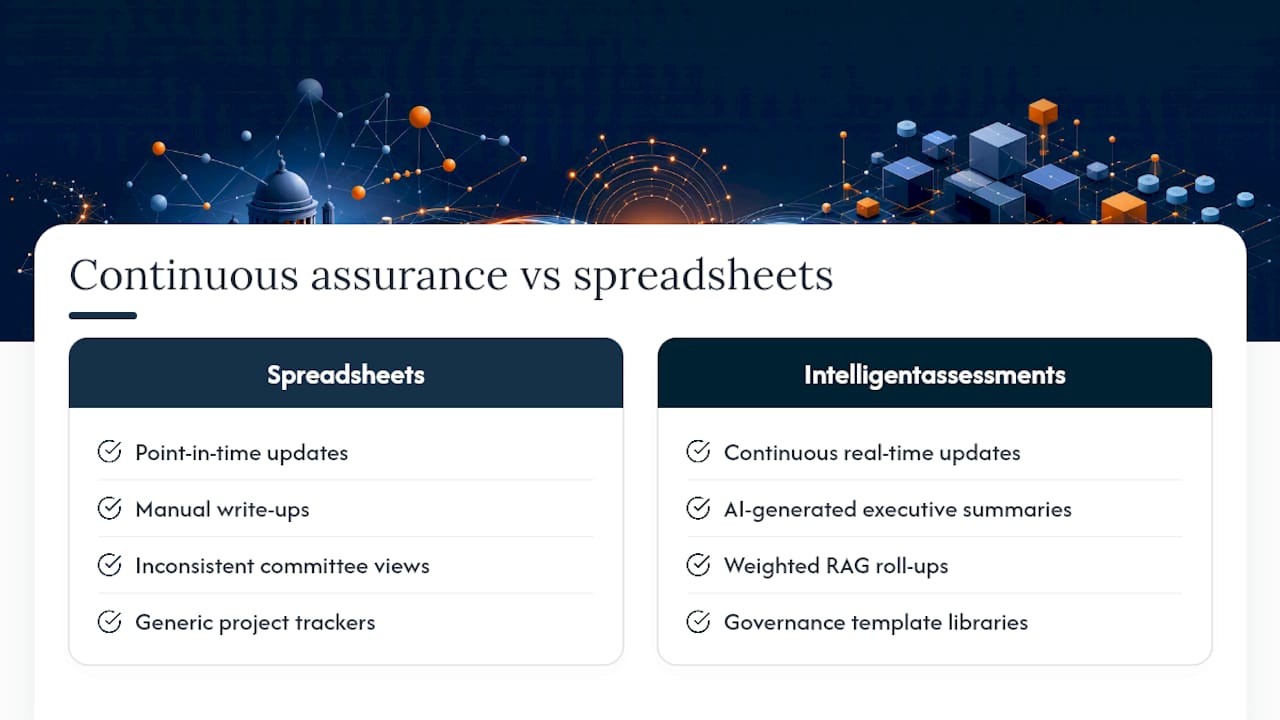
Most of the fixes above run into the same wall: spreadsheets and periodic reviews can't keep an assurance map current, and by the time someone updates the register, the board is already looking at stale data. Intelligentassessments was built as a continuous assurance platform specifically to close that gap, replacing spreadsheet-based, point-in-time reviews with structured, evidence-backed assessments that update in real time.
In practice, that means AI-generated executive summaries instead of manual write-ups, weighted RAG roll-ups that give committees a consistent view across risks and controls, and template libraries built for governance, compliance, and assurance reviews rather than generic project trackers. Evidence trails sit behind every score, so an audit committee asking "how do we know this control actually works" gets a documented answer rather than an assertion. Dashboards update as new assessments land, giving boards a live picture between formal reporting cycles rather than a snapshot that's already three weeks old by the time it reaches the pack.
If your governance risk reporting still starts with someone exporting a spreadsheet, it's worth seeing what continuous assurance looks like in practice. You can book a demo or review current plans to see which fits your organisation's scale.
Frequently asked questions
What is the difference between a risk register and a governance risk report? The register is an operational tool listing risks, owners, and controls. The governance report is a strategic summary that interprets register data for the board, linking it to decisions and assurance findings.
How often should risk reports go to the board? Full boards typically review strategic risk quarterly, while audit or risk committees often need monthly detail. Genuine escalations should bypass the normal cycle through an ad hoc route.
Does Provision 29 require a specific report format? No. It requires boards to explain how they monitored the risk and control framework and declare whether material controls were effective, but it doesn't prescribe a template.
What role does internal reporting play in governance risk reporting? Aggregated whistleblowing and control failure data can surface cultural and control weaknesses earlier than formal metrics, making it a valuable input when analysed alongside standard risk data.