
A project health check is an objective, time-boxed assessment of whether your project will deliver its agreed outcomes within agreed constraints. If you have not run one recently, the fastest next step is a five-to-ten minute diagnostic against three signals right now:
- Schedule: Is your current forecast end date within ten per cent of the baseline?
- Budget: Is your cost performance index (CPI) above 0.9?
- Scope: Have you had more than two uncontrolled scope changes in the last four weeks?
A red on any one of those warrants a structured review within the next one to two weeks. Two or more reds, and commissioning an independent assessor is worth serious consideration.
Pro Tip: Frame the health check as a support mechanism, not an inspection. Teams that understand the purpose cooperate more fully, and the findings are more honest as a result.
Key takeaways
A project health check is only as useful as the actions it generates: combine leading and lagging indicators, assign every finding to a named owner, and build follow-up into your governance schedule from the start.
| Point | Details |
|---|---|
| Run checks at the right cadence | Pulse checks every 6–8 weeks catch drift early; full reviews at gates or after major scope changes. |
| Use both indicator types | Lagging metrics (CPI, SPI) confirm what happened; leading indicators (escalation rate, RFI response time) signal what is coming. |
| Decompose every composite score | A single RAG score without component breakdown and named owners is not diagnostically useful. |
| Trace symptoms to root causes | Budget variance is a symptom; scope creep is a cause. Fix the cause or the problem recurs. |
| Intelligentassessments for scale | The platform digitises APM-aligned templates, weighted RAG roll-ups, and evidence management for regulated UK organisations running continuous assurance. |
Table of Contents
- Why run a project health check?
- When should you run a project health check?
- What frameworks and criteria should you use?
- What metrics should a project health check measure?
- Project health check checklist and sample questionnaire
- How to run a project health check: step by step
- How do you turn health check findings into action?
- What do project health checks cost and how long do they take?
- How can digitising health checks help you scale assurance?
- The mistakes assurance leads keep making
- Intelligentassessments makes portfolio assurance practical
- Sources
Why run a project health check?
Many projects in trouble may not appear so until recovery becomes costly. A health check for projects creates a structured moment to surface what the weekly status report smooths over.
The primary purposes are:
- Objective assurance: Confirms whether the project is genuinely on track, independent of the delivery team's own narrative.
- Early risk detection: Identifies emerging risks before they become costly issues.
- Governance evidence: Provides a documented basis for steering group decisions, gate approvals, and escalation.
- Recovery planning: Gives a structured starting point for replanning when the project is in distress.
Several groups benefit from health checks: project sponsors gain insight on investment status, steering groups receive an evidence base for decisions, project managers obtain external perspectives, and assurance and PMO teams access repeatable portfolio oversight mechanisms.
Practitioner guidance consistently highlights that the biggest barrier to a useful health check is team resistance born from fear of blame. Positioning the review as support rather than scrutiny, with a clear remit and a named assessor who has no line-management authority over the team, resolves most of that resistance before the first interview.
Pro Tip: Send a one-paragraph brief to the team before the review begins. Explain what will be assessed, who will see the findings, and what happens next. Transparency at the start prevents defensiveness throughout.
When should you run a project health check?
Timing matters as much as method. A project health assessment run at the wrong moment either misses the window for intervention or disrupts delivery unnecessarily.
Common trigger points:
- Pre-gate or major milestone, when a governance decision depends on current status
- Mid-project, roughly at the halfway point by cost or time
- After a significant scope change or a key team departure
- When KPI trends have declined for two consecutive reporting periods
- On sponsor request, or when a programme-level risk review flags a dependency
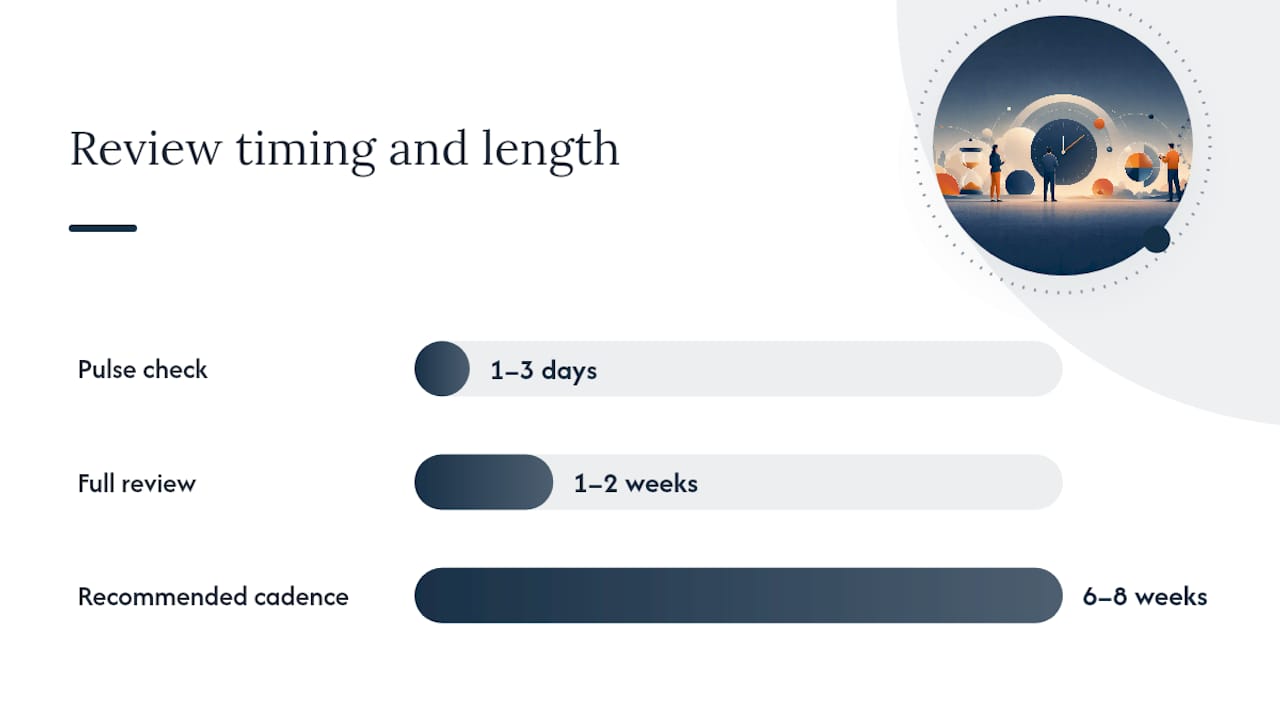
Recommended cadence: Industry practice suggests reassessing every 6–8 weeks for ongoing visibility. Frequent, shorter check-ins create a culture of continuous improvement and make remediation incremental rather than disruptive, rather than saving everything for an infrequent major audit.
The distinction between a pulse check and a full review matters practically:
Pulse check (1–3 days): Covers the four core indicators (scope, schedule, budget, quality) using existing reports and a short interview with the project manager. Output is a one-page RAG summary.
Full independent review (1–2 weeks): Covers all eight APM framework areas, includes stakeholder interviews, evidence review, and produces a prioritised recommendations report.
A rapid trigger checklist to prompt an immediate check: schedule variance exceeding ten per cent, budget variance exceeding five per cent, two or more unresolved Amber risks escalating to Red, stakeholder confidence declining in consecutive surveys, or a change request log growing faster than the delivery backlog.
What frameworks and criteria should you use?
The APM Measures for Assuring Projects toolkit is the most practical UK-aligned baseline for structuring a health check. It provides a set of measures across the key dimensions of project performance and is widely recognised in UK public sector and regulated-industry governance.
The eight assessment areas to cover, with minimum evidence inputs for each:
| Assessment area | Key questions to ask | Evidence inputs |
|---|---|---|
| Schedule | Is the forecast end date credible? Is float being consumed? | Integrated master schedule, critical path analysis |
| Budget | Is CPI above 1.0? Is EAC within approved budget? | Finance ledger, EVM report |
| Scope | Is scope baselined and change-controlled? | Change log, scope statement, WBS |
| Quality | Are quality gates being met? What is the defect rate? | Test results, quality register, inspection records |
| Risk and issues | Are risks actively managed? Are issues being resolved? | Risk register, issue log, action tracker |
| Benefits realisation | Are benefits tracked against a baseline? | Benefits register, realisation plan |
| Governance | Are decision-making forums functioning? Are roles clear? | Terms of reference, decision log, RACI |
| Stakeholder engagement | Is stakeholder sentiment monitored? Are communications effective? | Stakeholder map, comms log, survey results |
Map each area to a named owner before the review begins. A finding without an owner is just an observation. The KPI Tree metric-tree approach reinforces this: decompose the composite score into components, assign each to an accountable lead, and the score becomes a decision rather than a number.
Pro Tip: Use the APM toolkit as your baseline, then add two or three sector-specific criteria. A regulated utilities project needs asset-safety and regulatory-compliance dimensions that a standard framework will not include by default.
What metrics should a project health check measure?
The most common mistake in project status assessment is relying exclusively on lagging indicators. Cost variance and schedule variance tell you what has already happened. By the time they turn red, the window for low-cost intervention has often closed.
PMI's guidance on project health metrics synthesises Earned Value Management (EVM) formulas with forecasting measures to give a concrete picture of both current status and likely completion. The Construction Industry Institute identified 43 leading indicators that can predict project outcomes more accurately than financial metrics alone, which is why combining both types matters.
Lagging indicators to track
- Cost Variance (CV): Earned Value minus Actual Cost. Negative means over budget.
- Schedule Variance (SV): Earned Value minus Planned Value. Negative means behind schedule.
- Cost Performance Index (CPI): Earned Value divided by Actual Cost. Below 1.0 signals cost overrun.
- Schedule Performance Index (SPI): Earned Value divided by Planned Value. Below 1.0 signals schedule slippage.
- Estimate at Completion (EAC): Forecast total cost based on current CPI.
Leading indicators to track
- Team throughput (story points, deliverables, or tasks completed per sprint or week)
- Escalation frequency (number of issues escalated above project manager level per fortnight)
- Response time to Requests for Information (RFIs)
- Change request velocity (rate of new change requests entering the log)
- Test pass rates on first submission
- Skills and capability gaps against the resource plan
| Indicator type | Example metric | What it signals |
|---|---|---|
| Lagging | CPI below 0.9 | Cost overrun already occurring |
| Lagging | SPI below 1.0 | Schedule slippage embedded |
| Leading | Escalation frequency rising | Team losing confidence in resolution |
| Leading | RFI response time increasing | Supplier or stakeholder disengagement |
| Leading | Change request velocity accelerating | Scope instability building |
Pro Tip: Anchor as many metrics as possible to objective system outputs — the finance ledger, your issue tracker, CI/CD pipeline results — rather than self-reported status. Self-reported green metrics on a project that is actually red is what practitioners call a "watermelon": green on the outside, red underneath.
Project health check checklist and sample questionnaire
A practical project health check checklist for fast diagnostics (adapt to your project size):
Schedule and delivery
- Is the current forecast end date within ten per cent of the approved baseline?
- Is the critical path documented and actively managed?
- Have all milestone deliverables been accepted by the sponsor?
Budget and cost
- Is CPI above 0.9?
- Is the Estimate at Completion within the approved budget?
- Are all actual costs captured in the finance ledger within two weeks of incurrence?
Scope and change
- Is scope formally baselined with a signed-off scope statement?
- Is every change request logged, assessed, and approved before implementation?
- Has scope creep been identified and quantified in the last period?
Quality
- Are quality criteria defined for each major deliverable?
- Is the defect rate within the agreed threshold?
- Have all planned quality reviews taken place?
Risk, issues and governance
- Is the risk register reviewed at least fortnightly?
- Are all Red risks assigned to named owners with mitigation actions?
- Are governance forums meeting as scheduled with quorate attendance?
Stakeholder and benefits
- Is a stakeholder engagement plan in place and current?
- Are benefits tracked against a baseline in a maintained register?
RAG scoring and roll-up method
Score each area 0–100, then apply a weighting that reflects project priorities. Multiply each score by its weight, sum the results, and you have a single composite health score.
| Score range | RAG status | Recommended action |
|---|---|---|
| 80 | Green | Monitor; maintain cadence |
| — | Amber | Investigate root cause; agree corrective actions within two weeks |
| — | Red | Escalate to sponsor; convene recovery workshop within five days |
The KPI Tree guidance cautions that a composite score is only diagnostically useful when decomposed into its components with named owners. A single Red score with no breakdown tells a steering group nothing actionable. For guidance on setting RAG thresholds and governance for roll-ups, the Intelligentassessments resource covers the mechanics in detail.
Tailor the weighting for different project types: a regulatory compliance programme should weight governance and quality more heavily; an agile software delivery should weight throughput and change-request velocity.
How to run a project health check: step by step
MindTools recommends keeping the review time-boxed and short to minimise disruption and speed implementation of recommendations. The process below follows that principle.
For a pulse check (1–3 days):
- Define scope and objectives (half a day): Agree which framework areas to cover, what evidence exists, and what the output format will be.
- Select the assessor (same day): Internal manager with no line authority over the team, or external consultant for higher independence.
- Collect evidence (day one): Pull schedule, finance, risk register, change log, and quality records.
- Score and analyse (day two): Apply RAG scores, identify root causes, draft findings.
- Present and agree actions (day three): Share findings with the project manager and sponsor; agree owners and deadlines.
For a full independent review (1–2 weeks):
- Define scope, objectives, and governance remit.
- Select assessor(s) with appropriate independence and sector knowledge.
- Collect documentary evidence across all eight APM framework areas.
- Run structured interviews with the project manager, sponsor, key workstream leads, and two to three team members.
- Run a workshop to validate findings and test root-cause hypotheses.
- Score, weight, and produce the recommendations report.
- Present to the steering group; agree a remediation plan with named owners and deadlines.
- Schedule the follow-up pulse check at six to eight weeks.
Roles and responsibilities
| Role | Responsibility |
|---|---|
| Assessor | Leads evidence collection, scoring, and report; maintains independence |
| Project manager | Provides access to evidence; participates in interviews; owns remediation |
| Sponsor | Commissions the review; receives findings; approves escalation decisions |
| Governance forum | Reviews recommendations; ratifies remediation plan |
| SMEs / workstream leads | Provide evidence and context for their areas |
Pro Tip: In interviews, ask "What would need to be true for this project to fail?" rather than "What are the risks?" The first question bypasses defensive answers and surfaces the real concerns faster.
How do you turn health check findings into action?
Tracing symptoms back to root causes is where most health checks either earn their value or waste it. A budget variance is a symptom. Uncontrolled scope creep is a root cause. The remediation action needs to address the cause, not the symptom.

Prioritise findings using three dimensions: severity of the gap, likelihood of it worsening without intervention, and impact on the project's critical path or benefits case. High on all three means act within five days. Medium severity with low likelihood can sit in the next fortnightly review.
Common remediation types and when to use them:
- Replan: Schedule has slipped but scope and budget are recoverable. Rebuild the schedule with realistic float.
- Rebaseline: Scope has changed materially and the original baseline is no longer a valid reference. Formally reset with sponsor approval.
- Resource addition: Throughput is the constraint and budget headroom exists. Add resource to the critical path only.
- Scope reduction: Budget or time is fixed and scope is negotiable. Descope lower-priority deliverables with sponsor sign-off.
- Governance change: Decision-making is the bottleneck. Restructure the steering group or delegate authority downward.
When all three dimensions score high across multiple areas simultaneously, the right recommendation is often a stop-and-reset: a structured pause to replan before continuing delivery.
Pro Tip: Build remediation tracking into your regular assurance cadence rather than treating it as a separate exercise. A health check that produces a report nobody revisits is just documentation overhead.
What do project health checks cost and how long do they take?
Costs and timescales vary considerably by project size, sector, and depth of analysis. The figures below are indicative ranges for UK projects; get external quotes for firm estimates.
| Review type | Typical duration | Indicative internal effort | Indicative external cost |
|---|---|---|---|
| Pulse check (internal) | 1–3 days | 2–4 person-days | Nil |
| Pulse check (external) | 2–5 days | 1–2 person-days | £3,000 |
| Full independent review (medium project) | 1–2 weeks | 3–5 person-days | £10,000 |
| Full independent review (major programme) | 2–4 weeks | 5 person-days | £25,000 |
The main cost drivers are project complexity, the number of workstreams, the regulated-sector requirements (which add evidence and documentation overhead), and whether specialist technical expertise is needed for the assessor team.
Budget time in your governance schedule for the output as well as the review itself. A full review that produces a recommendations report needs a steering group slot within five working days of completion, or the findings lose momentum.
These figures are indicative only. Procurement processes and external quotes are required for firm cost commitments.
How can digitising health checks help you scale assurance?
Running health checks manually across a portfolio of five or more projects creates a coordination and consistency problem. Evidence arrives in different formats, scoring is applied inconsistently, and producing a portfolio-level view requires someone to manually consolidate spreadsheets. That process is slow, error-prone, and produces a snapshot that is already stale by the time it reaches the steering group.
Platforms designed for continuous assurance address this by digitising the template, the evidence collection, the scoring, and the reporting in a single environment. The practical benefits for assurance teams:
- Template libraries: Pre-built health-check frameworks (including APM-aligned templates) that can be deployed consistently across projects without rebuilding from scratch each time.
- Evidence management: Structured evidence upload linked directly to assessment questions, with version control and audit trail.
- Weighted RAG roll-ups: Automated scoring that applies your weighting model and produces component and composite scores without manual calculation.
- Real-time dashboards: Portfolio-level health view updated as assessments are completed, surfacing Red and Amber items without waiting for a report cycle.
- Automated reporting: AI-generated executive summaries and instant PDF exports, reducing the time from assessment completion to steering group presentation.
For regulated UK utilities and infrastructure organisations, data access controls, audit trails, and exportable reports are not optional extras. They are governance requirements. A platform that enforces role-based access and maintains a complete evidence trail removes a significant compliance risk from the assurance process.
The Intelligentassessments platform is built specifically for this use case: structured frameworks, evidence management, weighted RAG scoring, and real-time dashboards for regulated organisations running continuous assurance at scale.
The mistakes assurance leads keep making
The most persistent problem is treating the health score as the goal rather than the diagnostic. Teams learn quickly that a Green composite score ends the scrutiny. So they manage to the score. Lagging indicators stay green because actuals are smoothed; leading indicators are never tracked because nobody asked for them.
The second mistake is poor stakeholder framing. Announcing a health check with no context, no stated purpose, and no clarity on who sees the findings guarantees defensive responses and incomplete evidence. The review becomes a political exercise rather than a diagnostic one.
Third: insufficient remediation ownership. A health check that produces twelve recommendations assigned to "the project team" will see eleven of them quietly shelved. Every finding needs a named individual, a deadline, and a follow-up date in the assurance calendar.
What to do instead: track leading indicators from day one, frame the check explicitly as support, assign every recommendation to a named owner, and build the follow-up into the governance schedule before the report is even presented.
Pro Tip: The most useful question to ask at the end of a health check is not "what score did we get?" but "what are we going to do differently in the next six weeks?" The score is context. The answer to that question is the point.
Intelligentassessments makes portfolio assurance practical
Running a project health check once is straightforward. Running them consistently across a portfolio of ten or twenty projects, with comparable scores, auditable evidence, and a real-time view for the steering group, is where manual approaches break down.
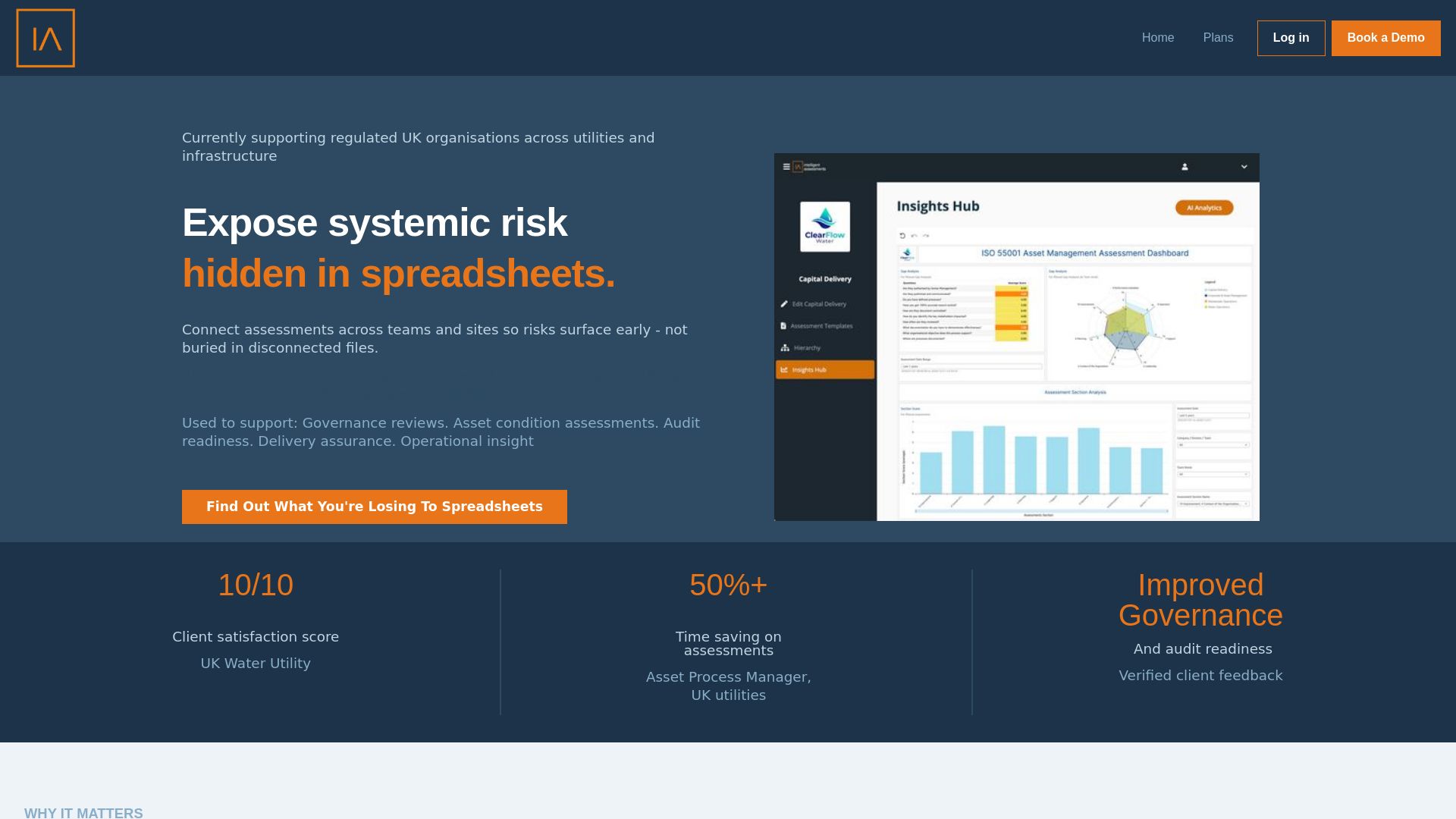
Intelligentassessments gives assurance and PMO teams a single platform to deploy APM-aligned health-check templates, collect and link evidence to specific questions, apply weighted RAG scoring automatically, and generate executive-ready PDF reports without touching a spreadsheet. For regulated UK utilities and infrastructure organisations, the platform's role-based access controls and complete audit trail meet governance requirements out of the box. Remediation tracking sits inside the same environment as the assessment, so follow-up actions are visible in the same dashboard as the original findings.
Book a demo to see how the platform supports your assurance cadence from first pulse check to full portfolio oversight.
Sources
- Understanding project health metrics
- Measures for assuring projects - APM toolkit
- Conducting a Project Healthcheck
- Project health score: definition, formula and how to calculate it - KPI Tree
- Project Health Assessment | Free Download | SoftWeb UK
- How to Conduct a Project Health Check A Simple Guide