
A risk appetite statement is the board-approved document that defines the aggregate level and types of risk an organisation will accept in pursuit of its strategic objectives. Done well, it is a one-to-two-page governance instrument that gives every decision-maker a clear reference point. Done poorly, it sits in a policy folder and influences nothing.
Three actions to take before you read further:
- Identify your three most material risk categories (financial, operational, regulatory, cyber, safety, or whichever are genuinely most consequential for your organisation).
- Draft one qualitative sentence per category that states your directional posture: averse, minimal, cautious, open, or seeking.
- Attach at least one Key Risk Indicator (KRI) to each sentence, with a named owner and a Green/Amber/Red trigger threshold.
That is the minimum viable risk appetite statement. The rest of this guide shows you how to make it board-ready, measurable, and genuinely operational.
Key takeaways
A board-ready risk appetite statement pairs a qualitative posture sentence with at least one measurable KRI, a named owner, and explicit escalation SLAs for every material risk category.
| Point | Details |
|---|---|
| Six essential components | Every board-ready statement needs strategic context, philosophy, per-category statements, KRIs, escalation protocol, and governance sign-off. |
| Appetite vs tolerance vs capacity | Appetite is what you choose to accept; tolerance is the operational boundary; capacity is the ceiling you must never breach. |
| 15–30 board-level metrics | Keep the board paper to the most material KRIs; push methodology and detail to committee dashboards and appendices. |
| Annual review plus ad-hoc triggers | Review the statement annually, and immediately after a material incident, regulatory change, acquisition, or strategy shift. |
| Intelligentassessments for monitoring | Intelligentassessments automates KRI roll-ups, enforces calculation rules, and maintains an auditable evidence trail for regulated UK organisations. |
Table of Contents
- What does a risk appetite statement actually contain?
- How do you draft a risk appetite statement step by step?
- How do you turn qualitative appetite into measurable KRIs?
- Board-ready examples you can adapt by sector
- Who owns the risk appetite statement, and how often should it be reviewed?
- How do you embed the RAS into dashboards and day-to-day monitoring?
- Common pitfalls and a pre-sign-off checklist
- What practitioners learn implementing RAS in regulated UK organisations
- Intelligentassessments: one way to monitor your KRIs without the spreadsheet overhead
- Sources
What does a risk appetite statement actually contain?
The canonical structure that boards and regulators expect has six components. Each one earns its place; none is decorative.
Strategic context sets the scene in two or three sentences: what the organisation does, what its current strategic priorities are, and why risk appetite matters at this moment. A utility mid-way through a capital programme has a different context sentence from a bank entering a new market.
Overarching risk philosophy states the organisation's general posture in plain language. "We accept risk proportionate to the returns it enables, provided it does not threaten our licence to operate or the safety of our customers" is a real example of the kind of sentence that belongs here.
Per-category appetite statements are the operational heart of the document. One sentence per material risk category, each stating the directional posture clearly. These are the lines the board debates, approves, and refers back to when a significant decision lands on the agenda.
Quantitative metrics and tolerances translate each qualitative sentence into at least one measurable KRI with Green, Amber, and Red thresholds. This is where most organisations underinvest, and where the document either becomes a governance tool or remains a policy aspiration.
Escalation protocol specifies what happens when a KRI moves into Amber or Red: who is notified, within what timeframe, and what remediation action is expected. Without this, the statement has no operational teeth.
Governance, approval, and review records who approved the document, the version number, the date of approval, and the scheduled review date. It also names the committee responsible for ongoing oversight.
How appetite, tolerance, and capacity differ
The Institute of Risk Management is explicit on this: appetite, tolerance, and capacity are distinct concepts, and conflating them in a board document creates confusion that auditors and regulators will flag.
Risk appetite is the amount and type of risk the organisation is willing to accept. It is a strategic choice.
Risk tolerance is the acceptable variation around that appetite: the boundary within which the organisation will operate before escalation is triggered. It is operational.
Risk capacity is the maximum risk the organisation could absorb before its viability is threatened. It is a ceiling, not a target.
A useful mental model: appetite is where you aim, tolerance is how far you can drift before someone acts, and capacity is the cliff edge you must never reach.
The table below maps the six components to example wording, a representative KRI, Green/Amber/Red thresholds, a named owner, and a review cadence. Treat the wording as a format to adapt, not numbers to copy.
How do you draft a risk appetite statement step by step?
The drafting process works best as a six-step sequence with clear ownership at each stage. Expect six to twelve weeks from kick-off to first board draft, depending on organisational complexity and board calendar constraints.
-
Materiality and risk taxonomy (weeks 1–2). The risk function maps the organisation's risk universe and identifies the categories material enough to warrant a board-level appetite statement. Typically five to ten categories. Use your existing risk register as the starting point, not a blank sheet.
-
Strategic alignment workshop (weeks 2–3). The CRO facilitates a session with the executive team to connect each risk category to the current strategy. The question is not "how much risk can we tolerate?" but "what level of risk do we need to accept to deliver our strategic plan, and what level would threaten it?" This conversation is where appetite is genuinely set, not in a spreadsheet.
-
Set qualitative posture (weeks 3–4). The risk function drafts one sentence per category, using a consistent scale. The five-level scale (averse, minimal, cautious, open, seeking) is widely used and gives boards a common vocabulary. Each sentence is reviewed by the relevant business unit owner before it goes to the executive.
-
Define metrics and tolerance bands (weeks 4–7). For each qualitative statement, the risk function works with finance, operations, and the relevant business unit to identify one or two KRIs and calibrate Green/Amber/Red thresholds. Use historical loss data, capacity analysis, and stress scenarios as inputs. Where precise quantification is not yet possible, use directional bounds and document the rationale.
-
Test and pilot KRIs (weeks 7–10). Run the proposed KRIs against the last twelve months of actual data. Do the thresholds produce meaningful signals, or do they trigger Amber every month? Adjust before the board sees them. Internal audit should review the calculation methodology at this stage.
-
Board sign-off and communication plan (weeks 10–12). The CRO presents the draft to the Board Risk Committee for challenge and refinement, then to the full board for approval. The communication plan covers how the approved statement cascades to business unit leaders, what training is needed, and how the KRI dashboard will be maintained. TechTarget's guidance recommends securing formal board approval as a distinct step, not a rubber stamp at the end of a longer agenda item.
Who does what:
- Board: approves the final statement and the overarching philosophy; challenges the qualitative posture.
- Board Risk Committee: scrutinises the metrics, thresholds, and escalation protocol; oversees ongoing monitoring.
- CRO: owns the drafting process, the KRI methodology, and the communication plan.
- Business unit owners: validate qualitative posture for their domain and own the named KRIs.
- Internal audit: provides independent assurance on the process and the KRI calculation rules.
Pro Tip: Start with directional bounds if precise thresholds are not yet available. An imperfect, monitored threshold is more useful than a perfect policy that never gets used. Document the rationale for directional bounds so the board understands they are interim, not permanent.
How do you turn qualitative appetite into measurable KRIs?
The conversion from a qualitative sentence to a measurable KRI follows a consistent pattern: qualitative posture + metric + threshold + named owner = Green/Amber/Red band. The GOV.UK practitioner's guide recommends translating appetite into measurable KRIs and calibrating thresholds using historical data and capacity analysis.
Three calibration methods are worth knowing:
Historical back-testing runs the proposed threshold against the last two to three years of actual data. If the Red threshold triggers more than twice a year on historical data, it is probably set too tight. If it has never triggered, it may be set too loose.
Capacity analysis works backwards from the organisation's maximum absorbable loss or disruption to set the Red threshold, then places Amber at a meaningful early-warning point above it.
Stress scenarios test whether the thresholds hold under plausible adverse conditions: a major cyber incident, a regulatory enforcement action, a significant market downturn. If a plausible scenario pushes a KRI into Red without triggering the escalation protocol, the threshold needs adjusting.
For RAG threshold design, the principle is that Green should represent normal operating range, Amber should be an early warning that prompts review without requiring immediate escalation, and Red should be unambiguous: something is wrong and named action is required now.
Pro Tip: Pair every qualitative line with a metric, a tolerance, and a named owner before the board signs. Supervisors and auditors increasingly expect this format, and a qualitative-only statement will draw challenge at the next regulatory review.
Board-ready examples you can adapt by sector
The most useful thing about published risk appetite examples is their format, not their numbers. Risk Publishing's sector examples make this point directly: steal the structure, calibrate the thresholds to your own organisation's history and capacity.
What changes across sectors is the risk category emphasis and the tolerance for certain types of loss. Here are five sector-specific snippets in board-ready format.
Public sector / NHS style
The NHSCFA risk appetite statement demonstrates the standard UK public-sector approach: zero appetite for preventable serious harm, paired with a named escalation owner and a clear timeline for reporting. The wording typically reads: "We have zero appetite for preventable serious harm to patients, staff, or the public. Any RIDDOR-reportable incident triggers immediate notification to the Chief Executive and Board within 24 hours."
Banking and financial services
Banks use quantitative capital and loan loss metrics as their primary KRIs. For boards outside financial services, 15–30 metrics is a more manageable and readable range.
Technology / SaaS
Availability and patching SLAs dominate. Any breach triggers a P1 incident response within one hour. For further context on AI risk tools for regulated sectors, the risk categories shift towards data governance and model risk.
Utilities and infrastructure
Safety and regulatory compliance carry zero appetite; operational continuity carries cautious to open appetite depending on the asset class. A typical line: "We accept operational risk inherent in managing ageing infrastructure, provided we maintain compliance with our licence conditions and meet our statutory safety obligations."
Charities and government bodies
Reputational risk and public trust dominate. "We have minimal appetite for activities that could damage public trust or our charitable objects, and zero appetite for financial irregularity or fraud." The GOV.UK practitioner's guide is the primary reference for public-sector organisations drafting their first statement.
Template structure guidance:
- Page 1: strategic context, overarching philosophy, per-category appetite statements (qualitative).
- Page 2: KRI table with Green/Amber/Red thresholds, named owners, and review cadence.
- Appendix: detailed dashboard for committee-level monitoring (not for the board paper itself).
Keep the board paper to two pages. Push the detail to the appendix and the committee dashboard. A board that has to read twelve pages to understand the organisation's risk posture will not engage with it.
Who owns the risk appetite statement, and how often should it be reviewed?
Governance clarity is what separates a statement that gets used from one that gets filed. The FSB Principles for an Effective Risk Appetite Framework are explicit: the framework must define clear roles for the board and senior management, and must enable both aggregation and disaggregation of metrics so the board sees the whole picture and committees can drill into the detail.
Ownership and approval:
- The Board approves the statement and the overarching philosophy. This is a reserved matter; it cannot be delegated.
- The Board Risk Committee (or equivalent) oversees ongoing monitoring, reviews KRI performance, and recommends amendments to the board.
- The CRO holds operational ownership: maintaining the statement, managing the KRI dashboard, and coordinating the annual review.
- Business unit owners are named owners for specific KRIs and are accountable for escalation when their metrics breach tolerance.
Review cadence:
Annual review is the minimum. The review should be timed to align with the strategic planning cycle so that changes in strategy are reflected in the appetite statement before the new financial year begins.
Ad-hoc reviews are triggered by:
- A material acquisition, merger, or disposal.
- A significant regulatory change or enforcement action.
- A material operational incident (a major cyber breach, a serious safety event).
- A significant shift in the external environment (a market shock, a geopolitical event with direct operational impact).
- A change in the organisation's strategic plan that alters the risk profile materially.
Escalation matrix:
The escalation protocol needs to be explicit about timing and named roles, not vague about "appropriate escalation."
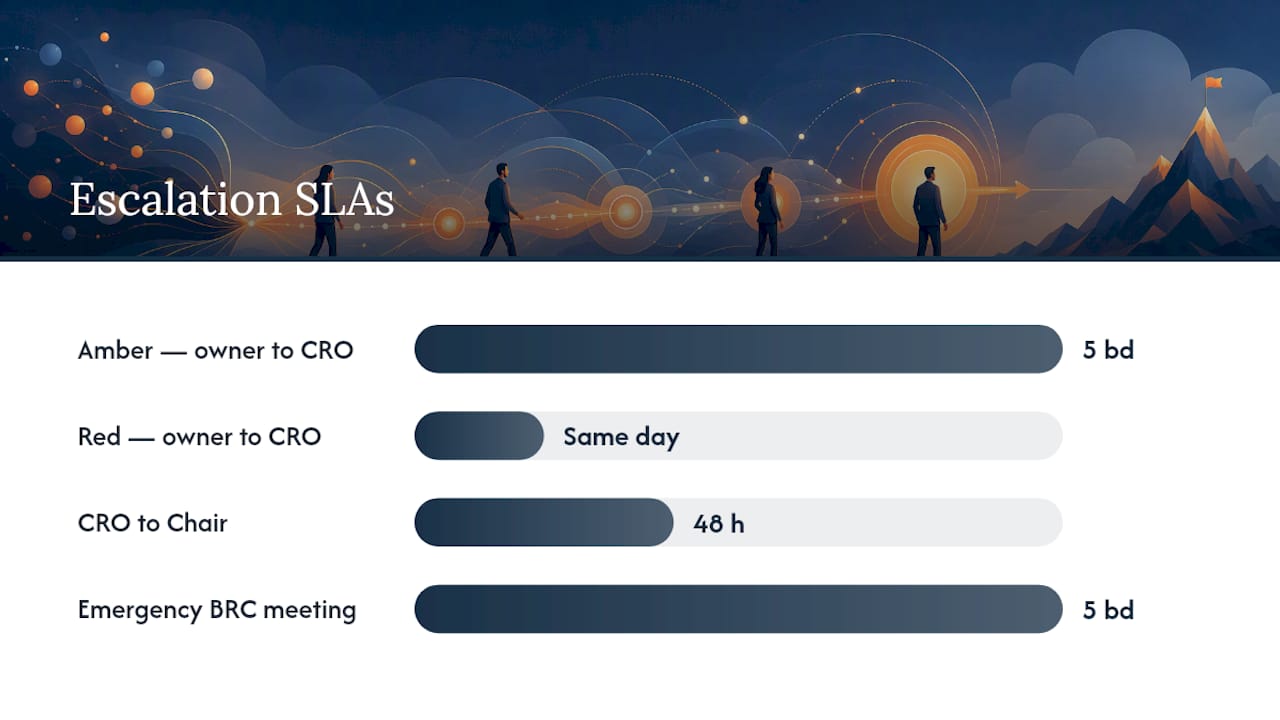
- Amber breach: the named KRI owner notifies the CRO within five business days. The CRO presents an exception report at the next scheduled executive risk committee meeting. A remediation plan with a target date is documented.
- Red breach: the named KRI owner notifies the CRO immediately (same day). The CRO notifies the Chair of the Board Risk Committee within 48 hours. An emergency Board Risk Committee meeting is convened within five business days if the breach is not resolved. The board is informed at the next scheduled meeting, or sooner if the CRO judges the matter material.
Every escalation step should have a named role (not a named individual, who may change) and a documented SLA. Version-control the statement: record the version number, the date of board approval, and the date of the next scheduled review on the document itself.
How do you embed the RAS into dashboards and day-to-day monitoring?
A board-approved statement that does not connect to a live monitoring architecture is governance theatre. The operational power is in the KRI dashboard, the committee cascade, and the evidence trail that supports each metric.
Cascading from board to first line:
- The board sees the one-page statement and the summary KRI table (Green/Amber/Red status, trend, and owner).
- The Board Risk Committee sees the two-page appendix: KRI performance over time, exception reports, and remediation status.
- Executive committees see the full dashboard: individual KRI data, calculation methodology, data sources, and escalation history.
- First-line teams see the KRIs relevant to their domain, with clear ownership and escalation instructions.
Monitoring architecture:
Each KRI needs a defined data source, a calculation rule, an update frequency, and a named owner responsible for data quality. Without this, the dashboard becomes unreliable and the board loses confidence in it quickly.
- Data sources: finance systems, HR systems, operational logs, regulatory submissions, incident management systems.
- Calculation rules: document exactly how each KRI is calculated so that the number is reproducible and auditable.
- Update frequency: financial KRIs typically update monthly or quarterly; cyber and safety KRIs often update weekly or in real time.
- Single source of truth: all KRI data should flow into one reporting environment, not be assembled manually in a spreadsheet before each committee meeting.
The FSB's aggregation and disaggregation requirement is practically important here: the board needs to see the aggregate picture, but the CRO and committees need to be able to drill into the components. A monitoring architecture that only produces a summary number cannot support that requirement.
When a digital assurance platform adds value:
Manual spreadsheet-based KRI tracking works at small scale. As the number of KRIs grows, as the organisation becomes more complex, or as regulatory scrutiny increases, the limitations become material: version control breaks down, calculation errors creep in, and the evidence trail for audit becomes difficult to reconstruct. A real-time compliance monitoring approach, supported by a digital platform, addresses these problems by automating data aggregation, enforcing calculation rules, and maintaining an auditable evidence trail.
Pilot one risk category first. Prove the data flows, the escalation notifications work, and the dashboard produces a reliable signal before rolling out across all categories.
Pro Tip: Push the detailed KRI methodology and data-source documentation to the committee dashboard, not the board paper. The board needs to trust the number; the committee needs to understand how it was produced. Keeping these audiences separate makes both documents more useful.
Common pitfalls and a pre-sign-off checklist
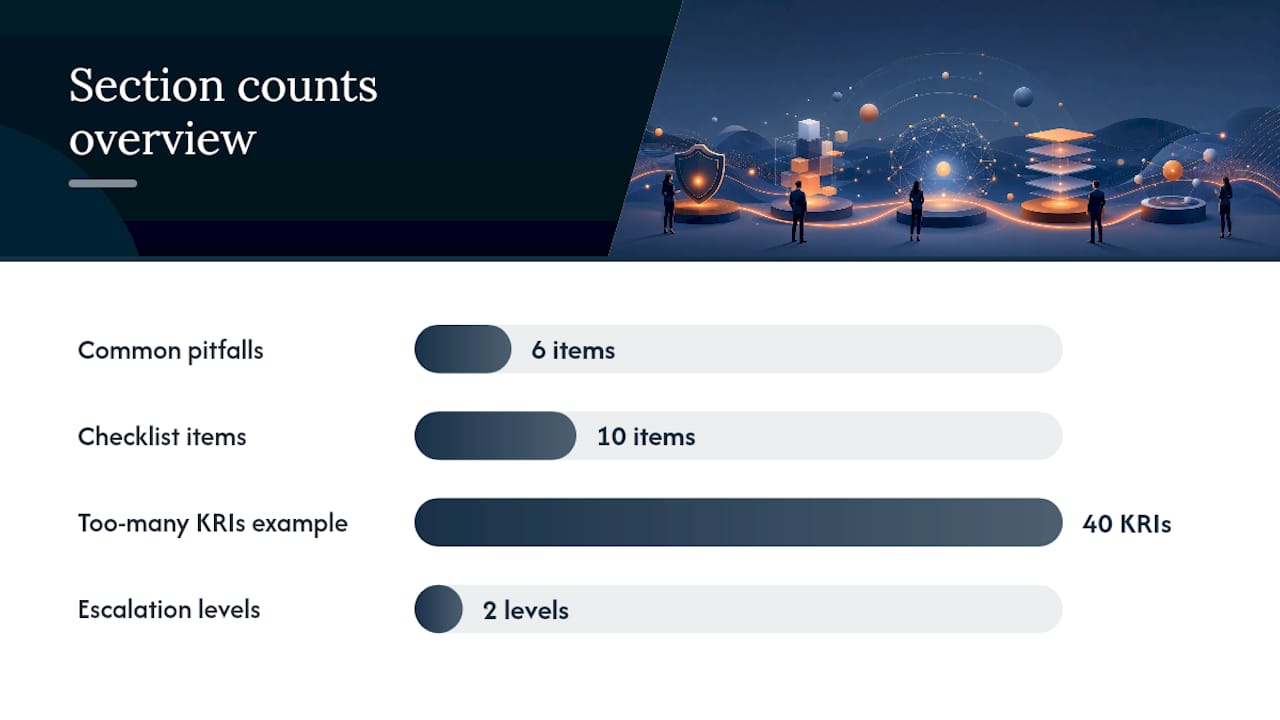
Most risk appetite statements fail in one of six ways. Recognising them before the board sees the document saves significant rework.
The six most common pitfalls:
- Qualitative only. A statement with no quantitative anchors gives the board no way to monitor performance or trigger escalation. Every category needs at least one KRI.
- False precision. Setting a threshold to three decimal places when the underlying data is estimated to one significant figure creates an illusion of rigour. Document the rationale where numbers are directional.
- Too many board metrics. A board paper with forty KRIs will not be read carefully. Keep the board view to the most material metrics; push the rest to committee dashboards.
- No named owners. "The risk function" is not an owner. Each KRI needs a named role (CFO, CISO, COO) with clear accountability for escalation.
- Missing escalation SLAs. Stating that a Red breach "will be escalated appropriately" is not an escalation protocol. Name the role, the timeframe, and the action.
- No link to strategy. A risk appetite statement that does not reference the organisation's strategic objectives is a compliance document, not a governance tool. The board should be able to read the statement and understand why the organisation accepts the risks it does.
Pre-sign-off checklist:
- Strategic context references current strategic priorities.
- Overarching philosophy approved by the board, not just the executive.
- At least one quantitative KRI per material risk category.
- Green/Amber/Red thresholds calibrated against historical data or capacity analysis.
- Named role owner for each KRI.
- Escalation SLAs documented for Amber and Red breaches.
- Governance sign-off path recorded (Board Risk Committee → Board).
- Version number, approval date, and next review date on the document.
- Communication plan agreed: who receives the approved statement and how.
- Committee dashboard appendix prepared and reviewed by internal audit.
Pro Tip: Before the board meeting, ask one non-executive director to read the draft cold and tell you which risk category they find most unclear. If they cannot articulate the organisation's posture in that category after reading one sentence, the wording needs work.
What practitioners learn implementing RAS in regulated UK organisations
The gap between a well-structured risk appetite statement and one that actually changes behaviour in an organisation is almost always a leadership problem, not a technical one.
Boards that engage seriously with the qualitative posture debate, before anyone mentions a threshold, produce statements that get used. Boards that treat the approval as a formality produce statements that sit in the governance folder until the next regulatory review. The conversation about whether the organisation is genuinely "cautious" or merely "open" on financial risk is not a semantic exercise. It surfaces real disagreements about strategy that need to be resolved before the document is signed.
The second lesson is about iteration. Organisations that wait until they have perfect data before setting thresholds rarely produce a statement at all. Start with directional bounds, name the rationale, and commit to refining the thresholds after twelve months of monitoring. An imperfect, monitored threshold is more useful than a perfect policy that never gets used. This is the consistent message from practitioner guidance on operationalising risk appetite.
The third lesson is about the escalation protocol. Most organisations write a reasonable qualitative statement and a credible KRI table, then write a vague escalation section that says something like "material breaches will be reported to the Board Risk Committee." That is not an escalation protocol. It is a placeholder. The organisations that get value from their statement are the ones that have named the role, the timeframe, and the specific action for every Red breach, and have tested whether the notification actually reaches the right person in the right timeframe.
Finally, keep the board paper short. The instinct to demonstrate thoroughness by including every KRI, every data source, and every methodology note in the board paper is understandable but counterproductive. The board needs to understand the posture and trust the monitoring. The committee needs the detail. Conflating the two audiences produces a document that serves neither well.
Intelligentassessments: one way to monitor your KRIs without the spreadsheet overhead
Once your risk appetite statement is board-approved, the monitoring challenge begins. Tracking fifteen to thirty KRIs across multiple data sources, maintaining an auditable evidence trail, and automating escalation notifications is manageable in a spreadsheet for a few months. It becomes a liability as the organisation grows, as regulatory scrutiny increases, or as the number of monitored categories expands.
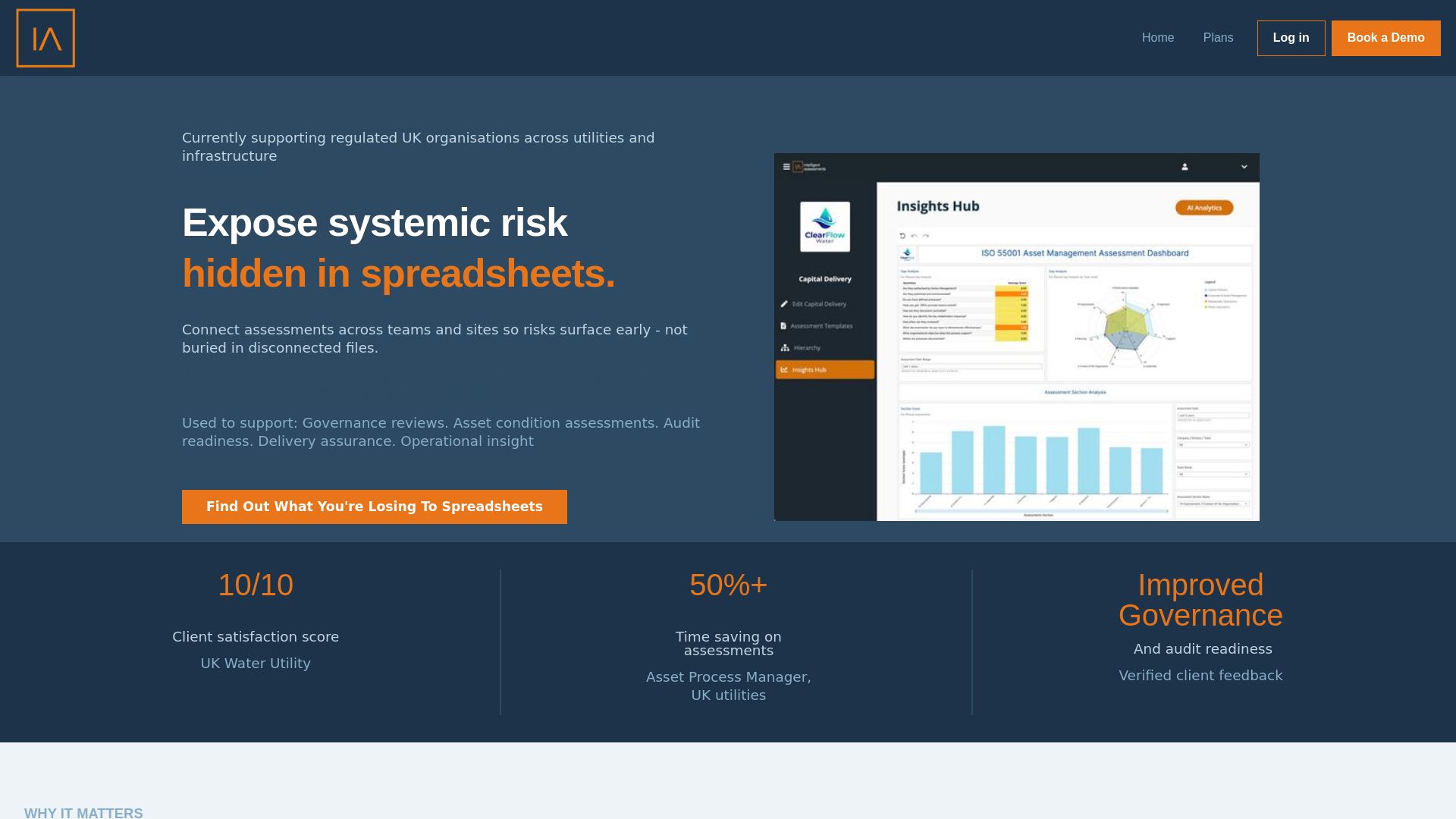
Intelligentassessments is an AI-powered continuous assurance platform built for regulated UK organisations. It replaces the manual spreadsheet cycle with structured KRI frameworks, weighted RAG scoring, automated roll-ups, and real-time dashboards that give the board and committees a single source of truth. Evidence is stored against each assessment, calculation rules are enforced consistently, and escalation notifications are automated so that an Amber or Red breach reaches the named owner without relying on someone remembering to check a spreadsheet.
The practical starting point is a 90-day pilot on one risk category. Prove the data flows, validate the escalation SLAs, and demonstrate the dashboard to the Board Risk Committee before rolling out across the full statement. To see how it works in practice, book a demo or review the platform plans to find the right fit for your organisation's scale.
Sources
The five sources below underpin the guidance in this article. Each one addresses a specific part of the drafting and governance process.
Core standards and guidance:
- The FSB Principles for an Effective Risk Appetite Framework
- How to write a risk appetite statement: Template, examples | TechTarget SearchCIO
- Managing your risk appetite: a practitioner's guide (GOV.UK)
- Risk appetite and tolerance (Institute of Risk Management)
- Risk Appetite statement | Corporate and information ... (NHSCFA)
Recommended reading sequence before board submission:
For a practical risk control matrix to link your appetite statement to control design and KRI ownership, the Intelligentassessments blog covers the methodology in detail.